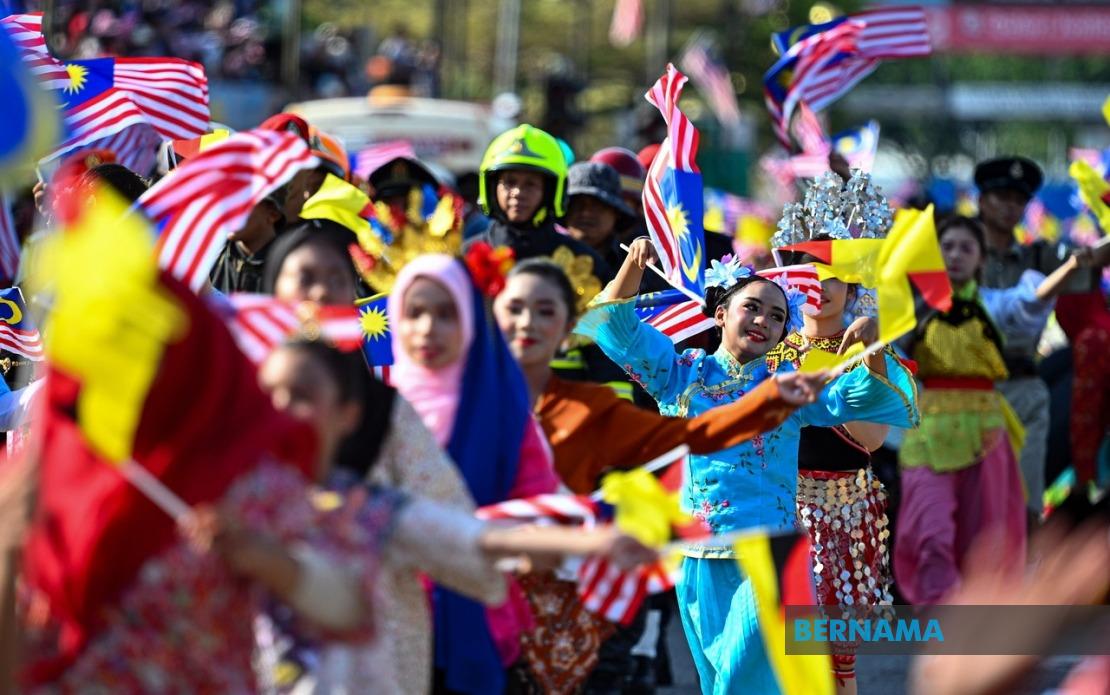
A surge of patriotic fervour swept through Seremban on National Day as more than 30,000 citizens from varied ethnic and social backgrounds converged on Dataran Majlis Bandaraya Seremban to commemorate Malaysia's independence. The exceptionally high turnout underscored the enduring national spirit that continues to unite Malaysians across generations, with families, community groups, and civil servants arriving at the venue well before sunrise to secure vantage points and participate in the festivities.
Menteri Besar Datuk Ismail Lasim attributed the impressive attendance to a deep-rooted enthusiasm for the occasion coupled with genuine affection for the nation. In conversations with early arrivals, Lasim learned that many spectators had made their way to the venue by 5.30 am, a testament to their commitment to the celebration despite the inconvenience of rising in the pre-dawn darkness. The Menteri Besar's observations highlighted how National Day continues to resonate powerfully with ordinary Malaysians across all walks of life, transcending the superficial trappings of official ceremony to touch something fundamental in the national consciousness.
Organisers made deliberate adjustments to this year's parade configuration, consciously reducing both the number of marching contingents and the volume of military and security assets on display. The rationale behind this strategic pruning reflected legitimate concerns about heat and haze exposure for the assembled crowds. Although atmospheric conditions proved favourable on the day itself, planners had acted with appropriate caution, prioritising public health and comfort over the spectacle of a sprawling procession. This measured approach demonstrates how local authorities balance the imperative to celebrate with practical consideration for citizen welfare.
The Yang Dipertuan Besar of Negeri Sembilan, Tuanku Muhriz Tuanku Munawir, graced the occasion alongside Tunku Ampuan Besar Tuanku Aishah Rohani Tengku Besar Mahmud, arriving at approximately 8.20 am to acknowledge the gathered masses. Their presence lent ceremonial gravitas to the proceedings and embodied the constitutional role of the monarchy in anchoring national identity and unity celebrations throughout the federation.
Despite the intentional scale-down, the parade remained a substantial civic undertaking that mobilised the broader Negeri Sembilan community across sectors. Eighty-two contingents representing more than 4,000 participants marched through the city, drawn from government ministries and departments, statutory corporations, local council administrations, civil society organisations, secondary and tertiary educational institutions, and private commercial enterprises. This organisational breadth ensured that the National Day observance genuinely reflected the pluralistic, multi-sectoral nature of contemporary Malaysian society rather than constituting merely a government-orchestrated programme.
The Guard of Honour drew its personnel from the 15th Battalion Royal Malay Regiment stationed at Senawang, with Major Dr Muhammad Hazim Abdul Qhalib commanding three officers and 103 other ranks. The ceremonial precision of this military contingent was enhanced by a combined brass band assembled from the 24th Battalion Royal Malay Regiment and the Malaysian Army Basic Training Centre, which performed traditional martial compositions under Drum Major Warrant Officer 2 Azwan Zakaria's direction. The musical accompaniment—featuring pieces such as Sembah Tari, Aladom, Seruan Tentera and Tentera Benteng—created an auditory backdrop that reinforced the ceremonial solemnity appropriate to the occasion.
Beyond the formal military dimensions, the celebration showcased an eclectic array of vehicles and assets that captured public imagination. Parade organisers incorporated decorated military vehicles, restored classic automobiles, and vintage bicycles that generated sustained spectator interest throughout the programme. Contributions from the Malaysian Armed Forces, Royal Malaysia Police, Immigration Department, Fire and Rescue Department of Malaysia, Health Ministry, Malaysian Civil Defence Force and Seremban City Council collectively demonstrated the institutional scaffolding through which the nation functions, making visible to ordinary citizens the diverse apparatus of state and public service that underpins national life.
Among the attending families, housewife Siti Ruayiza Rebin embodied a parenting philosophy explicitly centred on inculcating national consciousness in her children. The 42-year-old has maintained an unbroken tradition of bringing her three offspring—now aged 19, 15 and 12—to National Day festivities since their early childhood, a commitment that extends to supporting school-based independence observances. For Rebin, these occasions serve as pedagogical moments where young Malaysians can absorb visceral understanding of the nation's independence struggle and develop genuine appreciation for the sacrifices previous generations endured to secure contemporary freedom and sovereignty.
Private-sector professional Mohd Khairul Azmi similarly emphasised the instructional value embedded in National Day celebrations. Arriving with his five and seven-year-old children at 6 am to secure excellent viewing positions, Azmi curated a family experience designed to deepen his youngsters' historical consciousness and institutional awareness. The enthusiastic response of his children to military assets seldom displayed publicly—particularly the vintage vehicles and security equipment—demonstrated how direct sensory encounter with national symbols and institutions can crystallise abstract civic concepts into memorable, emotionally resonant experiences that shape formative understanding of national identity.
These testimonies from ordinary families underscored a frequently overlooked dimension of National Day celebrations in Malaysia. Beyond official speeches and ceremonial protocols, these occasions function as intergenerational transmission mechanisms through which established citizens deliberately cultivate patriotic consciousness in younger cohorts. The willingness of parents to rise before dawn and endure crowded venues reflects their conviction that democratic participation and national consciousness-building constitute essential parental responsibilities in pluralistic, multi-ethnic societies where competing allegiances and localised identities might otherwise fragment collective belonging.
The Negeri Sembilan celebration illustrated how National Day festivities remain potent occasions for reaffirming the bonds of common citizenship that transcend Malaysia's considerable ethnic, religious, and regional diversity. With attendance figures approaching 30,000 and families spanning multiple generations crowding the venue, the Seremban gathering provided tangible evidence of the nation's capacity to generate moments of genuine communal solidarity. For a country navigating complex questions about identity, integration, and social cohesion, such public demonstrations of shared patriotism carry significant political and social meaning beyond their immediate ceremonial context.

