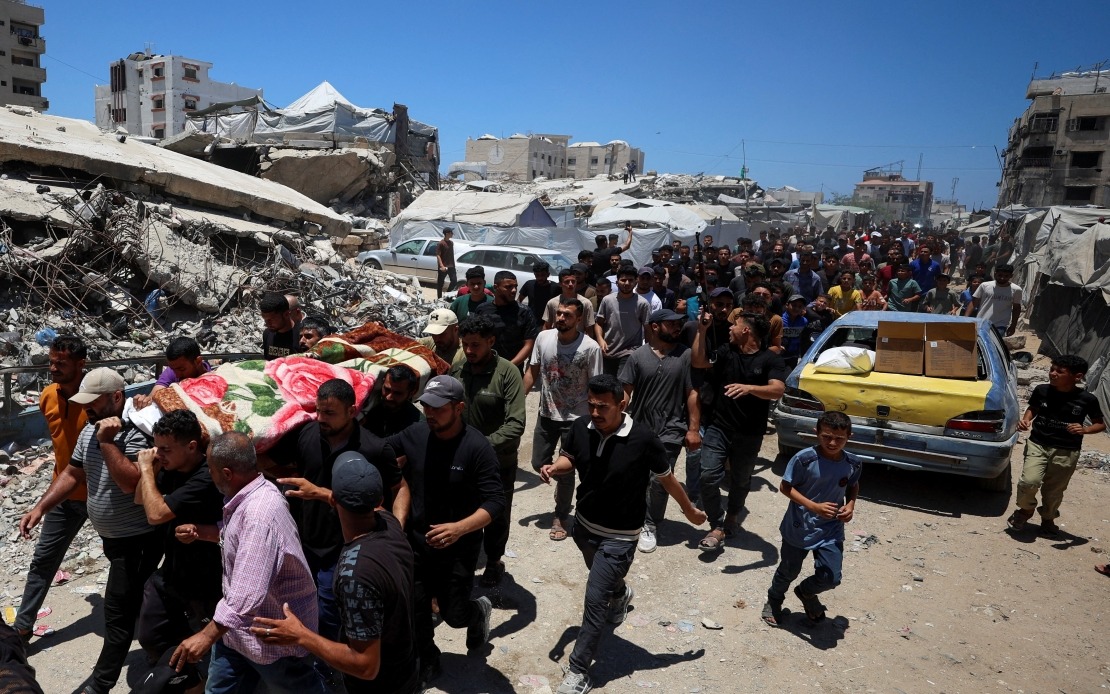
The humanitarian catastrophe unfolding across Gaza shows no signs of abating despite the implementation of a ceasefire agreement. According to the latest official documentation released by the Palestinian Prime Minister's Office, Israeli military operations have claimed 1,021 Palestinian lives since the ceasefire took effect, pushing the cumulative death toll since October 2023 to 73,032. The figures underscore the extent of devastation that has enveloped the densely populated enclave and highlight the ongoing challenges facing civilians caught in the prolonged conflict.
Conditions on the ground paint a grim picture of daily existence for Gaza's residents. The Government Communication Centre detailed how the humanitarian situation continues its downward spiral, with Israeli bombardments persisting alongside restrictions that severely curtail the flow of essential aid into the territory. The shortage of potable water has become so acute that the vast majority of residents have no choice but to depend entirely on the limited supplies delivered through humanitarian channels. This dependency creates a precarious situation where any disruption to aid flows threatens public health on a massive scale.
The physical destruction wrought upon Gaza's infrastructure has displaced nearly one million Palestinians, who now live in temporary tent settlements. Israeli military operations have destroyed or damaged approximately 76.6 per cent of the enclave's housing stock, eliminating any prospect of normal civilian life for hundreds of thousands of families. These figures represent not merely statistics but the erasure of homes, neighbourhoods, and the social fabric that holds communities together. The continuation of restrictions on humanitarian access compounds the suffering, as organisations attempting to deliver basic services face ongoing obstacles.
The targeting of civilian areas persists across multiple locations within Gaza. During the past week alone, air and drone strikes have struck Nuseirat, Al-Mawasi, Khan Younis, and Gaza City, generating fresh casualties and exacerbating the already dire conditions facing residents. Each strike adds to the psychological trauma affecting an entire population while simultaneously destroying whatever remnants of civilian infrastructure remain functional. The pattern suggests that military operations continue unabated regardless of the formal ceasefire agreement.
Children represent a particularly vulnerable segment of Gaza's population. United Nations Children's Fund data indicates that 265 Palestinian children have lost their lives since the ceasefire announcement, while over 400 have sustained injuries. These figures acquire additional poignancy when considered against the backdrop of an entire generation growing up amid violence, displacement, and deprivation. The psychological impact on survivors, combined with the physical toll of combat-related injuries, will shape Palestinian society for decades to come.
International humanitarian organisations have raised alarm bells regarding access restrictions that undermine relief efforts. When Oxfam addressed the United Nations Security Council, the charity highlighted how Israeli restrictions continue to obstruct humanitarian access and prevent the delivery of life-saving assistance. This systemic obstruction of aid represents a critical vulnerability in the humanitarian response, as organisations struggle to reach populations in acute need while bureaucratic and security-related barriers remain firmly in place.
Beyond Gaza, the occupied West Bank experiences its own escalating crisis of displacement and insecurity. The Office of the United Nations High Commissioner for Human Rights has documented a pronounced surge in forced Palestinian displacement across the West Bank, including East Jerusalem, driven by settler attacks, home demolitions, movement restrictions, and forced evictions. This dual crisis—acute suffering in Gaza and systematic displacement in the West Bank—creates an interlocking humanitarian emergency affecting Palestinians across occupied territories.
Agricultural destruction compounds the economic devastation. The Palestinian Ministry of Agriculture has meticulously documented the destruction of 7,258 trees, including 1,270 olive trees, with estimated losses reaching approximately US$5.17 million. These figures, while appearing abstract, represent generations of agricultural heritage and the livelihoods of farming communities. Arson attacks targeting mosques in Jiljilya and Mazra' al-Nubani add a disturbing sectarian dimension to the violence, suggesting a broadening pattern of attack against Palestinian civilian and religious institutions.
Refugee camps have become battlegrounds, with military operations in Jenin, Tulkarem, and Nour Shams displacing more than 33,000 Palestinians since January 2025 alone. These camps, which already housed vulnerable populations, now face systematic destruction and forced evacuation. Simultaneously, Palestinian prisoners held in Israeli detention facilities confront deteriorating conditions marked by overcrowding and disease proliferation, raising serious concerns about compliance with international humanitarian law.
Despite the overwhelming challenges, Palestinian educational institutions have demonstrated remarkable resilience. The Palestinian government has completed preparations for this year's General Secondary Education Examination, involving approximately 91,000 students. Remarkably, around 37,000 Gaza-based students will sit for examinations electronically for the third consecutive year, a testament to the determination to maintain educational continuity even amid conflict. This effort to preserve normality and invest in future generations reflects Palestinian commitment to building institutions that transcend the immediate crisis.
For Malaysian observers, the escalating humanitarian catastrophe in Gaza carries profound implications for regional stability and international norms. The apparent continuation of military operations despite ceasefire agreements raises questions about the effectiveness of international agreements and the willingness of parties to observe their commitments. Malaysia's traditional advocacy for Palestinian rights and support for humanitarian principles positions it as a voice for the vulnerable in international forums, making developments in Gaza directly relevant to Malaysia's foreign policy priorities and its role within ASEAN and the broader Non-Aligned Movement.
The compound crises affecting Palestinians—ongoing military operations, systematic displacement, destruction of civilian infrastructure, and humanitarian obstruction—create a long-term humanitarian challenge requiring sustained international attention. The scale of displacement, coupled with destruction of productive assets and restrictions on aid, suggests that reconstruction and normalisation will require years of effort and enormous resources. Regional powers, including Malaysia, face a responsibility to advocate for humanitarian principles and international accountability mechanisms that might constrain further escalation and protect civilian populations from systematic suffering.