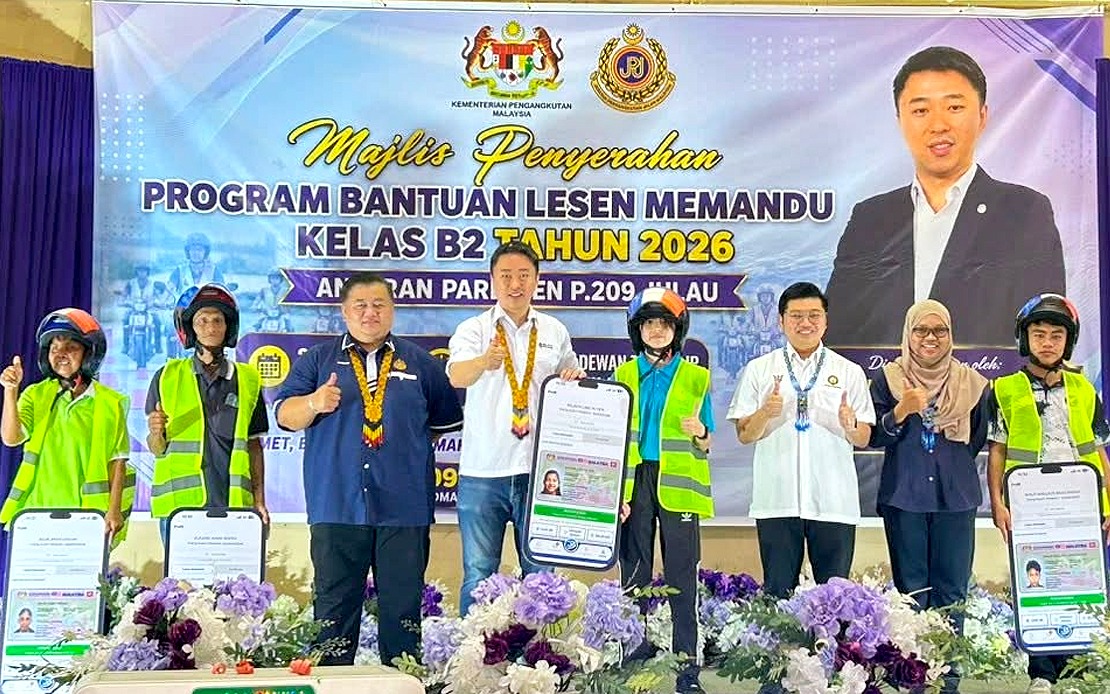
Rural communities in Sarawak's Julau parliamentary constituency have welcomed the completion of a major driving licence initiative that extends petrol subsidy eligibility to 885 newly licensed motorcyclists. The 2026 Class B2 Driving Licence Assistance Programme concluded on June 28 at the Julau Closed Stadium in Sarikei, with Julau MP Datuk Larry Sng Wei Shien officiating the closing ceremony. The programme represents a significant intervention aimed at formalising transport access in underserved areas where many residents previously operated vehicles without valid documentation.
For participants in remote settlements such as Rumah Ajau, Ulu Kuntau, and Bayong, obtaining a Class B2 Probationary Driving Licence opens tangible economic benefits beyond mere legal compliance. The most immediate advantage stems from eligibility to purchase petrol at government-subsidised rates, a privilege restricted to licenced riders. In a region where transportation costs directly impact agricultural productivity and livelihood sustainability, this subsidy access addresses a genuine financial pressure on smallholders and rural workers who depend on motorcycles for daily economic activity.
Bajik Undum, 57, from Rumah Ajau, exemplifies the programme's impact on rural women managing agricultural operations. Previously unable to access subsidised fuel because she lacked a valid licence, Bajik relied on non-subsidised petrol to transport herself and produce between her orchard and home. The cost differential between subsidised and unsubsidised fuel directly eroded her farming margins. With her new licence, she now qualifies for the fuel subsidy scheme, a development she characterises as alleviating her daily financial burden. Her participation as the oldest female recipient underscores how licence assistance programmes can reach demographic groups often overlooked in mainstream infrastructure rollout.
Kudang Jenggi, the oldest male participant at 64, works as a bird's nest house caretaker in Bayong, Sarikei, a role requiring daily motorcycle commuting across rural terrain. Previously navigating roadblocks without valid documentation created stress and legal vulnerability. Beyond the security of holding a lawful licence, Kudang emphasises the concrete benefit of subsidised fuel access, which materially reduces his transport expenses and enhances the financial viability of his employment. His case illustrates how licence programmes serve not merely administrative functions but directly support income stability in rural employment sectors.
For Daniel Padong, 45, operating an oil palm smallholding in Ulu Amot, the rising trajectory of petrol prices had squeezed operational costs substantially. As a smallholder dependent on motorcycle transport to access his plantation daily, fuel expenditure forms a significant proportion of his input costs. The licence programme provided pathway to subsidised fuel access precisely when market-driven petrol price increases threatened the economic sustainability of smallholder operations. By formalising his riding status, Padong gains access to the subsidy scheme, thereby reducing transport-related expenses and improving his competitive position relative to the rising cost environment.
The Driving Licence Assistance Programme reflects government recognition that administrative barriers sometimes prevent rural populations from accessing entitled benefits. Many participants had previously operated motorcycles without proper licensing, not necessarily through deliberate non-compliance but because rural access to licensing infrastructure remained limited or inconvenient. By bringing the programme to rural constituencies, the initiative removes friction from the process of becoming a licensed rider, thereby expanding the eligible population for subsidy schemes.
The involvement of the Sarawak Road Transport Department, represented by director Norizan Jili, signals institutional commitment to extending licensing services into rural communities. Julau MP Datuk Larry Sng Wei Shien, who chairs the Malaysian Timber Industry Board, occupies a position enabling him to advocate for rural infrastructure development within his constituency. The parliamentary tie to this initiative suggests that licensing programme expansion may become an ongoing feature of constituency services in rural Sarawak.
The subsidy eligibility component carries particular significance for Southeast Asian contexts where fuel price volatility directly impacts agricultural viability and rural employment sustainability. Malaysia's fuel subsidy framework typically favours motorcycles over private vehicles in subsidy tier structures, reflecting policy recognition that motorcycles dominate transport patterns in rural and lower-income communities. By expanding licence access in constituencies like Julau, the government effectively extends subsidy reach to populations previously excluded through documentation gaps rather than policy design.
The 885-participant scale suggests substantial unmet demand for licencing services in rural Julau. The high turnout indicates that when programmes remove access barriers, significant eligible populations emerge. This pattern has implications for licensing and subsidy policy throughout rural Sarawak and neighbouring Malaysian states, suggesting that targeted rural outreach could substantially expand both compliance rates and subsidy recipient numbers. Administrative simplification and geographical accessibility emerge as key variables determining whether policy benefits reach intended populations.
Participants' consistent emphasis on the subsidy benefit rather than licensing legitimacy per se reveals the practical economics driving rural transport behaviour. While riding legally carries intrinsic importance, the tangible fuel cost reduction translates policy intent into immediate household budget improvements. This outcome alignment suggests that integrating licensing programmes with direct economic benefits creates stronger participation incentives than licensing initiatives standing alone.
The programme's completion marks a milestone for rural Julau, though sustainability questions remain. Continued access requires that participants maintain valid licence status through renewal processes and that the subsidised fuel scheme persists as policy. Rural communities' experience with this initiative may influence demand for similar programmes elsewhere in Sarawak, potentially establishing a replicable model for extending licensing and subsidy access throughout agricultural and resource-dependent regions of East Malaysia.

