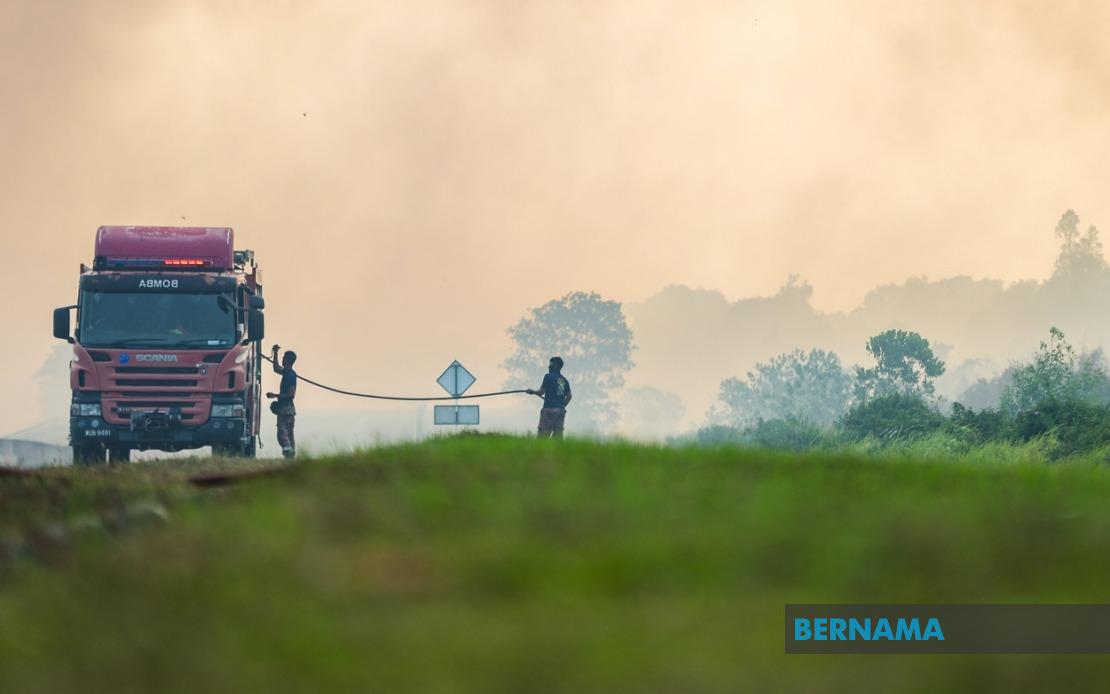
More than half of a significant peatland fire in Johor's Pengerang district has been brought under control following intensive multi-agency firefighting efforts. As of 4 pm on Monday, firefighters had successfully extinguished approximately 29 hectares of the total 51.4-hectare peatland area that ignited along Jalan Bypass Punggai-Sebana Cove, located near Kota Tinggi.
The blaze, which originated on Monday morning, has prompted a coordinated response involving multiple government and private sector organisations working in tandem across two distinct operational sectors. Fire Superintendent II Baharuddin Idris, commanding operations at Sungai Rengit Fire and Rescue Station, confirmed that continuous 24-hour firefighting and monitoring operations have been maintained since the initial outbreak to contain the flames, prevent further spread, and systematically extinguish the remaining hotspots.
Peatland fires present particular challenges for emergency responders across Southeast Asia. Unlike conventional vegetation fires that primarily burn surface material, peatland blazes can smoulder underground for extended periods, penetrating deep into the soil layer and reigniting with minimal provocation. This characteristic explains why the firefighting operation has been structured across two operational sectors with differentiated strategies, and why authorities have maintained continuous round-the-clock vigilance even as visible flames are brought under control.
Operational progress has been uneven across the affected zones. Sector A, which comprises the larger remaining challenge, still requires firefighting and firebreak construction operations across approximately 21 hectares. In contrast, Sector B has achieved near-complete extinguishment, suggesting that the heterogeneous nature of the peatland terrain and localised fire intensity have required tailored approaches to each zone rather than uniform firefighting methodology.
Recognising the scale of the remaining challenge, authorities escalated their intervention strategy by deploying aerial support. An aircraft approved by the Air Operations Control Centre took to the skies at 2.30 pm on Monday, representing a significant operational escalation that typically indicates either the establishment of new firebreaks to contain the fire's perimeter or the need to access terrain otherwise inaccessible to ground-based firefighting teams.
The response architecture demonstrates the layered coordination required for large-scale environmental emergencies in Malaysia. A total of 36 dedicated firefighters from the Fire and Rescue Department formed the backbone of frontline operations. These were supplemented by nine personnel from the Malaysian Civil Defence Force, who provide crucial logistical and support functions during prolonged emergency operations. Additionally, 14 workers from Ranhill SAJ, a water and engineering services contractor, contributed technical expertise, while the Department of Environment deployed two specialists and Pengerang Municipal Council provided three officers for local coordination and land management support.
For Malaysian readers, particularly those in industrial and agricultural regions of Johor, this incident underscores the vulnerability of peatland ecosystems to fire during certain seasonal conditions. Johor's peatland areas, which cover significant portions of the state's interior particularly around Kota Tinggi, represent critical ecological zones that filter water, store carbon, and maintain biodiversity. Uncontrolled peatland fires carry severe consequences extending far beyond the immediate burn area, including air quality deterioration that affects respiratory health across a broad geographic radius, disruption to water supply chains, and long-term soil degradation.
The Pengerang district location carries additional significance as the area hosts substantial petrochemical and industrial development, creating complex layers of risk management. Fire incidents in industrial zones demand heightened coordination between emergency services and facility operators, necessitating the involvement of specialist contractors like Ranhill SAJ who understand both the terrain and the proximity to sensitive industrial infrastructure.
The deployment of aircraft support, while necessary for containment, also signals that ground-based resources alone were insufficient to manage the remaining threat. This escalation reflects realistic operational assessment rather than alarm, yet it indicates that firefighting teams anticipate a multi-day containment operation. Peatland fires have historically proven persistent challenges for Malaysian authorities, occasionally reigniting weeks after initial suppression when moisture levels drop or weather patterns shift unfavourably.
Continuing surveillance remains critical throughout the post-active firefighting phase. Peatland fire management protocols in Malaysia increasingly emphasise extended monitoring periods where teams regularly inspect perimeter zones and assess subsurface thermal activity using infrared detection. A fire declared extinguished on the surface may continue burning underground, only to breach the surface again under adverse conditions.
This incident also reflects broader environmental management questions facing Malaysia's peatland regions. Understanding the origin of the fire—whether accidental, agricultural, or industrial—will inform preventive strategies for future incidents. Regional cooperation through ASEAN frameworks has increasingly focused on peatland fire prevention, recognising that transboundary smoke and atmospheric effects require coordinated approaches across borders, particularly during El Niño years when fire risk escalates dramatically throughout Southeast Asia.
The successful extinguishment of more than 57 percent of the affected area within hours of the initial reports demonstrates the effectiveness of Malaysia's fire response infrastructure when adequately resourced and coordinated. However, the remaining 21 hectares in Sector A represents both an immediate operational challenge and a reminder of the scale of environmental incidents that can rapidly overwhelm single-agency capacity, necessitating the multi-organisational approach now underway in Pengerang.

