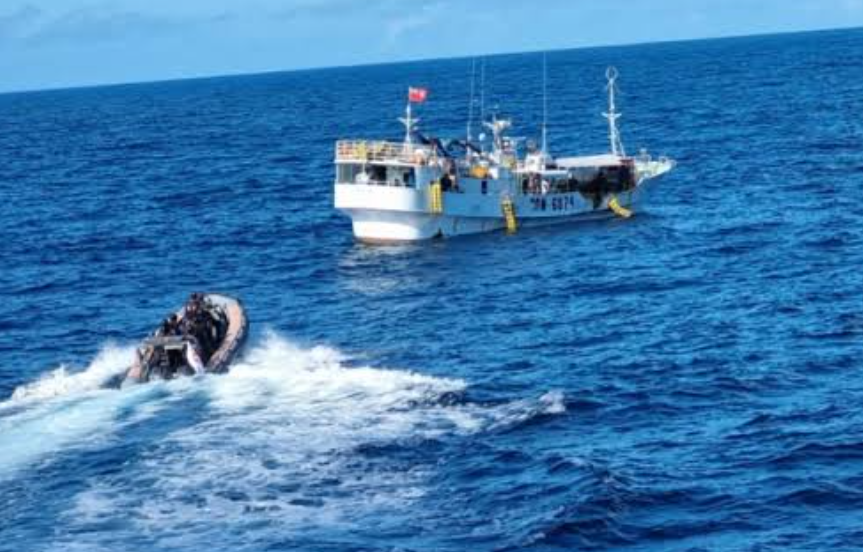
Coordinated enforcement action across the Pacific Ocean has yielded multiple arrests of foreign fishing vessels operating illegally in the region's waters. During a two-week operation this month, authorities in Kiribati, Palau, and Papua New Guinea apprehended four Chinese and Indonesian boats accused of breaching fishing regulations or operating without proper licensing. The effort, coordinated by the Pacific Islands Forum Fisheries Agency, represents an escalation in regional attempts to combat unlicensed and unreported fishing that has long plagued the world's most productive fishing grounds.
The scope of the surveillance initiative, known as Operation Island Chief, was unprecedented in its geographic reach. Between August 3 and 14, a combined maritime enforcement effort involving 11 island nations inspected more than 100 vessels across an area spanning 28 million square kilometres. The operation drew on substantial international support, including aerial reconnaissance from an Australian military aircraft and water-based patrols conducted by a United States Coast Guard vessel alongside Pacific regional maritime police. This coordinated approach underscores the challenge that small island states face in monitoring their exclusive economic zones—vast territories that would be impossible to patrol effectively without external assistance and regional cooperation.
The financial stakes underpinning these enforcement actions are substantial. The Pacific region produces approximately half of the world's tuna supply, yet the benefits of this wealth remain unevenly distributed. Pacific Island nations collectively earn roughly US$500 million annually through access fees paid by foreign fishing companies and an additional US$1.2 billion in export earnings. However, a structural imbalance persists: only 15 per cent of tuna caught in Pacific waters is actually processed or handled within the region itself. This arrangement means that while island economies depend heavily on fishing revenues, they capture relatively little of the value-added processing that generates maximum profits. For many Pacific communities, fisheries represent a lifeline—supporting the livelihoods of approximately one-third of all households across the island nations.
Large-distance fishing fleets, predominantly operated by Chinese, Taiwanese, and Indonesian companies, dominate the region's tuna industry. These vessels traverse the exclusive economic zones of smaller island states under licensing arrangements that provide crucial government revenue but offer limited direct employment or economic development to island populations. The practice of transmitting false vessel locations, as documented in a recent Tuvalu case, highlights how some operators deliberately circumvent monitoring systems. This evasion is particularly damaging because it undermines both the legitimacy of licensing agreements and the sustainability management frameworks that Pacific nations are attempting to establish. Detecting and prosecuting such violations remains resource-intensive, requiring both technological capability and political will from island governments.
The sensitivity surrounding enforcement against Chinese vessels reflects deeper geopolitical complexities within the Pacific region. Chinese fishing companies maintain substantial operations and joint venture arrangements with several island nations, creating economic interdependencies that can complicate enforcement decisions. Naming Chinese operators accused of illegal activity risks straining diplomatic and commercial relationships at a time when many Pacific countries seek Chinese investment and development assistance. Yet the failure to enforce regulations equally undermines the credibility of the entire licensing system and allows repeat offenders to operate with relative impunity. This tension between economic pragmatism and regulatory integrity remains one of the most challenging aspects of Pacific fisheries governance.
A revealing case emerged last month when Tuvalu authorities detained a Chinese-flagged vessel caught transmitting false location data while engaged in illegal fishing. The boat spent 24 days in custody and was subsequently fined and released, according to Peter Hammarstedt, captain of the conservation vessel Sea Shepherd, which participated in the enforcement patrol. Notably, Tuvalu maintains diplomatic recognition of Taiwan rather than the People's Republic of China, a status that may have enabled more forthright enforcement than might otherwise occur in nations with closer Beijing ties. This incident demonstrates both the possibility of effective action and the importance of independent observer presence—conservation groups like Sea Shepherd often provide documentation that supports prosecution and deters future violations.
Historical data on enforcement violations reveals persistent patterns of non-compliance among distant-water fishing fleets. Between 2008 and 2026, inspectors working for the Western and Central Pacific Fisheries Commission issued 278 penalty notices to Chinese fishing boats, representing the second-largest violation tally in the dataset. Taiwan-flagged vessels accumulated 319 infringements during the same period, indicating that enforcement occurs across multiple flag states and that violations transcend particular nationalities. These statistics suggest systemic challenges in the industry rather than isolated misconduct by specific operators. The volume of violations relative to the total number of vessels operating in the region suggests that detection and prosecution remain inconsistent, likely reflecting capacity constraints among island enforcement agencies and the vast ocean area requiring surveillance.
Climate change adds urgency to these governance challenges. Rising ocean temperatures and changing marine ecosystems are already affecting tuna distribution and abundance, threatening the sustainability of stocks that Pacific nations depend upon economically. As fish populations become less predictable and potentially more scarce, the temptation for operators to engage in unreported or unlicensed fishing may intensify. Simultaneously, island nations' capacity to enforce regulations may decline if climate impacts divert resources toward adaptation and disaster response. An upcoming meeting of 18 Pacific Island leaders scheduled for August 30 in Palau is expected to address these interconnected challenges through discussion of new strategies for protecting fishing rights and maximizing government revenues. The agenda likely includes mechanisms for strengthening regional enforcement, improving information-sharing, and negotiating more equitable benefit-sharing arrangements with distant-water fishing companies.
The operation also identified 16 additional vessels classified as "of interest" by authorities, though the FFA declined to provide specific details about the nature of their suspected violations or the nationalities involved. This discretion reflects both operational security concerns and the political sensitivity of publicly naming vessels and their operators. However, the withholding of such information also limits public understanding of enforcement patterns and may reduce transparency regarding how violations are investigated and prosecuted. Greater disclosure could strengthen the credibility of regional enforcement institutions and demonstrate to stakeholders that regulations are being applied fairly regardless of the economic or political weight of offending nations.
The coordination displayed during Operation Island Chief suggests growing institutional capacity and political commitment among Pacific Island nations to assert control over their marine resources. Yet sustaining such efforts requires continuous investment in maritime patrol assets, training, and surveillance technology—resources that small island budgets struggle to accommodate independently. The reliance on Australian and American support, while enabling enforcement action, also highlights the dependence of Pacific Island states on external powers for basic ocean governance functions. Moving forward, strengthening domestic maritime capacity, regional intelligence-sharing mechanisms, and joint prosecution frameworks will be essential for establishing consistent, credible enforcement that deters illegal fishing and ensures that Pacific Island nations capture a fair share of the wealth generated by their waters.

