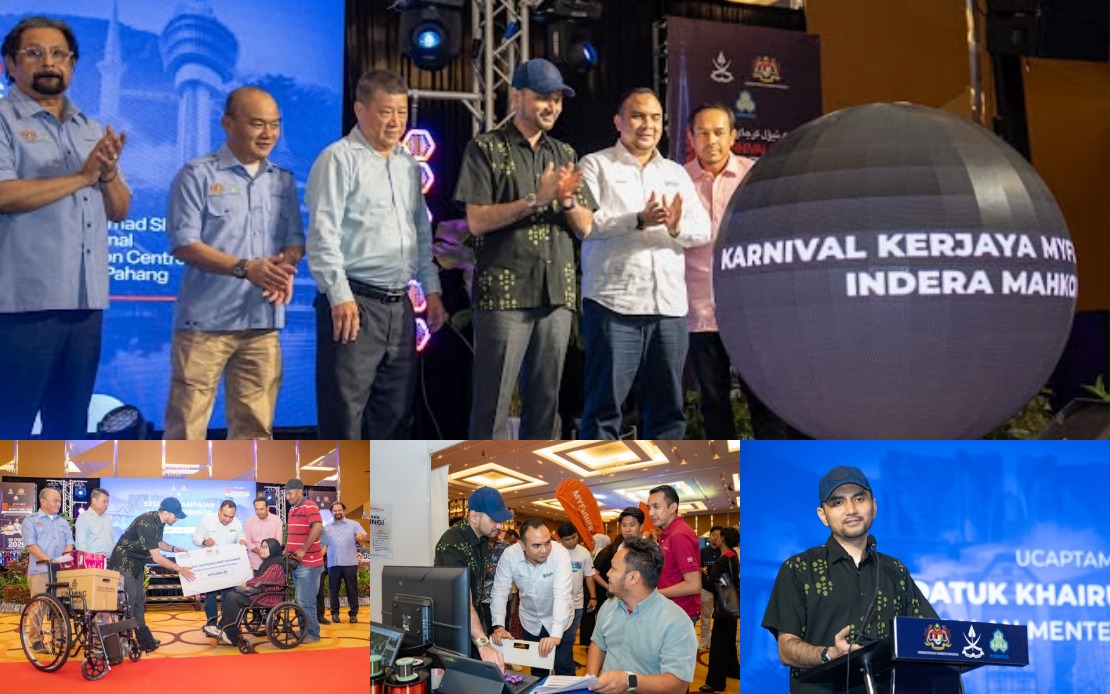
Pahang has emerged as the employment leader on Malaysia's East Coast, posting a labour force participation rate of 65.3 per cent in the first quarter of 2026 whilst maintaining an unemployment rate of just 1.9 per cent. The milestone reflects the cumulative impact of sustained job-placement efforts and reflects a broader regional strategy to connect working-age residents with available opportunities across diverse sectors. The figures underscore the state's resilience in maintaining labour market stability even as economic conditions shift regionally.
Deputy Human Resources Minister Datuk Khairul Firdaus Akbar Khan attributed these gains to a coordinated portfolio of employment initiatives, most notably the MYFutureJobs programme administered by the Social Security Organisation (PERKESO). Speaking at the Indera Mahkota MyFutureJobs Career Carnival 2026 in Kuantan, he framed the results as validation of a deliberate policy approach centred on making job pathways more accessible to citizens across all demographics. The carnival itself showcased the practical dimension of this strategy, presenting 6,000 vacancies across 30 employers spanning multiple industrial sectors to prospective candidates.
Since the MYFutureJobs platform's inception through late July 2026, PERKESO data reveals that 26,877 job seekers in Pahang have successfully transitioned into employment through the mechanism. This volumetric achievement becomes more meaningful when contextualized against the effort expended: across the same period, PERKESO facilitated 1,277 interview sessions and career events throughout Pahang. The cumulative advertising of over 10,000 vacancies through the digital portal has created a searchable inventory for workers, with 11,857 registered seekers recorded specifically in 2026, suggesting sustained engagement with the platform.
The employment gains carry particular significance for Southeast Asia's broader labour market narrative. As economies across the region grapple with demographic shifts and sectoral transitions, Pahang's experience offers insight into how targeted platforms combined with physical engagement—through carnivals and community events—can move jobless workers into positions. For Malaysia specifically, the results validate a strategy that prioritizes accessibility over centralisation, recognising that rural and peripheral areas require localised activation rather than reliance on urban job markets alone.
Beyond placement mechanics, Datuk Khairul Firdaus emphasised that government intervention encompasses human capital development. The ministry has woven skills-training programmes into its employment architecture, recognising that connecting workers to jobs represents only half the challenge; equipping them to succeed within those roles demands ongoing capability-building. He urged workers to embrace these training opportunities as mechanisms for adapting to evolving industry standards, enhancing personal development trajectories, and ultimately elevating workplace performance across sectors experiencing technological and operational transformation.
The Pahang results also reflect a broader MADANI Government initiative designed to tighten the connection between employment services and community proximity. Officials articulated a commitment to strengthening the integration between MYFutureJobs and the Sahabat MADANI volunteer movement, positioning employment support as a component of wider community engagement rather than an isolated transactional service. This architecture explicitly targets rural populations and geographically challenging communities, acknowledging that distance and information asymmetries have historically constrained opportunity access for Malaysia's dispersed populations.
Sahabat MADANI itself emerged as a central narrative element during the Kuantan event. Prime Minister's Political Secretary Datuk Ahmad Farhan Fauzi launched the Pahang-level instantiation of this initiative, framing it not as conventional volunteering but rather as a community movement functioning as a connective tissue between governmental apparatus and grassroots populations. The initiative's philosophy anchors itself to principles of collective action, mutual obligation, social compassion, and inclusive development—aspirational concepts intended to motivate participation beyond transactional incentives.
The volunteer dimension acquired operational specificity when Ahmad Farhan disclosed that Pahang had already recruited 2,000 Sahabat MADANI members, satisfying initial targets set for the state. However, rather than signalling completion, officials framed this milestone as a foundation for expanded recruitment. The articulated ambition involves cultivating a substantially larger volunteer cohort capable of addressing community needs whilst simultaneously functioning as distributed intelligence nodes for government on grassroots conditions, concerns, and dynamics. This dual function transforms volunteerism into a governance instrument.
The employment and volunteerism narratives converge around a governance philosophy emphasising distributed service delivery and community embedment. By linking job-placement mechanisms to volunteer networks, policymakers appear intent on creating redundant pathways through which citizens can access information and opportunity. For Malaysian workers—particularly younger cohorts and those in underserved areas—this architecture theoretically improves discovery probability; for government, the volunteer infrastructure provides continuous community feedback channels separate from formal administrative hierarchies.
For regional observers, Pahang's labour market performance invites scrutiny of replicability across Southeast Asia. The combination of digital platform infrastructure, localised physical events, and human capital development appears relatively straightforward to transplant across borders. However, Pahang's success likely reflects specific contextual advantages including administrative capacity, political prioritisation, and population characteristics that may not obtain uniformly across the broader region. Whether comparable results could emerge in Indonesian, Thai, or Philippine contexts absent these preconditions remains an open analytical question.
The 1.9 per cent unemployment rate merits particular attention given regional comparative baselines. Several Southeast Asian economies report substantially higher joblessness, particularly among youth cohorts. Pahang's achievement suggests that comprehensive, sustained policy commitment combined with multi-channel activation can suppress unemployment even within developing economy contexts. The sustainability of these gains remains contingent on continued government investment in platform maintenance, event staging, and training delivery alongside underlying economic conditions supporting employer hiring momentum.
Moving forward, officials signalled continuity in the employment support architecture. The emphasis on training participation, the expansion of Sahabat MADANI membership, and the stated commitment to deepening MYFutureJobs integration suggests that Pahang will maintain its policy focus on labour market activation. As Malaysia confronts sectoral transformation pressures and demographic shifts, sustaining the institutional frameworks that generated these results assumes strategic importance not merely for Pahang but for national employment stability objectives.

