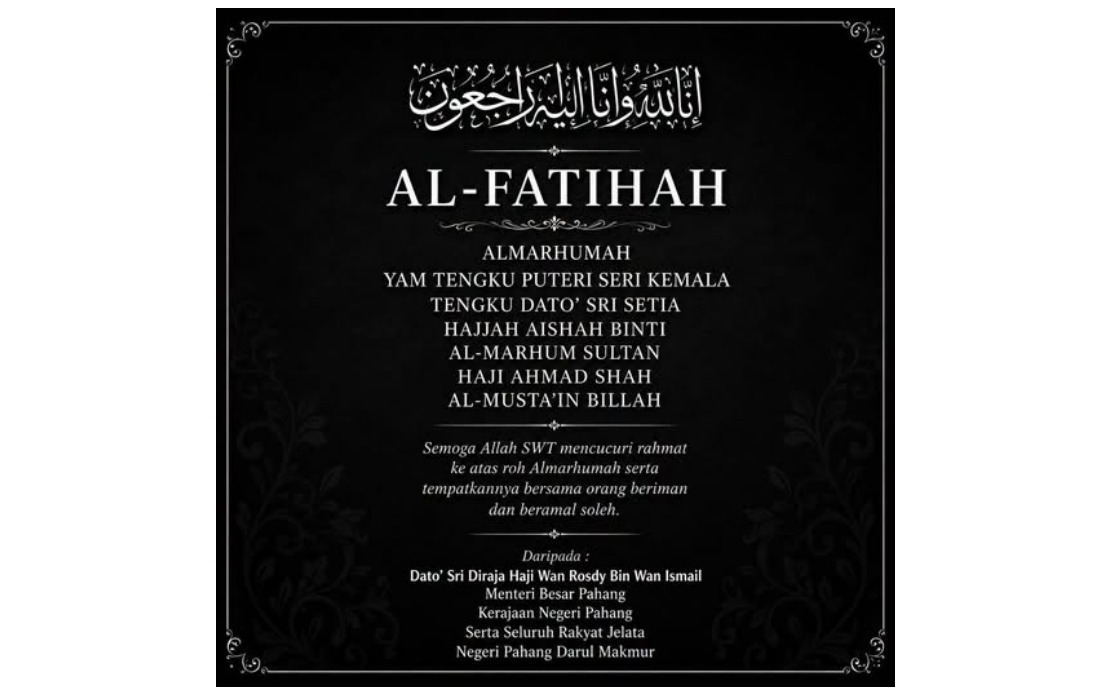
Pahang Menteri Besar Datuk Seri Wan Rosdy Wan Ismail has conveyed heartfelt condolences to the Pahang Royal Family following the death of Tengku Puteri Seri Kemala Tengku Datuk Seri Aishah, the elder sister of Sultan of Pahang Al-Sultan Abdullah Ri'ayatuddin Al-Mustafa Billah Shah. The prominent state official acknowledged the profound sadness surrounding her loss, which resonates deeply throughout Pahang's ruling establishment and the broader royal household.
Tengku Datuk Seri Aishah passed away on August 26 at a hospital in Kuala Lumpur at 9.15 pm. Her death marks the loss of a significant figure within the sultanate's inner circle, with her remains scheduled for interment at the Pahang Royal Mausoleum in Pekan on August 27. The timing of her funeral reflects the royal family's adherence to Islamic protocols, which generally require burial to occur within 24 hours of death.
In his public statement issued through social media, Wan Rosdy emphasized the collective grief shared not only by Sultan Al-Sultan Abdullah Ri'ayatuddin Al-Mustafa Billah Shah and Tengku Ampuan Pahang Tunku Azizah Aminah Maimunah Iskandariah, but also by the entire royal household. His remarks underscored how such losses reverberate across institutional and personal dimensions within the state's highest echelons of authority. The Menteri Besar's formal acknowledgment of the death serves as an important gesture of state solidarity with the monarchy during a time of private mourning.
The expressions of sympathy extended by Wan Rosdy reflect longstanding conventions within Malaysian political culture, where senior government officials routinely acknowledge significant losses affecting royal families. Such gestures carry ceremonial weight and demonstrate the intertwined relationship between political administration and the institution of monarchy in Malaysia's constitutional framework. The Pahang state government's formal response signals appropriate deference to the sultanate and recognition of the family's prominent status.
Wan Rosdy's invocation of Islamic supplication in his condolence message—calling for divine mercy upon the deceased's soul, forgiveness of sins, and acceptance of good deeds—aligns with mainstream Malaysian Muslim expressions of grief and respect. Such language resonates with both Islamic traditions and broader Malaysian social conventions around death and mourning. The inclusion of these spiritual sentiments reflects the intersection of faith and formal state protocol in Malaysia's institutional culture.
The death of Tengku Puteri Seri Kemala represents a significant moment within Pahang's royal history, as members of the sultan's immediate family occupy prominent positions within the state's symbolic and sometimes substantive authority structures. Her passing may prompt reflection within royal circles about succession matters and the continuity of family lineages, though such discussions traditionally remain private within the palace hierarchy. The formal state acknowledgment of her death, however, ensures public recognition of her status and contributions to the royal household.
Pahang's Menteri Besar, in articulating his condolences on behalf of the state apparatus and general population, functioned as an intermediary between the broader public and the royal institution. This role, while ceremonial in character, carries genuine significance within Malaysia's constitutional monarchy system, where symbolic gestures and formal protocols reinforce institutional relationships. By speaking for both government and people, Wan Rosdy performed a unifying function during a period of family bereavement.
The Pahang Royal Mausoleum in Pekan, where Tengku Datuk Seri Aishah's interment was scheduled, represents one of the state's most historically significant burial grounds for royal personages. The choice of this location underscores her standing within the sultanate and her family's deep roots in Pahang's political and ceremonial landscape. Such burial sites serve not merely as final resting places but as markers of royal lineage and historical continuity within Malaysian states.
For observers of Malaysian governance and royal affairs, such moments of documented condolence from senior political figures provide insight into the functioning of state-monarchy relations. The careful, respectful tenor of Wan Rosdy's remarks exemplifies how contemporary Malaysian political leaders navigate their relationships with royal institutions while maintaining appropriate boundaries between executive and monarchical authority. These ceremonial exchanges, though sometimes appearing formulaic to outside observers, represent important threads in Malaysia's constitutional tapestry.
The passing of Tengku Puteri Seri Kemala also underscores the broader human dimensions of institutional life in Malaysia, reminding citizens that those occupying positions within royal and political hierarchies experience personal losses comparable to those in ordinary households. Yet the public nature of state acknowledgment of such deaths distinguishes these moments from purely private grief, transforming personal loss into an occasion for formal institutional response and public expression of collective sympathy.

