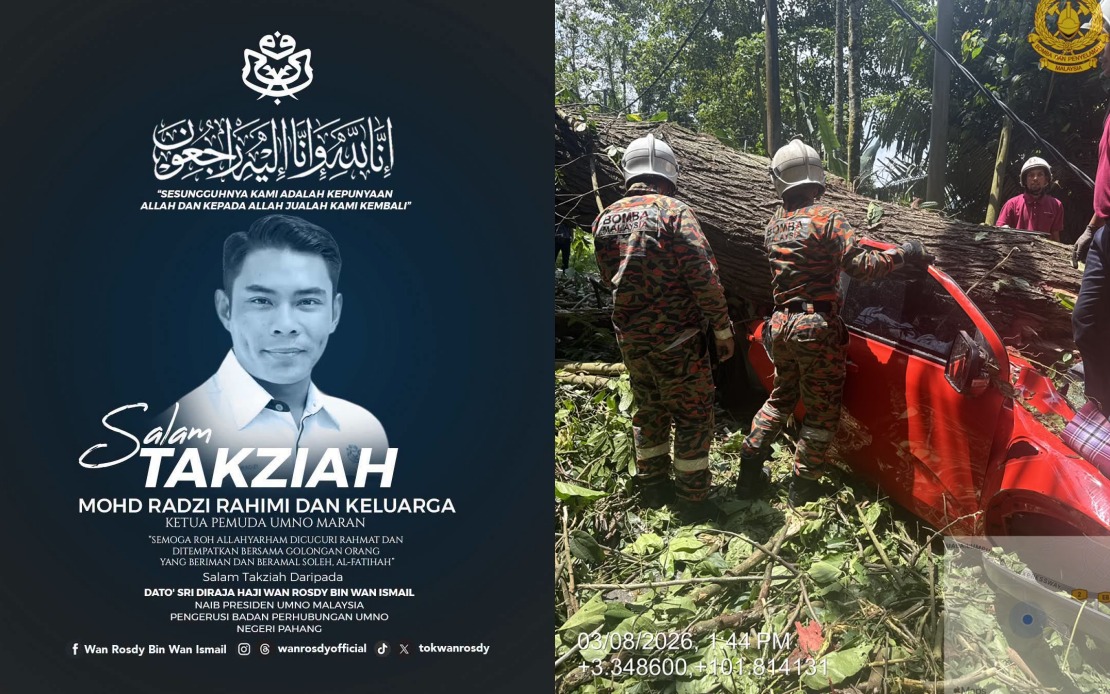
The Malaysian political landscape has lost a committed youth leader with the passing of Mohd Radzi Rahimi, also widely known as Edy Radzi, who served as chief of UMNO Youth in the Maran division. Pahang Menteri Besar and Pahang UMNO Liaison Committee chairman Datuk Seri Wan Rosdy Wan Ismail confirmed the tragedy in a heartfelt statement, reflecting the deep impact Radzi's death has had on the broader UMNO family across the state. The incident occurred in the afternoon along the old Kuala Lumpur-Bentong road near Janda Baik when a fallen tree struck the vehicle Radzi was travelling in, resulting in what authorities have described as a devastating accident.
Radzi's death was part of a broader tragedy that claimed multiple lives in a single incident. Three other individuals lost their lives alongside him: Nuriani Mohammad Jafri, her son Muhammad Rizz Hazim, and her younger brother Mohammad Nizam. Additionally, a child who was travelling with the group sustained injuries during the accident. The sudden and catastrophic nature of the event has sent shockwaves through the local UMNO structure and the broader Pahang community, which had benefited from Radzi's service in youth leadership.
In his tribute, Menteri Besar Wan Rosdy characterised Radzi as someone whose life was defined by an unwavering commitment to public service and community welfare. He emphasised that Radzi exemplified the qualities expected of youth leaders, consistently prioritising the needs and interests of the people he served above personal considerations. Such dedication to constituent welfare is particularly valued within the UMNO framework, where grassroots engagement remains central to the party's political machinery.
The Menteri Besar underscored that Radzi's loss represents far more than a personal tragedy for his immediate family. The impact extends across multiple institutional layers within the UMNO structure, affecting the Maran division's operations, the Pahang UMNO Youth movement, and the broader Pahang UMNO Liaison Committee. Youth wings of political parties often serve as crucial pathways for developing future leaders and mobilising younger demographic segments, making the loss of experienced youth leaders particularly significant from an organisational perspective.
Wan Rosdy extended formal condolences to all families affected by the tragedy, invoking religious sentiment appropriate to the Malaysian context by invoking mercy and patience. His statement reflected the gravity of the moment and the need for institutional acknowledgement of personal loss within the party framework. Such expressions of sympathy from senior leadership help channel grief through organisational channels while maintaining public dignity during difficult circumstances.
YABDatuk Dr Muhammad Akmal Saleh, national UMNO Youth chief, similarly recognised Radzi's passing and offered prayers for his spiritual rest. The involvement of national-level youth leadership in paying respects indicates that Radzi had earned recognition beyond his immediate divisional constituency. His work had apparently made sufficient impression to warrant acknowledgement from the apex of UMNO's youth structure, suggesting he had demonstrated leadership qualities and accomplishments worthy of broader notice within the organisation.
The tree-fall incident that claimed Radzi's life represents a broader category of accidents that periodically affect Malaysian roads, particularly along older routes such as the Kuala Lumpur-Bentong corridor. This stretch of road runs through terrain prone to heavy vegetation and weather-related hazards. The old route, less travelled than modern expressways, may present particular risks during certain weather conditions when tree falls become more likely. Road safety agencies often face challenges in maintaining vegetation management along older road networks, where budget constraints and terrain difficulties can complicate maintenance efforts.
From a political continuity perspective, Radzi's passing raises questions about succession planning within the Maran UMNO Youth division. The sudden loss of experienced divisional leaders can create organisational gaps that require swift and effective management to maintain momentum in grassroots engagement and youth mobilisation. UMNO's reliance on established networks of divisional leaders means that unexpected vacancies can temporarily disrupt coordination between national and local levels of the party structure.
The incident also underscores the unpredictability of personal tragedy and the importance of institutional resilience. While individual personalities and leadership styles matter significantly in Malaysian politics, organisations built around strong institutional frameworks can better absorb the shock of unexpected losses. The formal expressions of sympathy from multiple levels of UMNO's hierarchy demonstrate the existence of such institutional structures, even as they acknowledge the personal dimensions of the loss.
For the broader Pahang community, Radzi's passing represents the loss of a public figure who had committed himself to youth-focused agenda within the state's political landscape. Youth leaders occupy a distinctive role in Malaysian politics, serving as bridges between established power structures and emerging demographic interests. The loss of such individuals can create temporary voids in representation and advocacy for younger population segments within formal political institutions.
Moving forward, attention will likely focus on how UMNO Pahang manages the transition within the Maran youth division and whether it uses this moment to strengthen institutional mechanisms for developing replacement leadership. The manner in which parties handle such transitions often signals their internal health and preparedness for managing generational change. Radzi's legacy, as articulated by senior leadership, appears to centre on his commitment to putting community interests first—a benchmark that his successors will presumably be expected to uphold.

