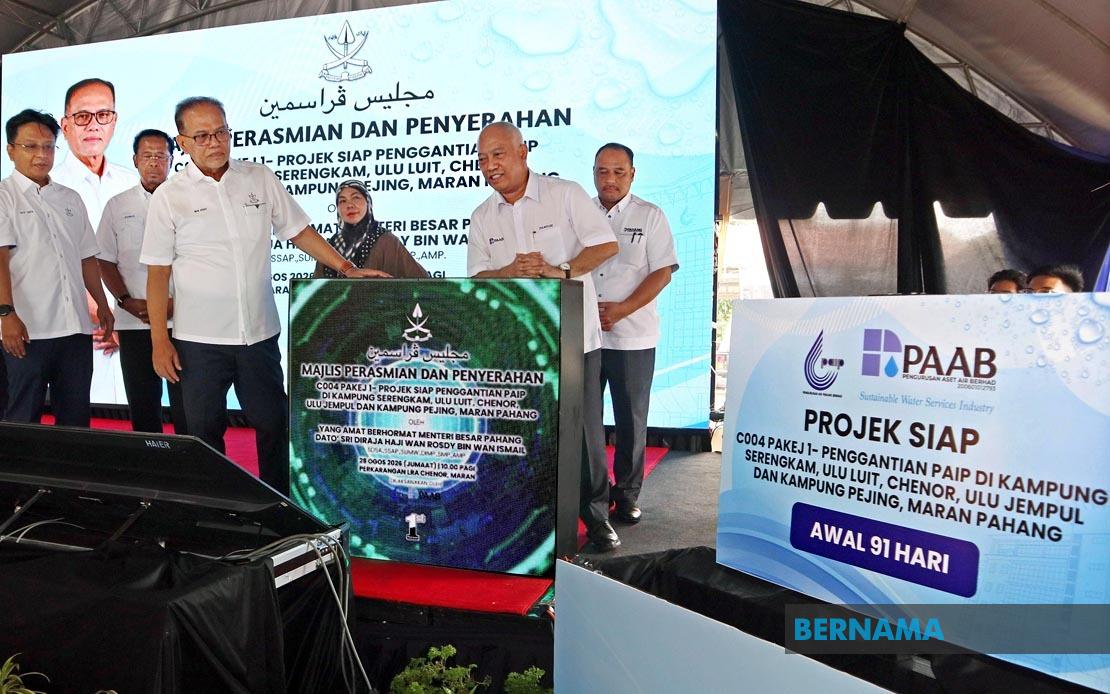
The Pahang state government is preparing to tackle a persistent problem affecting the Sungai Pahang, where shallow waters in specific localities such as Kampung Pesagi have disrupted economic activities and daily life for nearby communities. Menteri Besar Datuk Seri Wan Rosdy Wan Ismail announced that the administration will move forward with a layered approach combining short-term, medium-term, and long-term interventions, though implementation details remain pending completion of comprehensive diagnostic work.
The delay in announcing concrete remedial steps reflects the government's intent to proceed cautiously. Wan Rosdy explained that district authorities are currently compiling detailed assessments of the river's present state, which will subsequently be reviewed at state executive council meetings before any decisions are finalised. This methodical process signals recognition that river management decisions carry wide-ranging consequences for water security, transportation, and livelihoods across the region.
The Sungai Pahang issue carries particular significance for Pahang's development trajectory. The river has historically served as a crucial artery for commerce and subsistence activities in east-coast communities. When water levels fall dramatically, fishing operations suffer, agricultural irrigation becomes problematic, and small-scale commercial transport becomes unfeasible. The shallow-water phenomenon therefore represents not merely a hydrological concern but a socioeconomic challenge that touches multiple sectors of the regional economy.
Wan Rosdy's emphasis on data-driven decision-making underscores a shift towards evidence-based governance in the state. Rather than rushing into expensive dredging or damming schemes, officials are collecting baseline information to determine which combination of interventions—whether dredging, water retention projects, upstream management, or alternative resource allocation—would most effectively address root causes while remaining fiscally sustainable. This approach acknowledges that poorly planned river modification can produce unintended environmental and hydrological consequences elsewhere in the watershed.
The announcement came during an event celebrating progress in Pahang's broader infrastructure modernisation. The state highlighted completion of a pipe replacement initiative in Maran district, with four of the state's districts now achieving water supply resolution rates exceeding 90 percent. Maran is expected to follow suit, indicating that systematic attention to basic service delivery is yielding measurable improvements across multiple domains simultaneously.
Beyond the immediate river challenge, Pahang is simultaneously developing major energy infrastructure that officials believe will reshape the state's economic prospects. The Tenaga Nasional Berhad initiative in Kampung Awah involves constructing a 500kV Transmission Main Intake Substation at a cost approaching RM350 million, with completion targeted for 2030. This facility will integrate Pahang into a reinforced east-coast electricity network capable of supporting heavier industrial demand and attracting manufacturers seeking reliable power supply.
The energy infrastructure project exemplifies how Pahang's development strategy encompasses interconnected systems. Improved electricity networks are expected to catalyse foreign investment in manufacturing and processing industries, creating employment and tax revenue that can subsequently fund environmental remediation and community services. Officials argue that this integrated approach—addressing water supply, managing natural resources, and building industrial backbone simultaneously—offers a more durable foundation for long-term prosperity than treating each challenge in isolation.
The shallow Sungai Pahang problem itself reflects broader environmental pressures facing Malaysian river systems. Climate variability, upstream land-use changes, and cumulative sedimentation patterns have created seasonal low-flow conditions in multiple waterways across the peninsula. Pahang's response may therefore establish precedents for how other states manage similar challenges, particularly as climate patterns become less predictable and dry seasons potentially lengthen.
For residents dependent on the river, the extended period before comprehensive solutions emerge generates considerable uncertainty. Fishing communities, small traders, and agricultural operators face continued restrictions on their normal activities while technical assessments proceed. The government's insistence on thorough study before implementation reflects professional diligence but also means that immediate hardship may continue through multiple monsoon seasons before meaningful relief arrives.
The Menteri Besar's framing of these challenges as interconnected elements within a broader development narrative reveals how Malaysian state governments increasingly attempt to position infrastructure and resource management within larger economic transformation frameworks. Rather than presenting the river problem as an isolated crisis, Pahang's leadership links it to water security, energy security, and economic competitiveness, suggesting that community investment in long-term planning ultimately generates benefits across multiple dimensions of regional welfare.
Wan Rosdy's public commitment to deliberate, evidence-based action serves both practical and political purposes. From a technical standpoint, it acknowledges that major river interventions require careful hydrological and environmental analysis to avoid creating new problems while solving existing ones. From a political perspective, it demonstrates that the state government is taking constituent concerns seriously while projecting competence and systematic problem-solving rather than reactive crisis management.
The timeline ahead will test whether Pahang's measured approach delivers genuine solutions or becomes perceived as bureaucratic delay. Community expectations will intensify if the shallow-water problem persists through multiple additional seasons, and political pressure may eventually force accelerated action regardless of study completion. The state therefore faces the familiar challenge of balancing technical rigour against public demands for timely intervention in matters directly affecting residents' economic survival.

