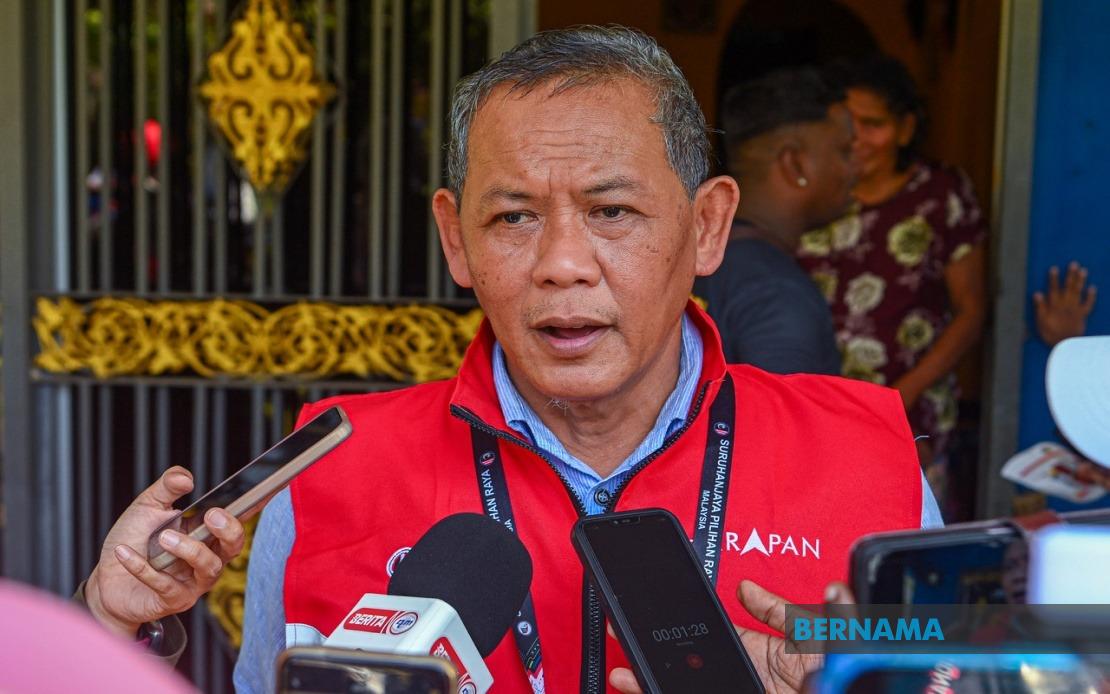
Datuk Seri Aminuddin Harun, chairman of Pakatan Harapan in Negeri Sembilan and the incumbent Menteri Besar, has signalled a strategic shift in the coalition's approach to social spending ahead of the August 1 state election. The manifesto unveiled under the banner 'Negeri Sembilan Kekal Harapan' (Negeri Sembilan Stays with Harapan) represents an expanded policy framework that deliberately reaches beyond the state's poorest households to encompass the middle-income stratum—a demographic category often squeezed between targeted assistance programmes. This recalibration suggests PH recognises that wealth-based eligibility thresholds can leave critical voter segments underserved, particularly as inflation and rising living costs have eroded the purchasing power of households once classified as comfortable.
The manifesto anchors ten core pledges designed to improve living standards across a broader economic spectrum. Aminuddin articulated the rationale behind this expansion during a community engagement event at Sekang Estate in Linggi, emphasising that inclusive growth requires policies calibrated to reach those earning above the B40 ceiling—the bottom forty percent of households—but below upper-income thresholds. By explicitly incorporating M40 households, defined as the middle forty percent of the income distribution, PH appears to be acknowledging a political reality: that electoral fortunes increasingly depend on securing support from voters whose struggles remain real but whose needs are often neglected by assistance schemes designed exclusively for the most impoverished segments.
Previously, PH's programmatic focus concentrated heavily on the B40 demographic, with education access, healthcare subsidies, and welfare transfers calibrated primarily toward families earning below RM4,850 monthly. This narrow targeting, while well-intentioned, left millions of middle-income Malaysians—including teachers, junior government employees, small traders, and skilled workers—ineligible for many schemes despite facing genuine hardship. The strategic pivot in Negeri Sembilan reflects a recognition that sustainability of electoral support requires demonstrating tangible benefit across income bands. Education initiatives now explicitly encompass children from M40 families, signalling that access to quality learning will no longer be stratified by parental income alone, a particularly salient commitment in a state where educational attainment drives longer-term economic mobility.
Aminuddin, who concurrently holds the Linggi state seat and Port Dickson parliamentary constituency, faces a three-cornered contest against incumbent Datuk Mohd Faizal Ramli of Barisan Nasional and Zamri Md Said of Parti Pribumi Bersatu Malaysia. This tight electoral environment likely informs PH's broader approach. The manifesto's expansion mirrors a nationwide pattern visible across Southeast Asian democracies: as middle-income cohorts expand and economic inequality deepens, political coalitions risk irrelevance if they fail to address the distinctive anxieties of households no longer classified as poor but increasingly precarious. By embedding M40 considerations throughout its ten commitments, PH attempts to inoculate itself against accusations of neglecting this demographic, a vulnerability that opposition parties routinely exploit.
The coalition's leadership emphasises its track record of implementation as crucial differentiator. Since 2018, when PH first assumed control of Negeri Sembilan following federal elections that unseated the long-ruling Barisan Nasional, state government has pursued infrastructure development, healthcare expansion, and educational enhancements. Aminuddin stressed that translating manifesto promises into reality demands sustained institutional commitment and fiscal discipline—demands substantially more taxing than rhetorical flourish. This positioning implicitly criticises opposition parties, particularly Bersatu, of deploying campaign manifestos as ephemeral electoral tools rather than binding governance frameworks. For Malaysian voters increasingly sceptical of political pledges, evidence of past delivery carries disproportionate weight, and PH's emphasis on implementation fidelity appears designed to capitalise on this sentiment.
The timing of this manifesto rollout occurs amid deteriorating social cohesion in several Malaysian states, where electoral campaigns have generated intercommunal tensions. Aminuddin appealed for mature political discourse that avoids exacerbating divisions, reflecting genuine concern that Negeri Sembilan's multiethnic composition—particularly its significant Indian and Chinese communities—could become weaponised through identity-based politics. His commitment to social harmony, articulated explicitly during community engagement with Linggi's Indian estate populations, signals awareness that electoral victory secured through divisive messaging would prove pyrrhic if it fractures the societal fabric required for effective governance thereafter. This principled positioning also differentiates PH from Bersatu, whose recent trajectory has involved increasingly communalist positioning.
For Malaysian readers and observers across Southeast Asia, the Negeri Sembilan contest illuminates broader regional trends. Middle-income households throughout the region face comparable pressures: stagnating wages, rising education and healthcare costs, deteriorating public service quality, and precarious employment. Political coalitions that ignore these constituencies risk losing electoral relevance, yet extending welfare schemes requires either efficiency gains or fiscal expansion that cash-strapped governments struggle to deliver. PH's Negeri Sembilan manifesto represents a pragmatic gambit—expanding the rhetorical tent while maintaining fiscal sustainability through improved targeting efficiency and administrative capacity. Whether this strategy succeeds depends partly on whether PH can simultaneously demonstrate competent delivery across both B40 and M40 segments without diluting impact through overextension.
The August 1 polling date approaches as state elections approach critical phase. Early voting scheduled for July 28 will test voter enthusiasm, offering preliminary indicators of turnout patterns and demographic participation rates. Negeri Sembilan's status as a bellwether state—its electoral results often correlating with national trends—means the outcome will reverberate beyond the state's boundaries. A decisive PH victory would signal broad acceptance of the expanded manifesto approach, validating the strategic calculation that middle-income inclusion drives electoral success. Conversely, a narrow victory or opposition gains would suggest voters require more concrete policy details or remain unconvinced of implementation capacity.
For Malaysian policymakers contemplating future electoral cycles and governance approaches, the Negeri Sembilan campaign offers instructive lessons regarding income-based policy design. The bifurcation of welfare programmes into B40 and M40 categories, rather than purely universal provision, reflects fiscal constraints common across developing economies. Yet this approach creates implementation complexity and eligibility verification costs that sometimes exceed programme benefits themselves. PH's manifesto expansion sidesteps some of these difficulties through universal education and healthcare access principles, which benefit all income groups while generating political credit across broader constituencies. As Southeast Asian nations confront widening inequality and middle-class anxiety, such inclusive policy architecture may increasingly define electoral competition.
The broader political context illuminates why this manifesto represents more than routine campaign messaging. Malaysia's federal system creates asymmetric power distributions: state governments control education, healthcare, and local economic development, while federal authorities retain income redistribution mechanisms. Negeri Sembilan's relatively prosperous economy, anchored in manufacturing and commerce, generates tax revenues enabling state-level welfare expansion without equivalent federal transfers. This fiscal capacity distinguishes Negeri Sembilan from poorer states, making expansive manifestos credible only insofar as financial sustainability appears achievable. PH's emphasis on efficiency gains and administrative improvement, rather than merely increased spending, acknowledges these constraints while maintaining ambition.
Aminuddin's dual role as party chairman and Menteri Besar creates particular accountability dynamics. As chief minister, he cannot merely offer opposition-style critiques of governance; he must defend his administration's track record and articulate plausible paths forward. This constrains rhetorical excess while demanding genuine policy substance. Opposition candidates, unburdened by executive responsibility, can critique more freely but face voter scepticism regarding implementation feasibility. The manifesto's expansion to include M40 households thus represents not merely electoral positioning but intellectual engagement with genuine policy challenges confronting modern Malaysia. As regional economies mature and develop, such substantive policy contests—rather than purely identity-based or patronage-based politics—become increasingly determinative of electoral outcomes and governance quality.

