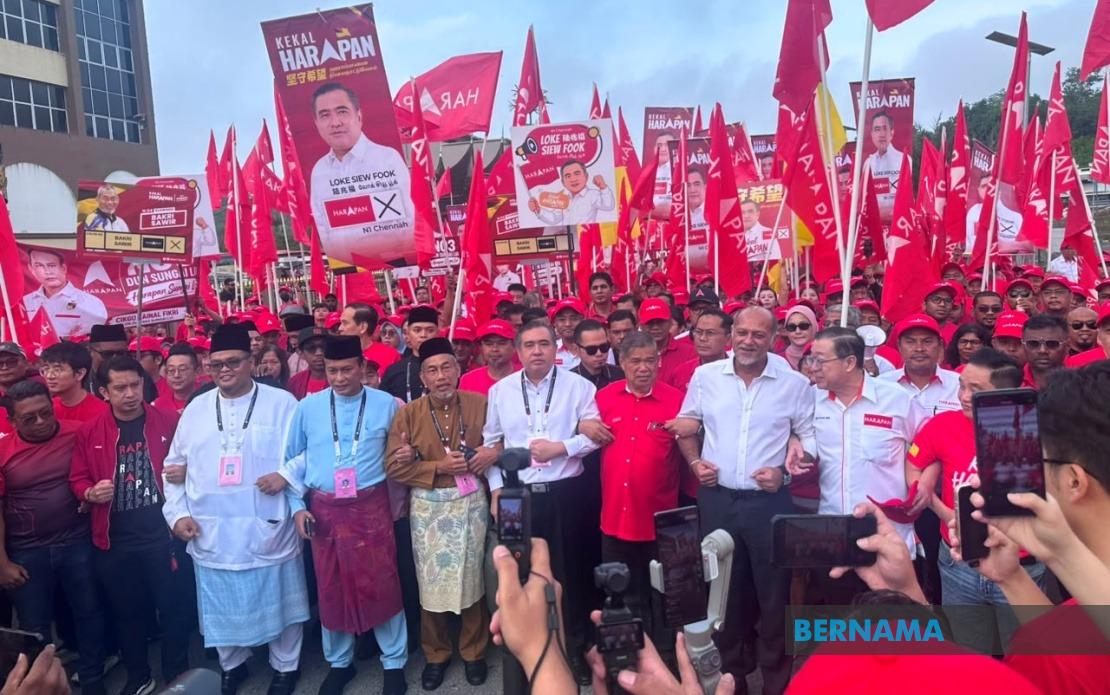
The coalition backing for Pakatan Harapan's candidates became evident on July 18 when senior party figures fanned out across Negeri Sembilan to accompany hopefuls filing their nomination papers for the 16th state election. The orchestrated show of unity among PH's various factions—DAP, PKR, and Amanah—signals the coalition's commitment to defending its 2023 electoral gains in the state, where it secured 17 of 36 seats. This synchronized deployment of leadership also underscores the importance PH places on maintaining its foothold in a state where the political landscape has become increasingly competitive.
At the Jelebu nomination centre in Dewan Besar Kuala Klawang, Transport Minister Anthony Loke, who serves as DAP secretary-general, filed his papers for the Chennah state seat while flanked by party chairman Gobind Singh Deo, former chief minister Lim Guan Eng, and Amanah president Mohamad Sabu. The presence of multiple senior figures at a single nomination venue demonstrates how PH strategically uses high-profile endorsements to boost candidate visibility and reinforce messaging. Loke's decision to contest reflects DAP's continued dominance within the PH coalition, particularly in Negeri Sembilan where the party holds several seats.
Elsewhere in the state, Communications Minister Fahmi Fadzil navigated the nomination process in Jempol District, where he supported four PH candidates seeking seats in Serting, Palong, Jeram Padang, and Bahau. Among these contenders, Teo Kok Seong, the PH candidate for Bahau, brings incumbency advantage from the 14th General Election, while the other three candidates represent fresh faces for the coalition. This mix of experienced and new candidates reflects a common strategy in Malaysian elections, where parties balance proven performers with emerging talent to signal both continuity and renewal. Teo Nie Ching, Deputy Communications Minister and Wanita DAP chief, also appeared at the nomination centre to support Teo Kok Seong, illustrating how women leaders within PH are increasingly visible during crucial electoral moments.
Negeri Sembilan's Menteri Besar Datuk Seri Aminuddin Harun, simultaneously filing nominations for his own Linggi seat, received support from DAP deputy secretary-general Hannah Yeoh, PKR secretary-general Fuziah Salleh, and the Prime Minister's political secretary Farhan Fauzi. Aminuddin's leadership in the state remains central to PH's election strategy; his re-election is widely viewed as essential to the coalition's hopes of retaining or expanding its presence. The convergence of national and state-level figures around his nomination underscores how Negeri Sembilan fits into broader PH calculations at the federal level.
Three other senior incumbents—Chuah's Yew Boon Lye, Lukut's Choo Ken Hwa, and Dr G Rajassekaran defending Sri Tanjung—also filed nominations during the day, collectively representing the bedrock of PH representation in the state. These seasoned politicians bring name recognition and grassroots networks that remain valuable in Malaysian state elections, where local connections often determine outcomes. Their presence at nomination centres alongside national figures sends a message that PH values institutional knowledge even as it recruits new candidates.
Minister for Entrepreneur and Cooperatives Development Steven Sim supervised the filing of six PH candidates at the Wisma MBS nomination centre in Seremban, with support from figures including Selangor State Legislative Assembly Speaker Lau Weng San, Bukit Gelugor MP Ramkarpal Singh, and PKR vice-president R. Ramanan. This particular gathering highlights how PH coordinates cross-state participation, with leaders from Selangor participating in Negeri Sembilan's electoral process. Such inter-state mobilization is characteristic of how Malaysian coalitions maintain cohesion during election campaigns, reinforcing that party interests transcend state boundaries.
The strategic timing and choreography of nomination day activities reveal how modern Malaysian political coalitions function operationally. By deploying senior figures across multiple nomination centres, PH sought to generate media coverage, boost candidate morale, and demonstrate party strength to voters. The presence of cabinet ministers—Transport, Communications, and Entrepreneur portfolios—signals that the federal government treats the Negeri Sembilan election as significant. Conversely, such appearances also invite scrutiny about whether federal resources are being mobilized inappropriately for state-level contests, a perennial tension in Malaysian electoral politics.
For Malaysian observers, the election's competitive dynamics warrant close attention. In 2023, the 36-seat legislature saw PH secure 17 seats, Barisan Nasional 14, and Perikatan Nasional five. This distribution meant that PH governed without commanding a supermajority, leaving room for potential coalition shifts or defections. The current election offers PH an opportunity to strengthen its mandate, though PN's five-seat representation and BN's substantial holding suggest a genuinely three-way contest rather than a coronation. Aminuddin's leadership will prove decisive in whether PH can translate its federal presence into state-level gains.
The Election Commission scheduled polling for August 1, with early voting on July 28, following the dissolution of the state assembly on June 5 after receiving the consent of Yang Dipertuan Besar Tuanku Muhriz Tuanku Munawir. The relatively compressed campaign period—from nomination day in July to polling in August—means that parties have limited time to maximize voter contact and mobilization. PH's coordinated nomination day strategy thus serves multiple purposes: generating immediate momentum while establishing the narrative for the subsequent campaign phase.
For the broader Malaysian political context, the Negeri Sembilan election functions as a barometer of PH's durability as a coalition and its appeal beyond urban constituencies. While PH governs federally, state elections test whether that national mandate translates into regional support. A strong showing could reinvigorate PH's standing; a weak performance might signal vulnerabilities that opposition parties could exploit. The leadership turnout during nomination filing suggests that PH regards the contest as consequential rather than routine, reflecting underlying anxieties about maintaining electoral competitiveness in an increasingly fragmented political landscape.

