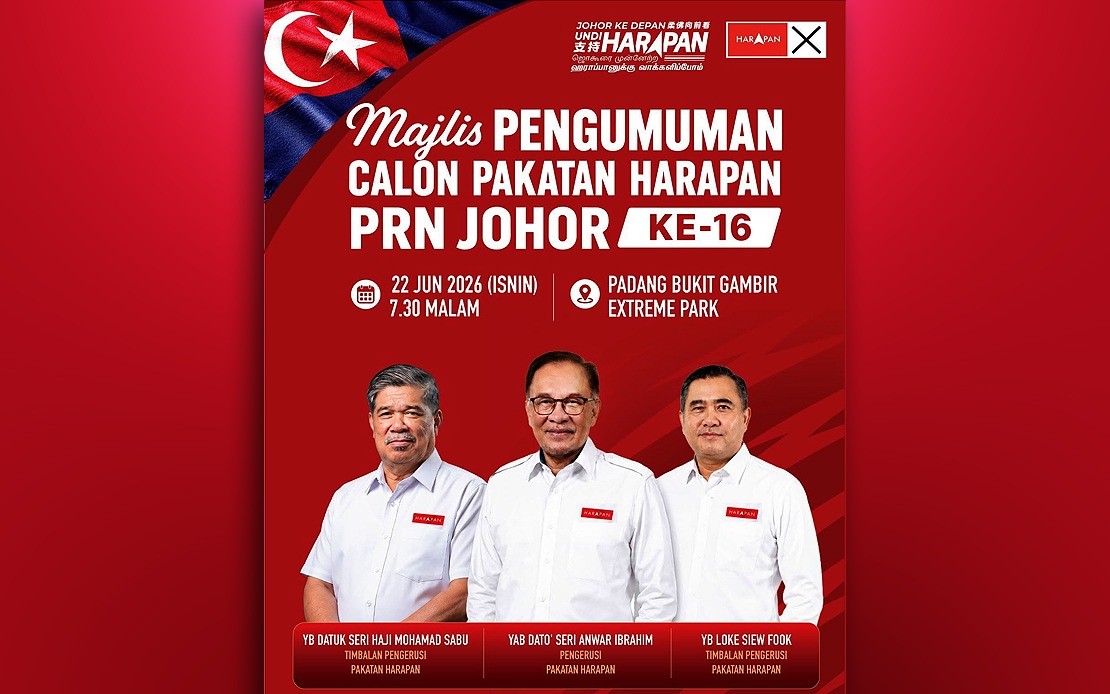
Pakatan Harapan is preparing to roll out its election manifesto for the Johor state contest in the coming weeks, with PKR vice president Datuk Seri Amirudin Shari indicating the coalition will unveil its platform immediately following the nomination ceremony scheduled for June 27. Speaking at the PH Candidate Announcement Ceremony for the Johor state election held at Padang Bukit Gambir Extreme Park in Tangkak, Amirudin stressed that the coalition's manifesto would not merely outline aspirational promises but would demonstrate proven accomplishments already underway in other states under PH stewardship.
The manifesto, branded under the slogan "Johor Ke Depan" (Johor Moving Forward), represents PH's strategic decision to position itself as a coalition grounded in demonstrable governance experience rather than untested political rhetoric. According to Amirudin, the document will centre on a sweeping development plan that extrapolates from the administration's established performance in three states where PH maintains executive control: Selangor, Penang, and Negeri Sembilan. This approach signals the coalition's attempt to translate regional successes into voter confidence at the state level, leveraging institutional knowledge and policy frameworks already in operation.
The timing of the manifesto release is strategically calculated to maintain campaign momentum. By announcing the platform immediately after June 27, when candidates are formally nominated, PH can capitalize on heightened media attention and public engagement during the early phases of the electoral campaign. The gap between nomination and the manifesto unveiling allows the coalition's policy team final refinements while ensuring the document remains fresh in voters' minds as they begin evaluating their choices. This sequencing also permits candidates to familiarize themselves with the complete policy platform before engaging constituents in substantive campaign discussions.
The attendance of senior PH leadership at the candidate announcement ceremony underscored the coalition's commitment to the Johor contest. Present were PH chairman Datuk Seri Anwar Ibrahim, DAP secretary-general Anthony Loke, Amanah president Datuk Seri Mohamad Sabu, and a roster of other party luminaries. This high-level gathering reflected the significance PH places on recapturing or consolidating control in Johor, a state historically viewed as a cornerstone of Malaysian politics and economic activity. The presence of these figures conveyed unified support for the coalition's electoral strategy and the candidates selected to represent PH across the state's constituencies.
Amirudin's emphasis that the manifesto represents demonstrated achievements rather than unfulfilled pledges reflects broader concerns about credibility in Malaysian electoral politics. By anchoring PH's Johor promises to tangible programs operating in Selangor, Penang, and Negeri Sembilan, the coalition attempts to inoculate itself against criticism that its commitments are merely rhetorical. This approach carries particular weight given Malaysia's fractious political landscape, where voters have grown increasingly sceptical of campaign pledges disconnected from track record. The coalition's ability to point to specific initiatives implemented in other jurisdictions provides empirical grounding for its electoral pitch.
The electoral timeline for the Johor state election has been firmly established by the Election Commission (EC). Beyond the June 27 nomination day, the EC designated July 7 as the early voting date and July 11 as the main polling day. This compressed schedule compresses the official campaign period to roughly two weeks, requiring parties to mount rapid, efficient outreach efforts. The truncated timeframe elevates the importance of pre-campaign positioning, including the release of comprehensive manifestos that distil party platforms into digestible form for voters with limited engagement opportunities.
For Malaysian readers and Southeast Asian observers, the Johor election carries significance extending beyond state-level politics. As the nation's second-largest state by population and a crucial economic hub, Johor's political complexion influences national political dynamics and investor confidence. The contest between PH and competing coalitions will test whether the federal administration can translate its national mandate into success at the subnational level, a crucial barometer of political stability and governance effectiveness. Additionally, Johor's outcome may reshape the regional balance of power within Malaysian federalism, affecting resource allocation, infrastructure development priorities, and the state's policy autonomy.
The invocation of success stories from Selangor, Penang, and Negeri Sembilan reflects an implicit acknowledgment that Johor presents distinct governance challenges requiring adaptation of proven models rather than wholesale replication. Each state operates within different fiscal constraints, demographic compositions, and developmental priorities. Selangor's role as an industrial and commercial powerhouse differs substantially from Penang's focus on technology and tourism or Negeri Sembilan's smaller, more dispersed economy. The manifesto's credibility will therefore depend partly on how thoroughly it articulates contextual adjustments to policies that have succeeded elsewhere, demonstrating both continuity with PH's broader governance philosophy and sensitivity to Johor-specific conditions.
The coalition's confidence in releasing a comprehensive manifesto before polling day stands in contrast to some electoral strategies emphasizing flexibility and responsive positioning. By committing to a detailed policy platform weeks in advance, PH signals confidence in its platform's electoral appeal and willingness to be held accountable for specific commitments. This approach carries both advantages and risks: it provides voters with substantive material for informed decision-making and establishes clear governance expectations, but it also creates fixed targets for opposition criticism and limits the coalition's ability to pivot messaging based on emerging campaign dynamics.
Looking ahead to the actual campaign phase beginning after nomination day, the manifesto's reception and effectiveness will depend significantly on how candidates and party machinery communicate its themes to diverse constituencies. Urban voters may prioritize economic growth and technology initiatives, while rural constituents emphasize agricultural support and rural infrastructure. The manifesto must address these variegated interests without appearing internally contradictory or opportunistically tailored to each audience. PH's ability to articulate a coherent vision that resonates across Johor's geographic and demographic breadth will substantially influence the election's outcome and the coalition's capacity to govern effectively should it secure the mandate.