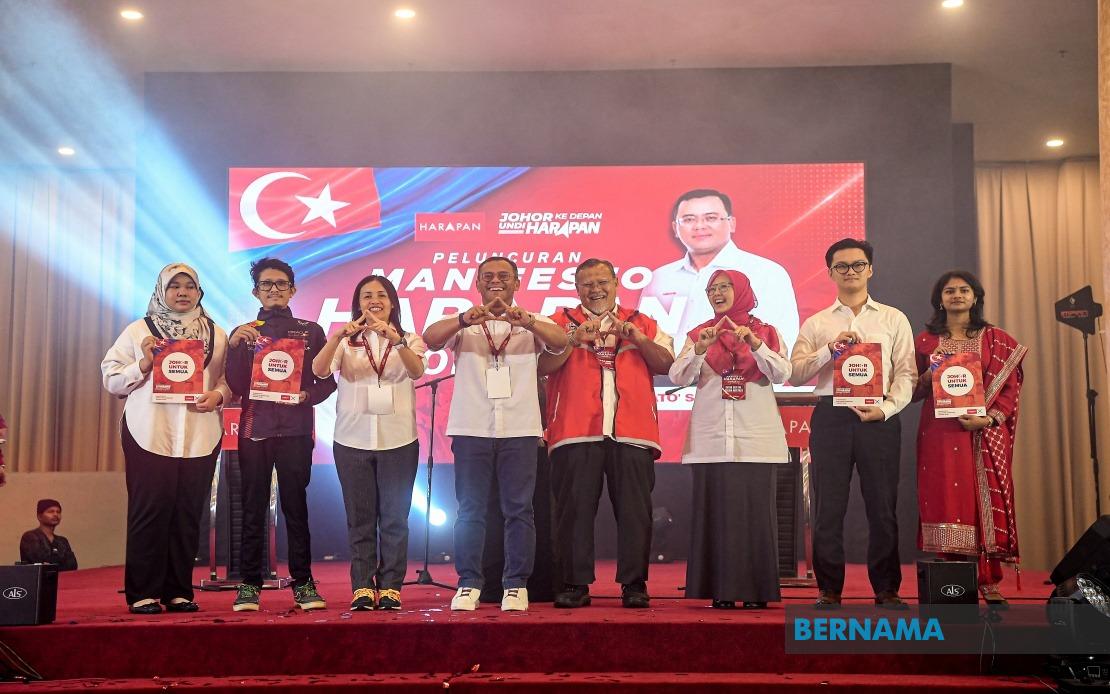
Pakatan Harapan has anchored its campaign strategy in Johor on a straightforward argument: judge us by what we have already delivered. Speaking at the launch of the coalition's "Johor for All" manifesto in Johor Bahru on July 3, the coalition's state chairman Aminolhuda Hassan made the case that voters should view the party's previous 100-day manifesto from the period following the 14th General Election as evidence of its commitment to executing what it promises. This appeal to electoral memory comes as PH contests all 56 state seats in the upcoming polls scheduled for July 11.
The specific initiatives that PH completed during its previous tenure in the state have become central to the narrative the coalition is presenting to Johor voters. Among the ten flagship programmes accomplished were constitutional amendments that capped the Menteri Besar's tenure at two terms, a move aimed at preventing indefinite consolidation of executive power at the state level. The coalition also introduced the Johor Health Card, a public health initiative designed to improve healthcare accessibility, and put in place an open tender system intended to increase transparency in government procurement practices. Additionally, PH implemented a provision guaranteeing ten cubic metres of free water monthly to qualifying households, a policy touching on one of the basic necessities that directly affects family budgets.
Beyond these flagship measures, the previous PH administration established what it described as a comprehensive social welfare architecture. A takaful scheme specifically designed for senior citizens provided religious-aligned insurance protection for elderly residents. The state rolled out higher education incentives to support young people pursuing tertiary qualifications, while hawkers operating in the informal economy received exemptions from licence fees to ease their operational costs. For residents of People's Housing Project units struggling with rental arrears, PH implemented a 50 per cent discount on outstanding payments, a measure targeting lower-income households. The coalition also introduced a vertical government quota, a policy promoting equitable representation, and established marriage incentives aimed at encouraging family formation among younger Malaysians.
Aminolhuda's argument carries particular weight in Malaysian politics because delivery on campaign promises remains a volatile electoral issue. Unlike federal politics where power often shifts between coalitions, state-level governance allows voters to directly assess whether pledges made during campaigns have materialised into tangible policy changes and public benefits. By systematically cataloguing completed initiatives rather than making aspirational claims, PH seeks to distinguish itself from rival coalitions that may lack equivalent track records of implementation. The specificity of the claims—naming exact programmes and their beneficiary groups—suggests an attempt to ground the campaign narrative in verifiable facts that voters may personally have experienced.
The composition of the leadership team present at the manifesto launch underscored the coalition's unified approach. Alongside Aminolhuda, the event featured PH Presidential Council member Datuk Seri Amirudin Shari, who brings federal-level institutional weight to the campaign. PKR secretary-general Datuk Dr Fuziah Salleh, Johor DAP chairman Teo Nie Ching, and Johor PKR chairman Datuk Seri Dr Zaliha Mustafa represented the coalition's constituent parties, signalling that campaign messaging emanated from the entire alliance rather than any single component party. This multi-party presence carries significance in Malaysian coalition politics, where factional tensions between alliance members occasionally undermine unified messaging.
Aminolhuda connected the state campaign directly to the federal government's trajectory under Prime Minister Datuk Seri Anwar Ibrahim. He expressed confidence that the leadership that would emerge from the July 11 election would continue the developmental work initiated at the federal level and maintain fidelity to the manifesto commitments being launched. This rhetorical linkage between state and federal performance attempts to leverage positive sentiment toward the national administration to bolster PH's standing in Johor, though it simultaneously ties state campaign fortunes to federal government popularity, a double-edged strategic proposition.
The timing of the manifesto launch on July 3, just eight days before the election, reflects standard campaign choreography in Malaysian elections, where such documents are typically released in the final stretch to shape voter perceptions in the critical period immediately preceding polling day. The manifesto's branding as "Johor for All" suggests an attempt to position the coalition as transcending divisive identities and appealing broadly across demographic and geographic segments within the state. This inclusive messaging strategy has become increasingly common in Malaysian electoral campaigns as parties attempt to broaden their voter coalitions beyond traditional support bases.
For Johor voters evaluating whether to return PH to power or grant the mandate to rival coalitions, the central question becomes whether past performance constitutes a reliable predictor of future governance. The coalition's emphasis on delivery metrics implicitly acknowledges that Malaysian voters increasingly demand concrete evidence of competence rather than relying on ideological alignment or party loyalty. This shift toward performance-based electoral judgement has gradually reshaped how political parties construct their campaign narratives, with greater emphasis on quantifiable results and demonstrable policy implementation.
The call for strong voter turnout on July 11 represents a standard feature of Malaysian electoral campaigns, as all competing coalitions seek to mobilise their core supporters. However, turnout patterns in state elections often differ significantly from federal contests, with lower participation rates sometimes shifting electoral outcomes in unexpected directions. For PH, securing the mandate to form the state government requires not merely convincing voters that it performed well previously, but translating that assessment into the actual votes needed to win a parliamentary majority among the 56 contested seats.

