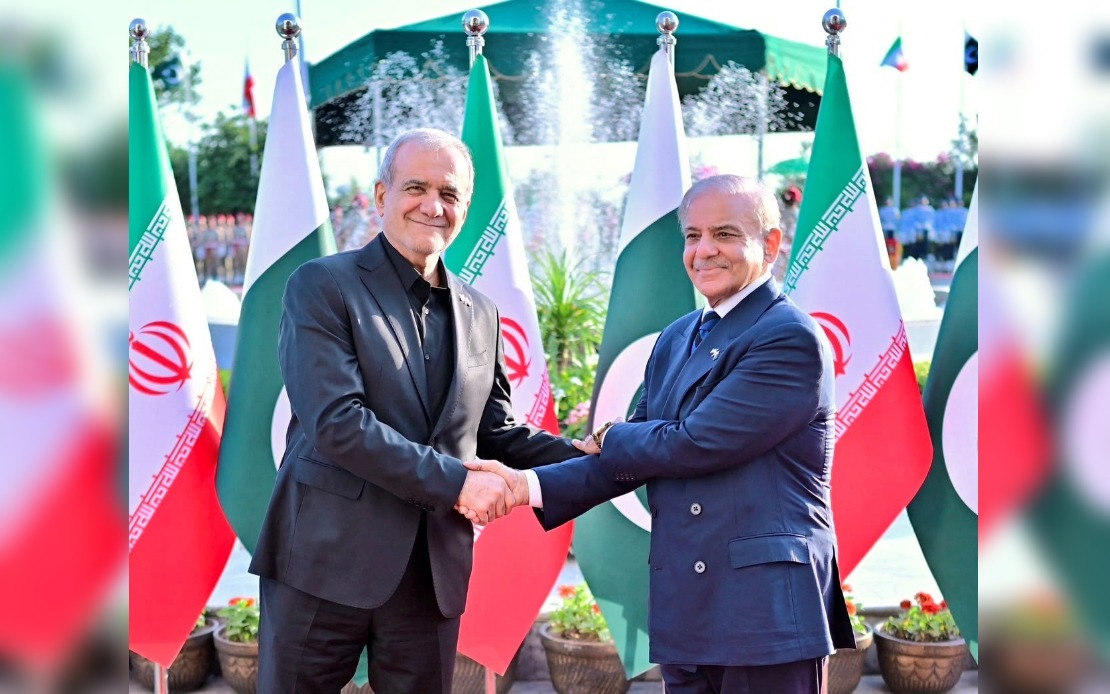
Pakistan's Prime Minister Shehbaz Sharif has firmly backed Iran's right to maintain and develop ballistic missiles, using the occasion of Iranian President Masoud Pezeshkian's state visit to Islamabad to challenge what he characterised as double standards in international arms policy. The statement underscores Pakistan's strategic alignment with Iran at a delicate moment in West Asian geopolitics, where tensions between Tehran and Western powers continue to simmer despite recent diplomatic breakthroughs.
Speaking during bilateral discussions with Pezeshkian and his delegation, Shehbaz emphasised that the ballistic missile question was conspicuously absent from the memorandum of understanding reached between Iran and the United States on June 17. This clarification carries significance for regional observers seeking to understand the scope and limitations of the recent peace arrangement brokered partly through Pakistani mediation. The prime minister's assertion that missile capabilities remained off the negotiating table contradicts suggestions from some quarters that Iran may have made concessions on its defence infrastructure as the price for de-escalation.
Shehbaz articulated a principled critique of selective weapons policies, rejecting the notion that Iran should face restrictions that do not apply universally across the international system. His argument reflects broader resentments within the developing world regarding perceived hypocrisy in global arms control regimes, where permanent Security Council members and their allies maintain extensive arsenals while other nations face censure for comparable programmes. This rhetorical stance appeals to Iran's domestic audience and to non-aligned nations watching the crisis unfold, signalling that Pakistan views Iran's security concerns as legitimate and proportionate.
The context informing Pakistan's position includes Iranian apprehensions about its vulnerability following military strikes attributed to Israel and the United States on February 28. Tehran regards its ballistic missile capability as the foundational pillar of its deterrence posture, a guarantee against the kind of surgical strikes that have damaged its military infrastructure. From Tehran's perspective, surrendering or constraining this capability would invite precisely the type of foreign military intervention that has destabilised neighbouring Iraq and Gaza. Pakistan's public support therefore provides psychological reassurance to Iranian leadership that its strategic choices enjoy backing from a significant regional power.
Pakistan's mediation role in facilitating both the temporary ceasefire in April and the subsequent US-Iran understanding in June represents a considerable diplomatic achievement for Islamabad, elevating its standing as an honest broker in a region fractured by competing interests. Shehbaz specifically acknowledged the contributions of Deputy Prime Minister Ishaq Dar and Field Marshal Syed Asim Munir, the Chief of Army Staff, underscoring that military and civilian leadership coordinated the diplomatic initiative. This internal coordination matters for Malaysian and Southeast Asian observers, as it demonstrates how Pakistan's institutional structures can be marshalled toward peace-building despite the country's own internal challenges.
Pezeshkian's response reinforced Iran's unwillingness to negotiate away its defensive capabilities under any circumstances. The Iranian president stated plainly that without such missiles, Israel and the United States would have mounted the kind of overwhelming offensive that has devastated Gaza, with no regard for civilian casualties. His language evoked the suffering of Palestinians to justify Iranian military preparedness, linking Iran's defence posture to a broader struggle against what Tehran characterises as imperial aggression. This framing resonates with anti-colonial sentiment across the Muslim world and among countries sceptical of Western military dominance.
The elaborate ceremonial reception accorded to Pezeshkian—including an escort of six Pakistani Air Force fighter jets, a 21-gun salute, and formal receptions from both Prime Minister Shehbaz and President Asif Ali Zardari—signalled Pakistan's intention to publicly demonstrate solidarity with Iran. Such pageantry serves multiple audiences: it reassures Iranian leadership of Pakistan's commitment to the relationship, signals to the international community that Islamabad maintains independent foreign policy, and shores up domestic support among Pakistani constituencies sympathetic to Iran. The optics matter as much as the substantive discussions in international relations, particularly in a region where symbolic gestures carry outsized significance.
US President Donald Trump's recent public acknowledgement that Iran should be permitted ballistic missiles, made during remarks in Paris on June 17, lends credibility to Pakistan's argument that the weapons question lies outside the MoU parameters. Trump's statement that "if other countries have them, it is a little bit unfair for them not to have some" represents a notable departure from the official position of previous administrations and even aspects of his own foreign policy establishment. This American flexibility may reflect pragmatic calculations that Iran's missile programme is irreversible and that insisting on its elimination would prove counterproductive to broader diplomatic objectives.
Shehbaz also warned of what he termed "spoilers" attempting to derail the peace process, an oblique reference to regional actors opposed to US-Iran rapprochement. While the prime minister did not name specific countries, his allusion to Israel as "the biggest obstacle to peace in West Asia" reflected frustrations shared by many governments regarding Israeli military operations in Lebanon and occupied Palestine. Pakistan's identification of spoilers reflects concern that the fragile understanding could unravel if hardliners on either side exploit provocation or miscalculation to reignite confrontation.
For Malaysia and other Southeast Asian nations, the Pakistani mediation and Iran's strategic reassurance hold indirect implications for regional stability and global supply chains. Any escalation in West Asia affects energy prices and maritime security in Southeast Asian waters, including the crucial Strait of Malacca through which regional trade passes. Pakistan's success in brokering understanding between Iran and the US demonstrates that middle-power diplomacy remains valuable in managing great-power rivalries, a lesson relevant to ASEAN's own efforts to maintain neutrality and stability amid superpower competition in the Indo-Pacific.
The visit also underscores the resilience of Pakistan-Iran ties despite occasional tensions over border security and sectarian issues. Both nations share an interest in regional stability that benefits their respective development agendas, and Pakistan's investment in mediating the US-Iran crisis reflects recognition that a destabilised West Asia threatens Pakistani interests through refugee flows, extremist recruitment, and energy security. Pezeshkian's reciprocation through this state visit, coupled with his firm statements on missile rights, indicates that Iran values Pakistan's diplomatic partnership and wishes to deepen bilateral engagement beyond the immediate crisis management.
Looking forward, the sustainability of the US-Iran understanding will depend on whether the Trump administration and future administrations can accommodate Iranian security concerns without demanding concessions on capabilities Tehran considers essential. Pakistan's insistence that ballistic missiles remain negotiable sets expectations that could prove difficult to manage if Western powers attempt to introduce weapons limitations into subsequent rounds of talks. The statement thus functions as a cautionary signal to international mediators that Iran will not permit its defence posture to become bargaining currency, a position Pakistan has now endorsed with public statements from its highest leadership.