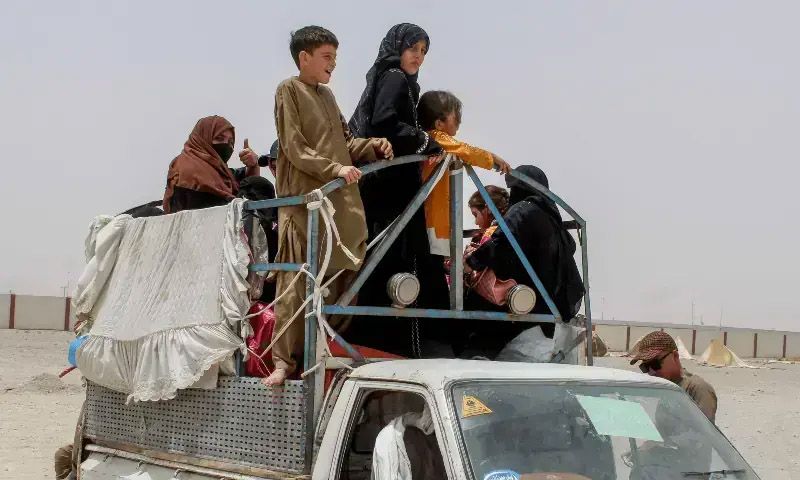
Pakistan's immigration authorities have removed 2.59 million Afghan nationals living illegally within its borders since 2023, marking one of the largest deportation campaigns in the region's recent history. The coordinated effort between federal authorities and provincial governments, particularly in Punjab, reflects Islamabad's determination to enforce stricter migration controls and secure its borders against undocumented foreign populations. The scale of these expulsions underscores the magnitude of Afghanistan's displacement crisis and the mounting pressure on Pakistan's infrastructure and social services following decades of Afghan migration into Pakistani territory.
Punjab province has emerged as the primary focus of this enforcement operation, with the provincial government's foreign national security cell managing the largest portion of deportations. The province operates 36 functional holding centres where undocumented Afghans are processed before being returned across the border. Within these facilities, authorities complete necessary documentation and coordinate logistics for the deportation process. To date, Punjab alone has detained and subsequently deported 138,342 Afghan nationals, demonstrating the administrative scale of what amounts to a mass migration reversal operation affecting millions of people.
The government's rationale for this campaign centres on immigration law enforcement. Officials maintain that individuals without valid visa documentation lack legal status to remain in Pakistan and must be removed. This position represents a hardening of Islamabad's approach to its historically permissive stance toward Afghan refugees and migrants, many of whom have resided in Pakistan for generations. The shift reflects changing domestic political pressures, resource constraints, and border security concerns that have prompted Pakistani policymakers to prioritise stricter compliance with immigration regulations.
Operational procedures established by the home department outline a systematic approach to identification and deportation. Teams have conducted comprehensive surveys across markets and residential areas, targeting locations where undocumented Afghans are believed to congregate. Upon identification, individuals are detained and transported to holding centres where authorities register them and arrange repatriation through the Torkham border crossing, the primary land route between Pakistan and Afghanistan. This procedural framework attempts to balance enforcement with humanitarian considerations by providing detained individuals with accommodation and facilitating orderly repatriation rather than ad hoc expulsions.
The holding centres currently maintain approximately 53 undocumented Afghan detainees awaiting processing and deportation. While this number may appear modest compared to the cumulative deportation figures, it reflects the ongoing nature of enforcement operations. The continued presence of detainees in these facilities suggests that the government views deportation as a prolonged operation rather than a completed campaign, indicating that more undocumented Afghans may remain within Pakistani territory. The home department has indicated its intention to sustain and expand these activities, suggesting that the 2.59 million figure may increase as operations continue.
For Malaysian observers, this situation carries significant implications for understanding regional migration dynamics and the pressures facing countries hosting large displaced populations. Pakistan's shift toward stricter enforcement demonstrates how even historically welcoming nations may eventually implement restrictive measures when migration reaches critical mass. The economic burden of hosting millions of undocumented migrants, combined with security concerns and domestic political opposition, has created conditions prompting Islamabad to pursue aggressive repatriation regardless of humanitarian consequences. This pattern is instructive for Southeast Asian nations managing their own refugee and migrant populations.
The repatriation process itself raises complex questions about whether Afghanistan's infrastructure can absorb millions of returning migrants simultaneously. Torkham, while a substantial border crossing, has limited daily processing capacity, and Afghanistan's conflict-ravaged economy offers few opportunities for returning migrants to rebuild lives. Pakistan's determination to proceed with large-scale deportations despite these challenges reflects a prioritisation of border control and domestic resource allocation over the welfare of deportees, a tension that Malaysian policymakers may confront as migration pressures in Southeast Asia intensify.
Public participation forms another dimension of Pakistan's enforcement strategy. The home department has requested that residents report undocumented Afghans to emergency telephone line 15, establishing a community-based surveillance mechanism. Officials have assured informants that their identities will remain confidential, attempting to encourage cooperation without exposing citizens to potential retaliation. This approach reflects a recognition that detecting undocumented populations through official surveillance alone proves insufficient, necessitating public engagement in the identification and reporting process.
The timing and scale of these deportations occur within a broader context of Pakistan's deteriorating relationship with Afghanistan's Taliban-led government. While diplomatic relations nominally exist, underlying tensions regarding border security, militant sanctuaries, and historical disputes have strained cooperation. Pakistan's unilateral deportation campaign proceeds without apparent coordination with Kabul, suggesting that Islamabad has prioritised its domestic interests over bilateral relations. This approach risks further straining ties between the two neighbours and complicates efforts to address the underlying drivers of Afghan migration into Pakistani territory.
The humanitarian dimension of this operation warrants consideration. While Pakistan characterises deportations as law enforcement, the reality affects vulnerable populations including women, children, and families who may have lived in Pakistan for decades. The Taliban government in Afghanistan has limited capacity to reintegrate returning migrants into functioning civilian society, particularly given the ongoing humanitarian crisis within the country. International humanitarian organisations have expressed concern about the consequences of forced repatriation, though their interventions have proven insufficient to alter government policy.
This precedent may influence migration management approaches throughout South and Southeast Asia. As countries experience migration pressures, the success or failure of Pakistan's mass deportation strategy will inform policy discussions elsewhere. If the operation proceeds without international consequences and achieves its intended reduction in undocumented populations, other nations may adopt similar approaches. Conversely, if humanitarian costs become politically untenable or if security and economic challenges persist despite deportations, alternative strategies may gain favour among policymakers seeking more sustainable solutions to regional migration challenges.

