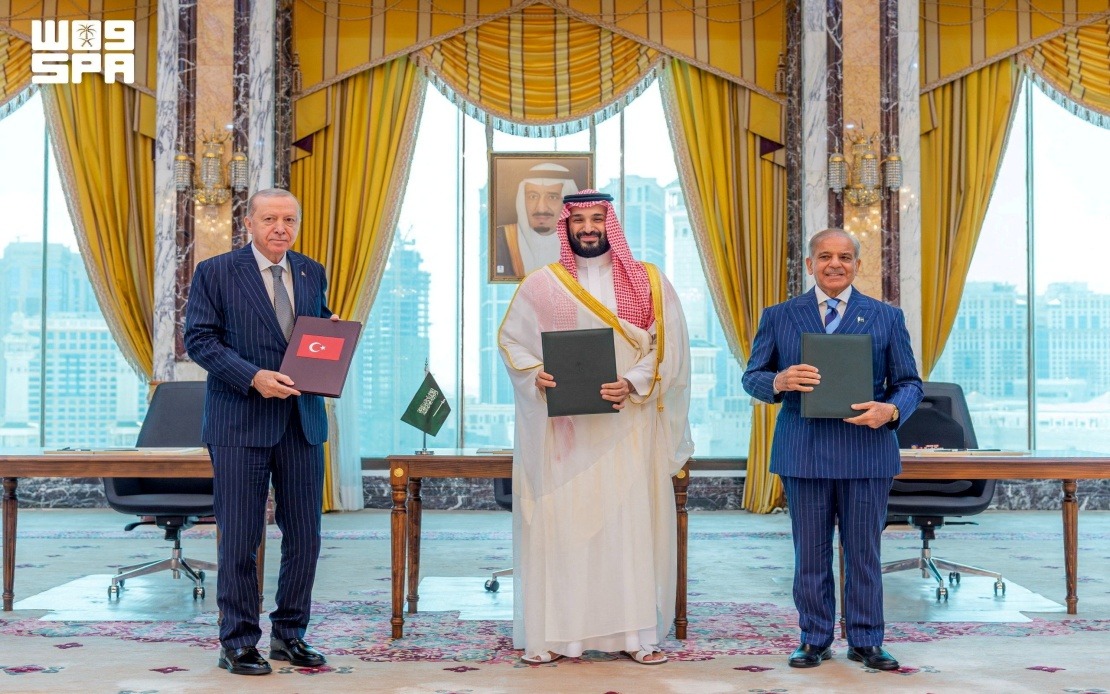
The leaders of Pakistan, Saudi Arabia and Türkiye have completed negotiations on a sweeping collective defence compact, signed at Al Safa Palace in Makkah on Friday. Saudi Crown Prince Mohammed bin Salman bin Abdulaziz Al Saud, Pakistani Prime Minister Shehbaz Sharif and Turkish President Recep Tayyip Erdogan jointly endorsed the Joint Defence Agreement following their trilateral summit, marking a significant realignment of security partnerships across the Muslim-majority nations of South Asia and the Middle East.
Central to the pact is a binding commitment that any armed assault directed against one of the three signatory states will be treated as an attack upon all three. This principle of mutual defence obligation represents a substantial escalation in the depth of security cooperation among nations that have long maintained bilateral defence ties but have historically operated within distinct geopolitical orbits. The agreement encompasses far more than symbolic solidarity, establishing concrete mechanisms for enhancing defence cooperation across multiple domains and operational theatres.
For Malaysian observers, the trilateral arrangement carries particular significance given the region's fluid security environment and the rising interconnectedness of threats spanning terrorism, maritime security, and strategic competition. Pakistan's status as one of nine nuclear-armed countries on the global stage lends considerable weight to any collective defence framework it enters, while Saudi Arabia and Türkiye represent the most influential regional powers in their respective domains. The pact therefore signals the emergence of a coordinated security bloc with genuine deterrent capacity.
The three governments have emphasised through their joint statement that the agreement reflects shared aspirations to reinforce collective security architecture while advancing peace and stability throughout the broader region and beyond. This language suggests ambitions extending beyond the immediate trilateral relationship to encompass influence over regional security dynamics more broadly. The signatories specifically frame their commitment as oriented toward building a prosperous and secure future, positioning the defence pact within a wider developmental and diplomatic framework rather than as a purely defensive reaction to external threats.
Saudi Arabia's deputy public diplomacy minister, Rayed Krimly, offered clarification through a statement on the social media platform X, detailing that the agreement empowers the member states to construct integrated defence capabilities while strengthening strategic deterrence and operational readiness. Krimly's intervention underscores official determination to shape the narrative around the pact, particularly regarding how neighbouring and international actors might interpret its implications. He was explicit in asserting that the arrangement poses no menace to regional security broadly and should not be construed as an escalatory step between any two states.
The three nations bring complementary strategic assets to their collective arrangement. Pakistan contributes military manpower and nuclear capability alongside its positioning as a bridge between South Asian and Middle Eastern security concerns. Türkiye offers sophisticated defence technology, NATO interoperability experience, and geographic significance straddling Europe and Asia. Saudi Arabia provides financial resources, regional influence, and a leadership role within the Gulf Cooperation Council framework. Together they form a constellation capable of addressing diverse security challenges across maritime domains, counterterrorism operations, and potential interstate conflicts.
This latest agreement builds upon existing bilateral defence frameworks between the parties. Pakistan and Saudi Arabia previously formalised their own defence compact in September of the preceding year, establishing reciprocal obligations to provide military assistance should either face external aggression. The expansion to a trilateral format multiplies the complexity and potential impact of these commitments, creating a network of mutual obligations that could reshape regional security calculations. Turkey's inclusion particularly broadens the geographic and strategic scope, connecting the Middle Eastern security environment more directly to developments in the Eastern Mediterranean and Central Asia.
The timing of the pact reflects broader geopolitical trends within Muslim-majority nations, where traditional Cold War alignments have fractured and new partnerships have emerged. Pakistan's historical defence partnerships with both Türkiye and Saudi Arabia provided the foundation for this expansion, yet formalising collective defence obligations represents a qualitative shift. The agreement suggests these three capitals have concluded that coordinated security strategy serves their respective interests more effectively than unilateral or purely bilateral approaches.
For Southeast Asia, including Malaysia, the development warrants careful observation. The trilateral bloc's orientation toward regional stability and prosperity alignment with ASEAN principles, though potential overlaps in security challenges—particularly concerning maritime security, counterterrorism and great power competition—create opportunities for dialogue and coordination. The pact also demonstrates how major regional powers construct collective security frameworks outside existing multilateral organisations, a pattern potentially relevant as Asian nations navigate complex security environments.
The agreement's emphasis that it neither threatens neighbouring countries nor represents escalatory posturing reflects awareness of sensitivities surrounding security blocs in a region already inhabited by multiple overlapping great powers. China, Russia and the United States maintain substantial interests across South Asia and the Middle East, necessitating careful messaging from the three signatories to avoid triggering counterbalancing responses. The defensive framing of the pact as genuinely protective rather than aggressive represents standard diplomatic practice but also indicates genuine concern about regional reactions.
Implementation mechanisms remain to be detailed through subsequent military-to-military engagement channels. The agreement's value ultimately depends upon how substantially the three nations integrate their defence planning, share intelligence, conduct joint exercises and align operational doctrines. The joint commitment to enhance all aspects of defence cooperation suggests an ambitious agenda extending well beyond ceremonial declarations. Success will require overcoming potential coordination challenges across different military structures, procurement systems and strategic cultures.
The pact arrives amid ongoing regional volatility affecting all three signatories. Pakistan confronts persistent terrorism and border security challenges; Saudi Arabia navigates complex dynamics in Yemen, the Persian Gulf and relations with Iran; Türkiye manages security concerns across multiple frontiers. A genuine collective defence framework could amplify their individual capacities to address these challenges, though divergent national interests may constrain unified responses to particular crises. The agreement's true test will come if circumstances arise requiring invocation of its mutual defence provisions.

