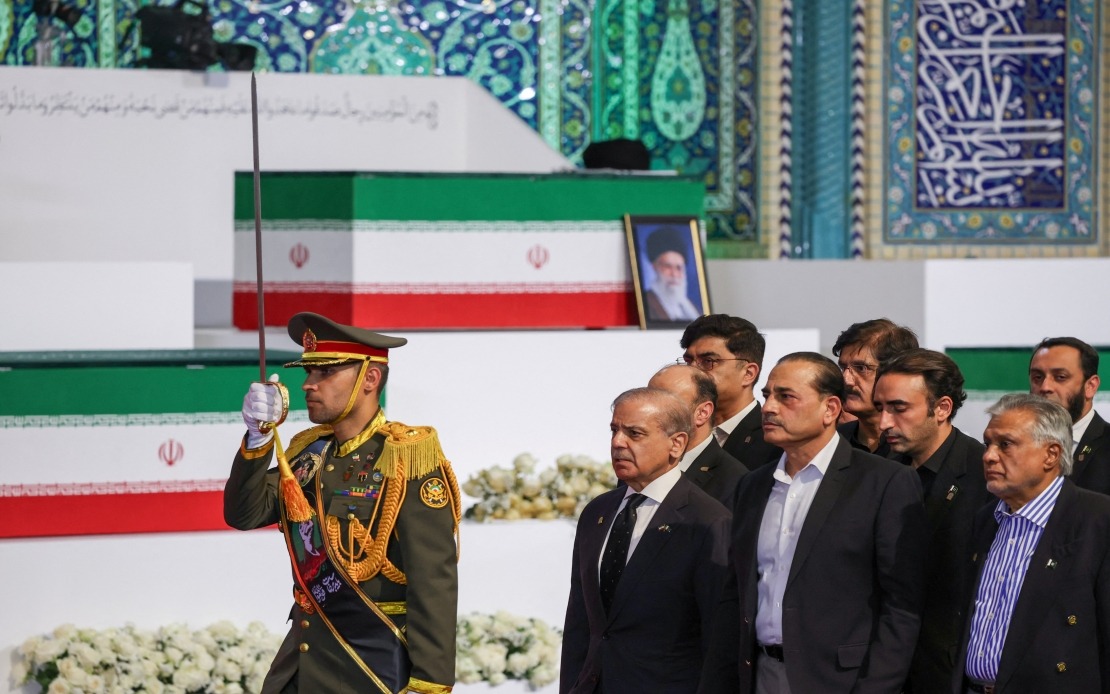
Pakistan's government signalled its commitment to strengthening ties with Iran by dispatching an exceptionally high-level delegation to the funeral of Supreme Leader Ayatollah Ali Khamenei in Tehran on Friday, a gesture that drew widespread commendation from Iranian officials. The scale and seniority of Islamabad's representation at the ceremony underscored the strategic importance both nations place on their relationship at a moment when regional dynamics remain fluid following the February 28 attack on Khamenei's compound.
Iran's Ambassador to Islamabad, Reza Amiri Moghadam, publicly acknowledged Pakistan's participation in unusually effusive terms, describing the delegation as both the most numerous and highest-ranking contingent from any single nation at the funeral proceedings. This distinction carries symbolic weight in diplomatic circles, where attendance size and rank often communicate the sending country's view of bilateral relationships. Moghadam's remarks, posted on social media platform X, stressed that Pakistan's presence reflected "enduring friendship, mutual respect, and fraternal bonds between our two brotherly nations," language that goes beyond routine diplomatic courtesy.
Prime Minister Shehbaz Sharif led the Pakistani delegation, which reflected the breadth of the country's civilian and military leadership. The team included Deputy Prime Minister and Foreign Minister Ishaq Dar, whose portfolio makes him a key architect of Pakistan's foreign policy; Army Chief Field Marshal Syed Asim Munir, underscoring the military's central role in Pakistan's strategic calculations; National Assembly Speaker Sardar Ayaz Sadiq; Interior Minister Mohsin Naqvi; Information Minister Attaullah Tarar; and Pakistan People's Party chairman Bilawal Bhutto Zardari, representing major political forces. This cross-sectional representation signalled that Pakistan's Iran policy commands consensus across institutional and partisan divides.
The funeral drew mourners and official representatives from approximately 100 nations, reflecting Khamenei's significance as a regional and global figure. Among the countries represented were Malaysia, Bangladesh, Saudi Arabia, Turkiye, Qatar, Oman, Egypt, Russia, Iraq, China and India, forming a cross-section of Middle Eastern, Asian and global powers. The attendance list itself revealed the geopolitical salience of Iran and the funeral's role as a moment when regional and international actors could signal their positions on Tehran at a critical juncture.
Khamenei, who had served as Iran's Supreme Leader since 1989, died in the February 28 attack alongside several family members. The assault marked a significant breach of Iran's security apparatus and triggered considerable uncertainty about succession and Iran's regional posture. The funeral ceremony thus transcended a routine state function to become a measure of international sentiment toward the Iranian system and an occasion for bilateral relationship-building among attending nations.
Sharif used his presence at the ceremony to pay personal homage to Khamenei, praising his "wisdom, leadership and profound influence on Iran and the wider region," and noting that his legacy would endure for generations. Such remarks, delivered at a solemn state occasion, carry weight beyond ceremonial convention—they represent a sitting prime minister's formal statement of respect for the deceased leader and implicitly, endorsement of Iran's political continuity. For Pakistan, which shares a long border with Iran and navigates complex relationships with multiple Middle Eastern powers, such positioning reflects careful calibration.
Iran's observance of its Supreme Leader's death extended over several days, with public funeral ceremonies commencing on Saturday and the burial scheduled for July 9 in Mashhad, Khamenei's birthplace. This extended ritual underscored the significance of the succession moment and allowed for the gathering of international delegations over a structured timeframe. For Islamabad, the timing and depth of participation allowed for multiple touch points with Iranian leadership during a sensitive transition.
The diplomatic significance of Pakistan's delegation extends beyond ceremonial attendance. Iran and Pakistan maintain complex ties encompassing trade, security cooperation, and regional alignment, alongside periodic tensions over border management and the activities of militant groups. Pakistan's military, represented at the funeral by its Chief of Staff, has particular interests in Iran policy given shared security challenges and the need to manage the Pakistan-Iran border effectively. Sharif's presence conveyed civilian commitment to the relationship, while the military's prominent role indicated that defence and strategic matters remain prioritised.
For Malaysia and other Southeast Asian nations attending the funeral, Pakistan's prominent positioning offered insight into how a neighbouring Muslim-majority state with significant geopolitical weight approaches Iran relations. Malaysia's own attendance reflected the Islamic world's broader engagement with Iran as a significant Muslim power, irrespective of sectarian differences. Pakistan's decision to send its most senior available figures suggested that regional consensus, particularly among non-Arab Muslim states, favoured maintaining strong diplomatic channels with Tehran during this transition period.
The ambassador's emphasis on "historic ties and shared values" between Pakistan and Iran roots the contemporary relationship in deeper historical currents. Both nations emerged from the collapse of British imperial rule, share Islamic heritage, and have parallel experiences navigating Cold War pressures and post-Cold War regional realignment. Yet Pakistan's ties with Saudi Arabia and the United States complicate straightforward alignment with Iran, making Pakistan's funeral representation a careful statement of balancing multiple relationships.
Looking forward, Pakistan's visible commitment at Khamenei's funeral may facilitate smoother engagement with Iran's post-succession leadership. Diplomatic relationships often benefit from gestures made during moments of institutional transition, as new Iranian leaders take office mindful of who stood with their predecessor's memory. For Pakistan, investing in this relationship serves medium-term strategic interests in regional stability and trade, particularly as Pakistan seeks to manage its own economic and security challenges.

