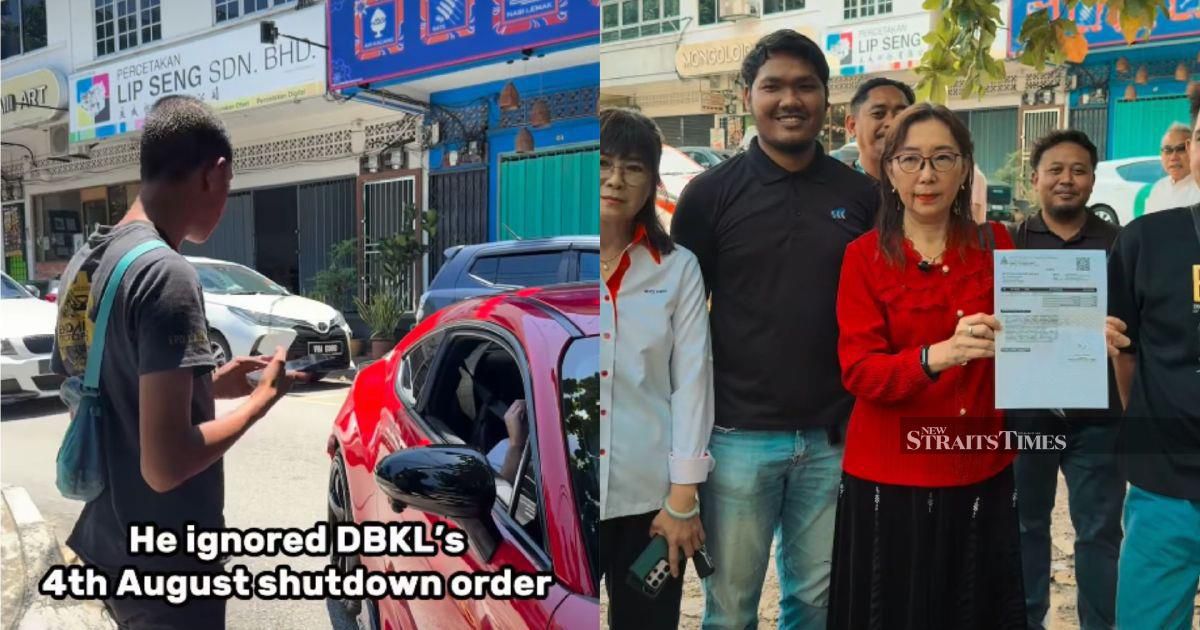
An unlicensed parking collector operating in Taman OUG has been taken into custody following a heated confrontation with a municipal enforcement officer. The incident, which occurred along Jalan Hujan, highlights the ongoing struggle between city authorities and informal parking operatives who continue to collect fees from motorists without proper licensing or authorization. The arrest came after the individual repeatedly disregarded multiple enforcement notices issued by the relevant authorities, suggesting a pattern of defiant behaviour against regulatory attempts to curb illegal street-level commerce.
The operation that led to the arrest was part of a broader enforcement drive targeting unauthorised parking collection activities, which remain endemic across Kuala Lumpur's residential and commercial areas. These unregulated operators, commonly referred to as parking touts, occupy street spaces and demand payment from drivers without holding any legitimate right to do so. They represent a significant source of public grievance, as their presence creates ambiguity for motorists uncertain whether they are dealing with legitimate parking attendants or criminals extracting informal levies. The proliferation of such activities has prompted municipal authorities to intensify crackdowns in problematic hotspots.
The alleged assault during the enforcement action raises serious questions about the volatility that can erupt when officers attempt to enforce regulations against entrenched informal operators. Confrontations of this nature underscore the challenging operational environment faced by municipal enforcement teams, who must balance firmness in upholding regulations with personal safety when encountering resistance. The incident in Taman OUG is unlikely to be isolated, as enforcement actions nationwide frequently result in verbal altercations or physical resistance from individuals whose informal livelihoods are threatened by such operations.
Taman OUG, situated in the federal territory, has been a recurring focus of enforcement concerns. The area's mix of residential densities, commercial activity, and proximity to transportation nodes creates conditions favourable for such informal service provision. Motorists in the vicinity often find themselves approached by parking collectors who stake territorial claims over sections of road, effectively creating a parasitic layer between vehicle owners and any official parking management system. The authorities' continued efforts to clear such operations reflect broader municipal governance challenges in managing public spaces and regulating informal economic activity.
The practice of unlicensed parking collection operates across clear legal boundaries. Malaysia's municipal bylaws explicitly prohibit unauthorised individuals from soliciting parking fees, yet enforcement remains inconsistent across different jurisdictions and neighbourhoods. The individuals involved typically earn their livelihood entirely through these informal arrangements, operating without contracts, insurance, or accountability to any formal entity. When enforcement actions target them, the stakes become personal and sometimes combative, particularly among those who view such work as their primary income source and have few alternative employment prospects.
Authoritative responses to parking tout operations have intensified in recent years, reflecting both increased public complaints and municipal determination to restore order to public spaces. The transition from issuing warnings to making arrests signals escalation in enforcement strategy when operators prove unresponsive to earlier interventions. Multiple enforcement notices, as reportedly issued to the Taman OUG individual, constitute documented evidence of persistent non-compliance that justifies stronger action. The alleged assault component adds a criminal dimension that goes beyond regulatory violation and into the realm of obstruction of public duty.
For residents and businesses in affected areas, the elimination of such informal practices carries tangible benefits. The removal of unauthorised parking collectors reduces street-level disorder, eliminates confusion about legitimacy, and contributes to perceptions of municipal effectiveness. However, authorities must also grapple with the social dimension: many parking touts lack formal employment alternatives and depend on this income for survival. This underlying tension between regulatory necessity and economic hardship remains largely unaddressed in enforcement-focused approaches, creating a cycle where operations are disrupted but eventually resurface.
The incident also reflects broader challenges in public space management across Southeast Asian cities, where informal economic actors occupy regulatory grey zones. Kuala Lumpur shares similar experiences with other regional capitals facing comparable parking collection problems. The visibility of such enforcement actions, particularly when they involve video documentation that circulates on social media, serves both deterrent and awareness-raising functions, signalling to the public that authorities are actively tackling such problems while potentially discouraging similar behaviour among other operators.
Moving forward, the arrest at Taman OUG represents a data point in the ongoing enforcement narrative rather than a definitive solution to parking collection informality. While individual arrests address immediate compliance failures, structural change requires complementary strategies such as improved official parking management, alternative employment pathways for displaced operators, and consistent municipal coordination across residential neighbourhoods. Without such holistic approaches, enforcement operations, however well-intentioned, risk becoming repetitive cycles that address symptoms rather than underlying conditions driving informal economic behaviour in urban Malaysia.

