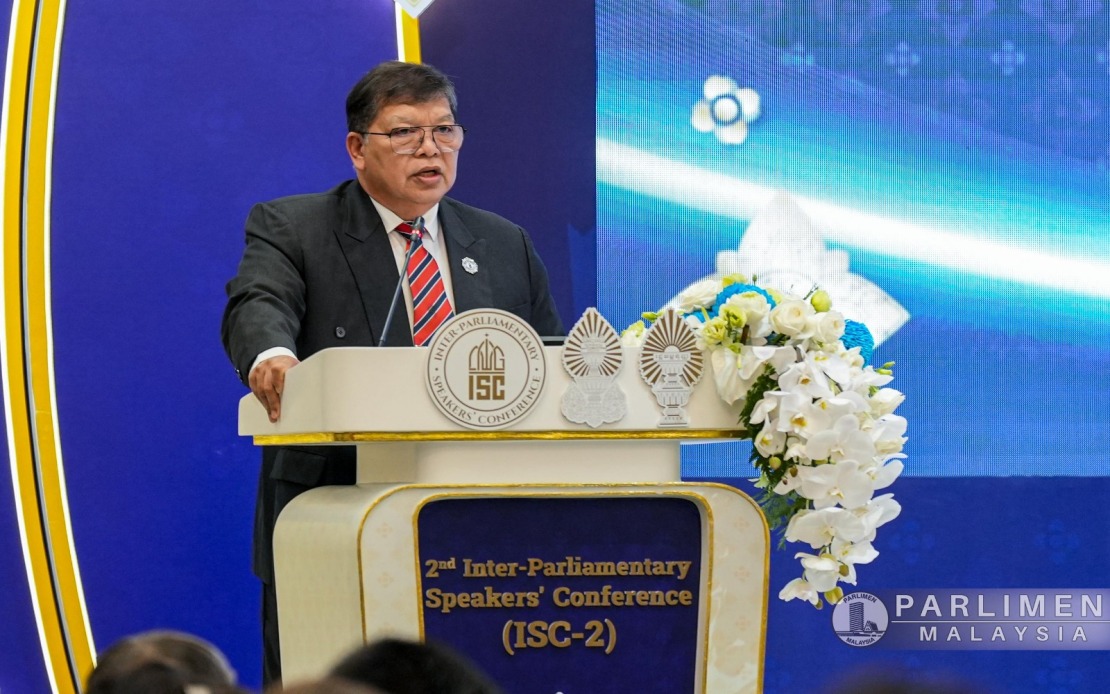
The Dewan Rakyat Speaker has issued a stark warning about the mounting toll of climate change, declaring that inaction is inflicting severe hardship on vulnerable populations and irreversibly altering the planetary ecosystem. Speaking during the Second Inter-Parliamentary Speakers' Conference in Phnom Penh on Friday, Tan Sri Dr Johari Abdul emphasised that the climate emergency can no longer be compartmentalised as merely an environmental challenge, but must be recognised as a multifaceted crisis threatening economic stability, public health infrastructure, and the security of food and energy supplies across the region and beyond.
Johari expressed deep frustration at the apparent complacency among policymakers, highlighting a troubling gap in both political discourse and legislative expertise. He lamented that many world leaders remain silent on the issue, while certain lawmakers lack even basic education on climate dynamics and solutions. His criticism extended to fundamental policy choices, questioning why governments continue to prioritise deforestation when renewable alternatives such as solar, wind, and ocean wave energy remain largely untapped. The Speaker contended that the persistent reliance on coal-fired power generation represents a catastrophic failure of imagination and political will, demonstrating how outdated energy infrastructure perpetuates environmental degradation.
In response to these systemic failures, Johari advocated for a comprehensive reorientation of public investment priorities. He stressed the necessity of embedding climate science education throughout school curricula, ensuring that future generations understand both the urgency of the crisis and the technological pathways toward solutions. Equally critical, he argued, is substantially increased funding for research and development initiatives capable of generating breakthrough innovations in renewable energy, carbon capture, and climate adaptation technologies. Such investments, Johari contended, would equip societies across Asia with the tools necessary to mitigate climate impacts while building economic resilience.
Johari's warnings gain particular resonance when considered against the catastrophic climate-related disasters sweeping across South and Southeast Asia. Nepal experienced a devastating calamity just days before the parliamentary conference when glacial collapse in the Himalayan ranges triggered catastrophic flooding along the Nepal-China border. The preliminary death toll reached 469 confirmed fatalities with 2,381 individuals reported missing, among them 644 foreign nationals. Several Malaysian citizens remain unaccounted for in the disaster, underscoring how climate impacts transcend borders and claim lives among Malaysia's own population. The glacial collapse itself serves as a haunting manifestation of rapidly warming mountain ecosystems, where accelerating ice melt destabilises ancient geological structures.
The vulnerability extends far beyond Nepal's mountainous terrain. Throughout the broader South Asian and Southeast Asian regions, communities inhabiting both rugged highlands and landlocked territories confront recurring waves of climate-induced catastrophes. Rural populations across the Himalayan foothills, the Mekong Basin, and island nations face relentless threats from flash flooding, severe storms, landslides, and tropical typhoons that devastate agricultural production and destroy critical infrastructure. The Philippines alone experiences approximately twenty typhoons annually, a frequency that reflects the region's exposure to tropical cyclone systems intensified by warming ocean temperatures. These recurring disasters disproportionately affect rural and lower-income communities lacking the resources for comprehensive disaster preparedness and recovery.
Johari contextualised the challenge within the broader framework of global inequality and political capacity. He emphasised that climate change represents fundamentally a collective crisis demanding unified international response, yet acknowledged that converting rhetoric into concrete action requires both unprecedented political determination and genuine leadership commitment. The widening gap between wealthy and disadvantaged nations further complicates these efforts, as developing economies lack the financial and technological resources to simultaneously pursue development goals and climate adaptation measures. Without substantial support from industrialised nations, this disparity threatens to deepen existing inequalities while leaving vulnerable populations increasingly exposed to climate hazards.
Notably, Johari cited China's long-term strategic approach to green technology as a model worthy of emulation. China's comprehensive investment in eco-friendly innovations, electric vehicle manufacturing, and expansion of green urban spaces demonstrates how sustained policy commitment can reshape national infrastructure toward sustainability. While China's record on environmental governance remains contested in certain respects, its willingness to mobilise capital and state resources toward renewable energy development illustrates possibilities that other governments might pursue with equivalent determination and resource allocation.
Scientific evidence continues to accumulate, reinforcing the urgency of Johari's warnings. Climate researchers worldwide document accelerating temperature increases, rising sea levels driven by melting polar ice and thermal expansion, and shifting rainfall patterns that destabilise agricultural systems and freshwater availability. These physical changes interact synergistically to increase systemic risks affecting ecosystems, infrastructure, and human populations simultaneously. Southeast Asia faces particular vulnerability given its concentration of low-lying coastal zones, river-delta agriculture, and monsoon-dependent economies.
Cambodian Prime Minister Hun Manet echoed these concerns days before the Phnom Penh conference, warning of rising Mekong River water levels and urging riverine communities to maintain heightened vigilance. While acknowledging the impossibility of completely preventing natural disasters, Hun Manet stressed the essential importance of developing societal resilience and functional early-warning systems capable of responding effectively to climate-related hazards. This pragmatic assessment reflects the reality that mitigation alone remains insufficient; adaptation infrastructure and disaster response capacity require equally urgent development.
The parliamentary conference itself provided a crucial venue for legislative leaders across the Indo-Pacific region to confront climate policy collectively and commit to enhanced action. Johari's interventions during the three-day gathering sought to elevate climate change from peripheral concern to central legislative priority, pushing fellow speakers toward embedding climate considerations within parliamentary operations and budget allocations. His advocacy reflects growing recognition among legislative bodies that democratic institutions must lead rather than follow scientific consensus on existential threats.
For Malaysia specifically, Johari's emphasis on educational investment and technological innovation carries distinct implications. As a tropical nation with significant coastal development, substantial forest resources, and growing urban centres, Malaysia confronts interconnected climate risks spanning sea-level rise, shifting monsoon patterns, and biodiversity loss. The presence of missing Malaysian citizens in Nepal's glacial disaster provides immediate, personal context for understanding climate change not as abstract future risk but as present-day threat claiming regional lives.
The Speaker's advocacy ultimately frames climate action as inseparable from broader development objectives, particularly education and technological capability-building. This framing challenges the false dichotomy between environmental protection and economic progress, suggesting instead that genuine prosperity depends upon rapidly transitioning toward sustainable systems. For parliamentary leaders across Asia, Johari's message carries particular weight: legislative institutions possess both the responsibility and the capacity to reshape economic incentives, education systems, and investment priorities toward climate-resilient futures. Whether sufficient political will emerges to translate such rhetoric into transformative policy remains the defining question facing the region's democracies.

