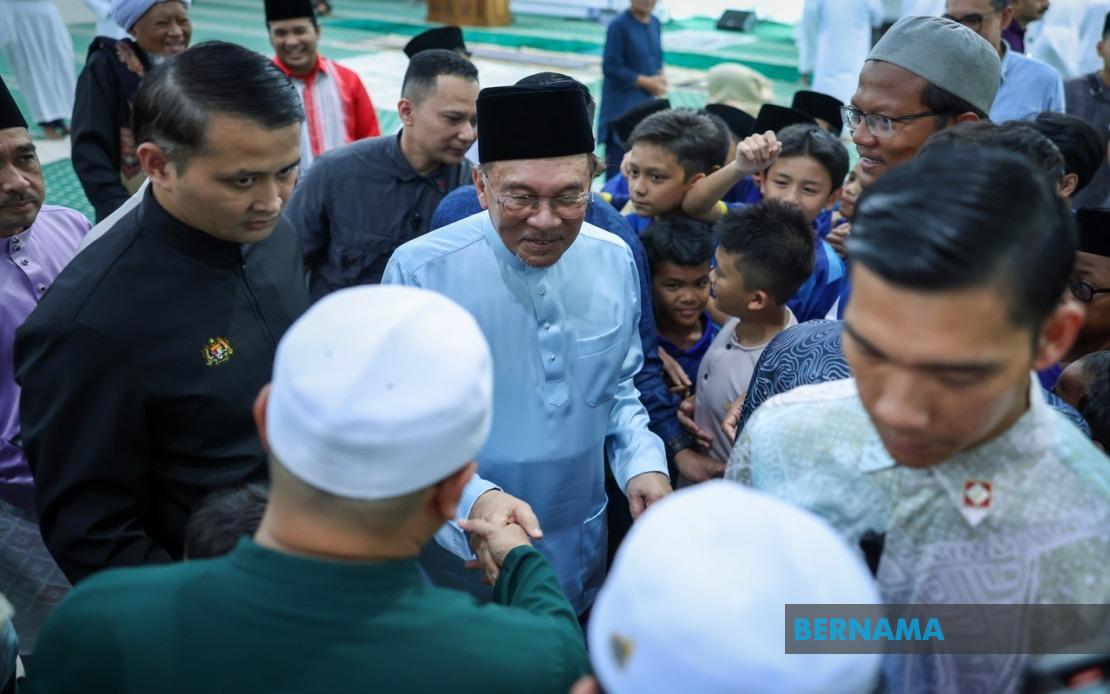
Prime Minister Datuk Seri Anwar Ibrahim has drawn a sharp distinction between parliamentary allocations and the roles of elected representatives, asserting that constituency funds belong fundamentally to the people rather than to their Members of Parliament. Speaking after Friday prayers in Alor Gajah, the Prime Minister made clear that the government views these budgets as instruments for grassroots development and community improvement, not as discretionary resources for individual MPs to dispense as they see fit.
The clarification carries significant implications for Malaysia's political system, where the distribution of constituency funds has long been a contentious issue between government and opposition lawmakers. Anwar's statement appears designed to address grievances from opposition MPs who have claimed the government withheld funding allocations, suggesting instead that such withdrawals represent a policy shift rather than punitive measures. By reframing the conversation around beneficiaries rather than gatekeepers, the Prime Minister is establishing that parliamentary funds serve a developmental mandate that supersedes partisan considerations.
According to Anwar, the allocation mechanism should channel resources directly toward tangible community infrastructure and services. A RM2 million allocation, he explained, ought to be directed toward educational institutions, religious establishments, drainage systems, and other local necessities rather than retained or controlled by the MP holding that constituency's parliamentary seat. This framework suggests the government intends to monitor how funds flow from federal coffers to ground level, ensuring that designated budgets translate into visible improvements in constituency conditions.
The Prime Minister indicated this governing principle was not newly minted but rather reflected established practice known to lawmakers from previous administrations. His emphasis on continuity suggests the policy represents institutional convention rather than Anwar's personal innovation, though his administration appears committed to stricter enforcement. This distinction matters because it implies the current controversy stems not from rule changes but from changed implementation, potentially affecting both government and opposition constituencies equally under the new approach.
Anwar's position on opposition-held constituencies deserves particular attention. He stated explicitly that if a parliamentary seat is held by an opposition member, the government will channel allocated funds directly to the constituency's residents rather than withholding resources or requiring MP intermediation. This commitment, if operationalized consistently, would demonstrate whether the administration views constituency development as a depoliticized function or as leverage in inter-party competition. For Malaysian voters in opposition areas, such assurance carries practical weight given the previous perception that ruling coalition constituencies receive preferential funding flows.
The practical mechanics of direct fund distribution remain underspecified in Anwar's remarks, raising questions about implementation. Schools, mosques, and drainage boards would presumably become primary recipients of diverted funds, but the specific mechanisms for identifying priorities, evaluating needs, and executing projects across diverse constituencies could prove complicated. Whether opposition MPs retain any consultative role in identifying local needs, or whether the government unilaterally determines spending priorities, will shape how effectively these funds serve their ostensible purpose. Malaysian constituencies vary enormously in infrastructure status and community requirements, suggesting a standardized approach might miss contextual opportunities.
The timing of Anwar's statement responds to multiple opposition voices claiming marginalisation in resource allocation. By addressing this preemptively with a principled statement about fund allocation philosophy, the Prime Minister positions his government as defending a system-wide principle rather than defending against specific accusations. This rhetorical strategy may prove more durable than case-by-case responses to individual MP complaints, creating a framework against which future allocation decisions can be evaluated. However, opposition legislators will likely scrutinize whether government constituencies experience faster project implementation or preferential access despite Anwar's stated policy.
The statement also touches on a separate matter regarding PKR deputy president Nurul Izzah, Anwar's daughter, who has stepped down temporarily to pursue other commitments. Anwar characterized this as a personal decision reflecting her current priorities rather than a permanent departure, emphasizing her continued party involvement despite her hiatus from formal leadership. This clarification appears designed to prevent speculation about internal PKR friction or family dynamics influencing party operations, though the brief nature of Anwar's comments may only partially satisfy curiosity about the arrangement's scope and duration.
For Malaysian constituents across both government and opposition areas, Anwar's declaration potentially signals greater scrutiny of how parliamentary allocations translate into tangible development. If enforced, the policy could reshape constituency politics by decoupling fund distribution from personality-driven politics where individual MPs historically mediated resource flows. Opposition constituencies might experience improved infrastructure investment, while government MPs would need to demonstrate value through advocacy and non-budgetary services. This reorientation could strengthen democratic accountability by making fund utilization a measurable criterion for evaluating MP performance.
The broader Southeast Asian context illuminates why such clarifications matter. Across the region, parliamentary allocation systems vary significantly, with some countries maintaining tight executive control over local budgets while others grant MPs substantial discretionary authority. Malaysia's system has historically balanced these poles, creating ambiguity about whether allocations represent MP entitlements or constituency investments. Anwar's clarification moves Malaysia's model toward treating them as developmental tools rather than personal political assets, aligning more closely with systems that view local budgets as serving constituent welfare rather than MP prestige.
Enforcement credibility will ultimately determine whether this policy produces meaningful change. Government MPs accustomed to controlling allocation flows might resist relinquishing discretion, while opposition lawmakers may remain skeptical that promised direct distribution actually materializes. Civil society organizations monitoring development spending could play crucial roles in verifying whether constituencies receive allocated funds regardless of parliamentary representation. For Malaysian voters in opposition areas, this policy's genuine implementation would constitute a material improvement in their access to federally-funded development compared to previous patterns.

