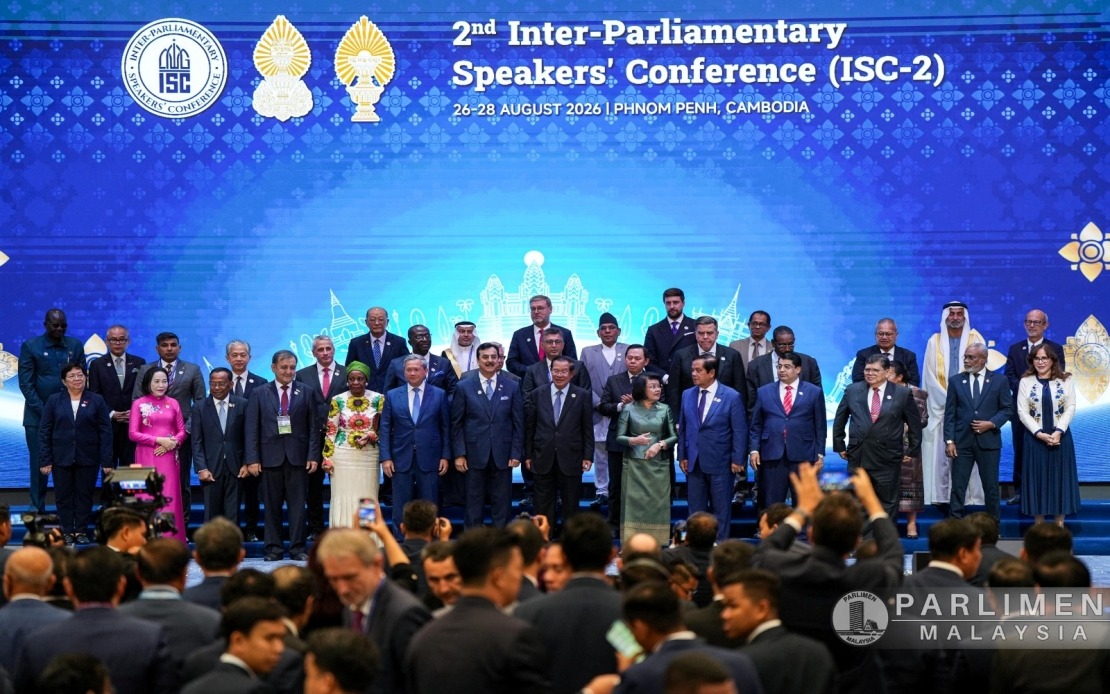
Tan Sri Dr Johari Abdul, Speaker of the Dewan Rakyat, has called for legislatures to assume greater responsibility in tackling the world's most pressing challenges, from armed conflicts to geopolitical rivalries and climate crises. Speaking at the Second Inter-Parliamentary Speakers' Conference in Phnom Penh this week, Johari emphasised that parliaments represent a crucial but often underutilised channel for addressing issues that governments alone cannot resolve. The gathering, co-hosted by Cambodia's National Assembly and Senate from August 26 to 28, brought together legislative leaders from across the globe to discuss how democratic institutions can jointly pursue peace and prosperity.
The conference theme, "Solidarity for Peace and Shared Prosperity: Strengthening International Law and Resolving Conflicts Peacefully," underscores a growing recognition that parliamentary engagement offers something fundamentally different from traditional government-to-government diplomacy. Johari articulated a vision in which legislatures work in tandem with their respective executives, each bringing distinct perspectives to the table. While executive branches operate within political and strategic constraints, parliaments often enjoy a broader view of public sentiment and grassroots concerns. This complementary dynamic, he suggested, creates opportunities for finding solutions that purely top-down approaches might miss.
The Malaysian Speaker highlighted how contemporary conflicts have become increasingly multifaceted, with geopolitical divisions widening at a pace that challenges the post-World War II institutions designed to maintain international order. Beyond casualty figures and military metrics, the human dimensions of war—displacement, educational deprivation, and the psychological fracturing of communities—demand responses that extend across government structures. Parliamentary diplomacy, Johari argued, offers a mechanism to maintain open lines of communication precisely when formal state-to-state relations have deteriorated or frozen. When official channels narrow, legislative forums can preserve dialogue across entrenched political positions, building incremental trust that might eventually unlock progress at higher levels.
In his conference address, Johari positioned Malaysia as an advocate for principles long central to Southeast Asian statecraft: respect for national sovereignty, territorial integrity, adherence to international law, and commitment to peaceful dispute resolution. These ideals, he noted, form the bedrock of ASEAN's founding philosophy and remain vital to regional stability. ASEAN itself emerged from recognition that dialogue, consensus-building, and mutual consultation provide more durable frameworks than coercion or military posturing. By extension, Johari suggested that regional parliaments have a duty to reinforce this diplomatic culture through enhanced cooperation and mutual engagement.
The implications for Southeast Asia are substantial. The region faces multiple pressure points—territorial disputes in the South China Sea, competing strategic interests from global powers, and transnational challenges ranging from maritime security to pandemic preparedness. ASEAN's much-vaunted consensus principle sometimes struggles when member interests diverge sharply. Parliamentary networks offer a secondary track through which legislators can build understanding among peers across borders, potentially creating political space for governments to manoeuvre toward compromise. This "Track 1.5" engagement, sitting between official diplomacy and civil society activism, can amplify voices within each country advocating for constructive regionalism.
Johari's emphasis on the legislature's role also reflects contemporary anxieties about democratic accountability and representation. Executive branches, concentrated in fewer hands and operating under security classifications, can pursue policies disconnected from public opinion. Parliaments, by contrast, remain answerable to constituent voters and must justify their positions in open debate. When legislatures engage internationally, they bring this accountability mechanism with them, creating pressure toward solutions that command broader domestic support. This matters particularly in democratic societies like Malaysia, where parliamentary legitimacy ultimately depends on retaining public confidence.
The conference itself represents a relatively young but expanding institutional network. Following Pakistan's hosting of the inaugural Inter-Parliamentary Speakers' Conference in 2025, Cambodia took the lead this year, and Indonesia will assume the mantle for the next gathering. This rotation among diverse nations signals commitment to inclusive multilateralism, though it also raises questions about whether such forums can translate rhetoric into concrete action. The success of parliamentary diplomacy ultimately hinges not on eloquent speeches but on whether legislators return home with strengthened relationships and concrete commitments to collaborative problem-solving.
For Malaysia specifically, participation in such forums strengthens its claim to regional leadership while advancing its diplomatic interests. The country's position as a moderate Muslim-majority nation with deep ASEAN roots and significant economic ties to major powers gives it natural convening authority. By championing parliamentary engagement as a complement to government diplomacy, Johari positions Malaysia as a mature democratic voice counselling restraint, dialogue, and respect for international norms—a posture that appeals across ideological divides and enhances Malaysia's soft power.
Yet challenges remain substantial. Parliamentary bodies frequently lack resources, technical expertise, and enforcement mechanisms available to executive branches. Legislative processes move slowly, constrained by procedural requirements and multiple veto points. The most intractable conflicts—those rooted in historical grievance, resource competition, or existential threat perception—may prove resistant to dialogue alone. Moreover, parliaments themselves are often divided along partisan lines, meaning they sometimes amplify rather than bridge national differences. The vision of harmonious parliamentary coordination can obscure these realities.
Despite these obstacles, Johari's argument carries weight. International law, respect for sovereignty, and peaceful conflict resolution are principles parliaments can champion more credibly than executives preoccupied with strategic advantage. By creating space for legislators to engage across borders, the Inter-Parliamentary Speakers' Conference and similar initiatives acknowledge that governance in an interconnected world requires multiple channels, multiple voices, and multiple levels of engagement. Malaysia's voice in advocating this vision reflects both idealism and pragmatism—idealism about democracy's potential to generate peace, pragmatism about the limits of executive diplomacy alone.

