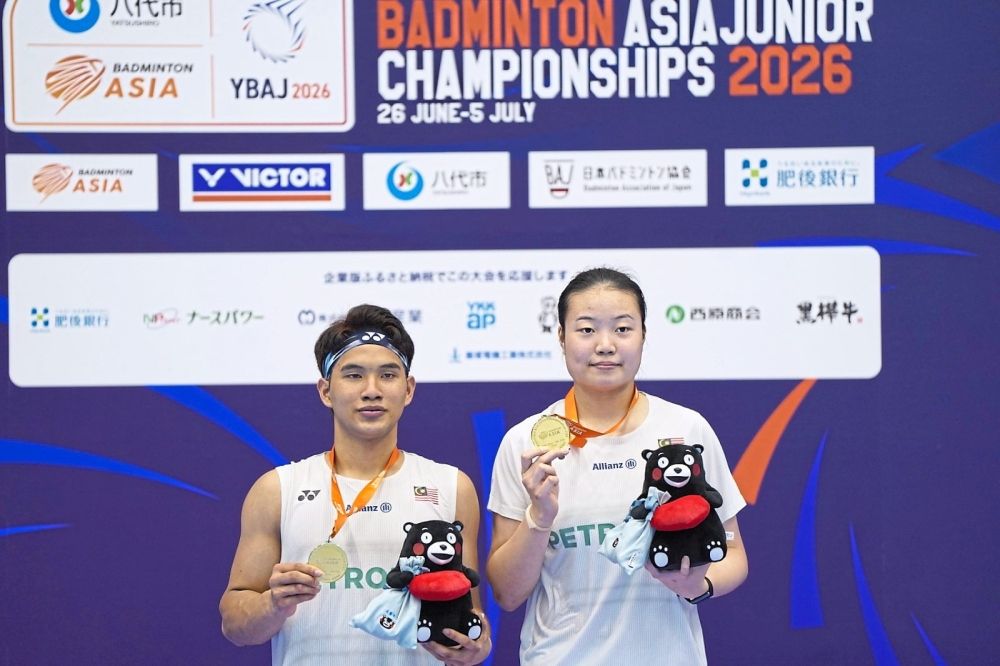
Ahmad Redzuan Zulwaqqarizal and Low Zi Yu have written a significant chapter in Malaysian badminton history by claiming the mixed doubles crown at the Asian Junior Championships in Yatsushiro, Japan, yesterday. The victory marks the end of a two-decade absence from the podium's top step in this discipline, with the Malaysian mixed doubles partnership finally breaking through against China's Zheng Weigang and Li Menghan in a tightly contested 43-minute affair that ended 21-15, 22-20. The triumph represents a turning point for Malaysian junior badminton, which has endured a lengthy gap since Tan Wee Kiong and Woon Khe Wei last captured the mixed doubles title in Kuala Lumpur in 2007.
The path to victory was anything but straightforward for the Malaysian pair, particularly during a second game that tested their resolve and composure under mounting pressure. With victory seemingly within grasp at just two points away from the title, Redzuan and Zi Yu were forced to dig deep when their Chinese opponents mounted a fierce comeback to drag the match to a deciding third game. The critical juncture arrived at 20-20 in the final game, where mental fortitude rather than technical prowess became the decisive factor. The Malaysians managed to separate themselves from their rivals precisely when it mattered most, ultimately prevailing through sheer determination and focus.
Zi Yu's reflections on the final reveal the psychological dimension of junior badminton competition at the highest Asian level. The teenager attributed their success to patience and composure, suggesting that the Malaysian duo remained better focused than their Chinese counterparts during the pivotal moments that shaped the outcome. Beyond technical execution, Zi Yu highlighted the intangible value of support from their teammates on the sidelines, many of whom had already been eliminated from their respective competitions. This camaraderie and encouragement provided crucial emotional fuel during the final's most intense passages, demonstrating how team dynamics influence individual performances even in head-to-head competition.
For Redzuan, the gold medal carries particularly deep resonance given his previous struggles on the Asian Junior Championships stage. The Terengganu-born shuttler made his debut at the 2023 edition in Yogyakarta, competing in both boys' doubles and mixed doubles, yet departed with disappointment following early eliminations in both categories. Rather than gaining confidence from the experience, his subsequent appearances at the 2024 Yogyakarta and 2025 Surakarta championships continued this trend of premature exits. Three consecutive disappointing campaigns created a narrative of unfulfilled promise, making yesterday's triumph even more emotionally resonant for a player who persisted through setback after setback.
Redzuan's approach to breaking this pattern reflects the mindset required to succeed in competitive badminton. He emphasised satisfaction with his execution of strategies developed during training sessions, acknowledging that his performance aligned with the tactical and technical preparations he had undertaken. Yet he demonstrated admirable realism by recognising significant areas for improvement, particularly as he contemplates progression to senior-level competition where the demands intensify substantially. This balanced self-assessment—celebrating the achievement while maintaining humility about remaining gaps—suggests maturity beyond his years.
Zi Yu's championship run extended beyond the mixed doubles title, as she also captured a bronze medal in girls' doubles alongside Genevie Lim. The teenage shuttler and her partner fell to Japan's second-seeded pairing of Aoi Banno and Yuzu Ueno in the semi-finals, succumbing 21-16, 17-21, 17-21 in a match that showcased the rising standard of Japanese junior badminton. Despite competing simultaneously in two separate events, Zi Yu managed to maintain consistency and deliver creditable performances across both disciplines, something that would challenge the focus and energy reserves of many competitors her age.
The logistics of competing in multiple events simultaneously raised questions about mental and physical fatigue, yet Zi Yu dismissed concerns about juggling both commitments. She credited the quality and self-sufficiency of her respective partners, both of whom she described as exceptionally capable competitors able to shoulder responsibility on court. This partnership structure allowed Zi Yu the luxury of concentrating primarily on her own game rather than directing or managing her teammates' performance. Her approach reflects contemporary badminton philosophy where mixed partnerships function as autonomous units with each player contributing equally to tactical and technical execution.
Zi Yu's maturity extended to her understanding of the supportive role required within team environments. While she maintained focus on her own performance, she acknowledged the importance of constructive feedback and encouragement when her partners committed unforced errors. This balance between individual focus and collective responsibility represents an important psychological skill in junior sport, where players must develop accountability while maintaining supportive relationships essential for sustained motivation and improvement.
The broader significance of this Malaysian triumph lies in its implications for the national badminton pipeline. After nearly two decades without capturing this particular title, the sport's development authorities and coaching structures have engineered conditions enabling younger players to compete effectively against dominant badminton nations. China's continued presence in multiple finals—with Zheng Weigang and Li Menghan reaching the mixed doubles final, and Chinese shuttlers claiming the men's and women's singles titles—demonstrates the formidable competition Malaysian juniors must overcome to achieve gold.
The championship results paint a picture of regional badminton strength distributed unevenly across nations. Japan's dominance in women's doubles, evidenced by Aoi Banno and Yuzu Ueno's title and the all-Japanese women's doubles final, contrasts with Malaysia's breakthrough in mixed doubles. Taiwan's success in men's doubles, where Huang Tzu-yuan and Lin Sheng-ming defeated compatriots Chen Ping-hsuan and Lee Wei-ting in an all-Taiwanese final, indicates how competitiveness shifts across categories and nations. This competitive landscape suggests that Malaysian badminton's future strength may lie particularly in mixed doubles partnerships, where Redzuan and Zi Yu's breakthrough could serve as a catalyst for development.
The implications for Malaysian sport extend beyond badminton's confines, as junior championship successes establish confidence and international recognition that can facilitate athlete development pathways. With Redzuan and Zi Yu now positioned as returning Asian champions, they attract increased coaching investment and competition opportunities that accelerate progression toward senior levels. This trajectory, if sustained, could produce another generation of Malaysian badminton champions capable of competing on the World Tour circuit where significant prize money and ranking points determine career trajectories.
Looking forward, the duo's challenge will involve transitioning from junior success to the considerably more demanding senior badminton environment. Many promising junior champions struggle with this transition, as senior competition features stronger, more experienced opponents employing more sophisticated tactics and maintaining superior fitness levels. Redzuan and Zi Yu's demonstrated mental resilience—particularly their ability to recover from setbacks in the final—suggests psychological foundations capable of supporting successful progression, provided they continue developing their technical repertoire and physical capabilities. Their achievement in Yatsushiro has provided the foundation; the critical phase now lies in consolidating this breakthrough into sustained senior-level success.

