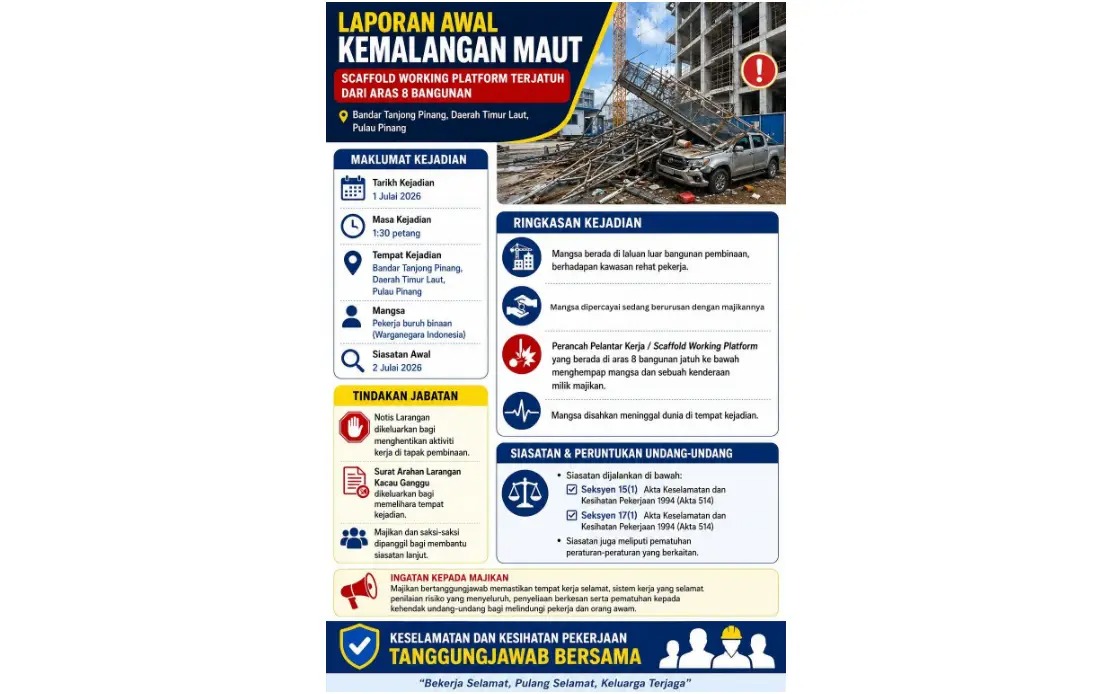
The Department of Occupational Safety and Health (DOSH) in Penang has moved swiftly to impose a work prohibition order at a Bandar Tanjong Pinang building site following the death of an Indonesian construction worker in a scaffolding collapse incident. The fatal accident occurred on July 1 at approximately 1.30 pm, when a working platform fell from the eighth floor of a building under construction, striking the worker and an employer's vehicle. The decisive action underscores mounting pressure on Malaysian construction regulators to enforce stricter safety protocols across the nation's rapidly expanding building sector, where such incidents remain distressingly common.
According to DOSH's official statement, the victim was positioned on an external walkway adjacent to a workers' rest area at a lower level of the building when the scaffolding gave way. He was reportedly engaged in work-related discussion with his employer at the moment of impact. The investigative team has determined that the incident warrants immediate suspension of all related construction activities at the location, pending a comprehensive examination of what led to the structural failure and loss of life.
The regulatory intervention reflects growing attention to occupational hazards within Malaysia's construction industry, particularly regarding the safety infrastructure protecting migrant workers who comprise a significant portion of the workforce. Indonesia supplies thousands of workers to Malaysian construction projects annually, and incidents of this nature raise serious questions about whether employers maintain adequate safeguarding measures. The incident also highlights the vulnerability of foreign nationals who may lack full awareness of their legal protections or mechanisms for reporting hazardous conditions.
DOSH has implemented a comprehensive investigative framework designed to establish whether employers breached their statutory obligations under the Occupational Safety and Health Act 1994 (Act 514). The enquiry specifically examines compliance with Sections 15(1) and 17(1) of this legislation, which establish fundamental employer responsibilities for maintaining safe working environments. Investigators are currently gathering statements from employers and eyewitnesses to reconstruct the sequence of events leading to the platform's collapse and to identify any contributing factors such as improper installation, inadequate maintenance, or failure to conduct proper risk assessments.
The prohibition notice represents a precautionary measure aimed at preventing further potential incidents while the investigation proceeds. Under the order, no work activities connected to the initial project may resume until DOSH explicitly authorizes recommencement. Additionally, a non-disturbance order has preserved the accident scene in its original state, allowing forensic examination of the failed scaffolding structure, attachment points, and any documentation concerning the platform's specification, installation, and inspection history. This forensic approach is essential for determining whether design flaws, manufacturing defects, or human error precipitated the collapse.
For construction industry stakeholders across Southeast Asia, the incident serves as a cautionary reminder of the consequences of cutting corners on safety. Malaysia's construction sector has faced repeated criticism from international labour organizations regarding worker protections, particularly for migrant labour. This latest fatality adds pressure on developers, main contractors, and subcontractors to invest substantially in safety training, equipment inspections, and compliance infrastructure rather than prioritizing cost reduction through deferred maintenance or understaffing of safety positions.
DOSH officials have signalled that enforcement action will be pursued if the investigation reveals legal violations. Such sanctions can range from substantial financial penalties to criminal prosecution of responsible individuals, particularly if negligence is established. This approach reflects a hardening regulatory stance aimed at creating genuine deterrence in an industry where profit margins sometimes encourage shortcuts that endanger workers' lives. The agency's explicit warning to employers, developers, contractors, and subcontractors emphasizes that future incidents will receive identical scrutiny and enforcement attention.
The Bandar Tanjong Pinang site closure carries broader implications for the Penang construction sector, which has experienced significant growth driven by residential, commercial, and industrial development projects. A prolonged work suspension could create scheduling cascades affecting related projects and suppliers. However, DOSH's firmness signals that regulatory compliance must take precedence over commercial pressures, a message that resonates across Malaysia's entire building industry where safety standards require consistent reinforcement.
For workers and their families, particularly migrant employees from Indonesia and other nations, the investigation outcome will carry substantial weight. A finding of employer negligence or contractor liability could strengthen claims for compensation and establish precedent regarding duty-of-care standards. Many construction workers lack adequate insurance coverage or understanding of Malaysian compensation frameworks, making transparent investigations and enforcement essential for ensuring families receive appropriate support following workplace deaths.
The incident underscores systemic challenges within Malaysia's construction safety regime. While regulatory frameworks exist through DOSH and the Act 514, their effective implementation often depends on inspectional capacity, industry cooperation, and penalties sufficiently severe to motivate compliance. Training programmes for workers on hazard recognition and reporting procedures remain inconsistently deployed, particularly for migrant workers whose language barriers may hinder their ability to raise concerns. Industry bodies and government agencies must collaborate more closely to develop integrated safety culture frameworks that move beyond reactive investigations toward proactive prevention.
Moving forward, this fatality should catalyze broader sector-wide initiatives addressing scaffolding safety specifically. Many accidents involve temporary structures whose specifications and installation standards vary considerably across Malaysia. Establishing standardized certification requirements for scaffolding design and installation, combined with mandatory periodic inspections and worker training, could substantially reduce preventable incidents. Regional cooperation through ASEAN could facilitate knowledge-sharing regarding best practices in temporary structure safety, benefiting all member nations' construction workforces.

