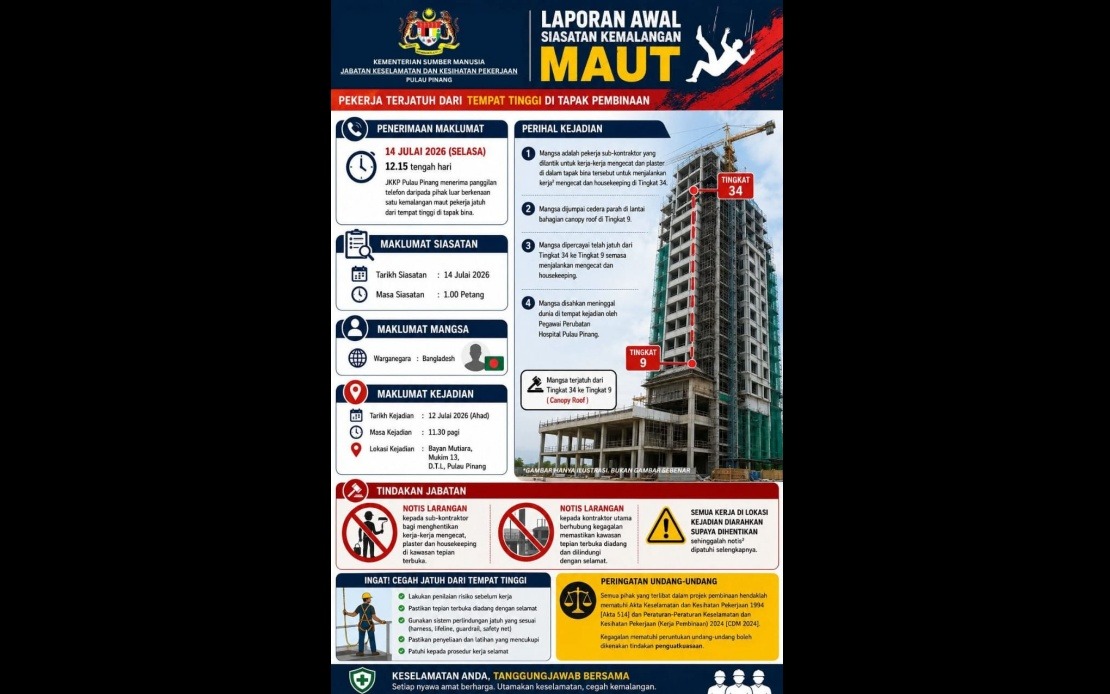
The Penang Department of Occupational Safety and Health (DOSH) has launched an investigation into the fatal incident involving a Bangladeshi migrant worker who sustained fatal injuries after plummeting from a residential construction project in Bayan Mutiara. The tragedy, which occurred on July 15, has raised renewed concerns about workplace safety standards at high-rise construction sites across the state, particularly regarding safeguards for foreign workers employed by subcontracting firms.
According to Penang DOSH director Hairozie Asri, the department was notified of the incident through an external party at 12.15 pm, prompting immediate deployment of an investigative team to the site. Upon arrival, officers conducted a preliminary assessment to determine the circumstances surrounding the worker's fatal fall. Medical personnel from Penang Hospital subsequently attended the scene and declared the victim dead, marking yet another fatality in Malaysia's construction sector that employs hundreds of thousands of migrant labourers.
The initial inquiry revealed that the deceased was contracted by a subcontracting firm engaged to perform painting, plastering, and housekeeping operations across various levels of the structure. Evidence gathered during the preliminary assessment indicated that the worker was stationed on the 34th floor at the time of the accident but was discovered critically injured on the canopy roof section at Level 9—a vertical distance of approximately 25 floors. The precise sequence of events leading to the fall remained under examination as investigators worked to establish whether the worker fell through inadequate protective barriers or due to a loss of footing.
In response to the incident, Penang DOSH immediately exercised its regulatory authority by issuing a prohibition notice to the subcontractor, explicitly forbidding the continuation of painting, plastering, and housekeeping activities in any open-edge areas of the construction site. A parallel prohibition notice was simultaneously served to the main contractor overseeing the entire project. These enforcement actions underscore the regulatory framework's capacity to halt potentially dangerous operations when safety violations are suspected, though critics argue that such interventions often come only after tragedies occur rather than preventing them through proactive inspections.
Compounding the enforcement response, Penang DOSH ordered an immediate suspension of all work-related activities at the accident site until the subcontractor and main contractor fully satisfied every requirement stipulated in their respective prohibition notices. This cessation of operations, while necessary from a safety perspective, reflects the broader challenge facing Malaysia's construction industry: balancing project timelines and commercial pressures against the fundamental imperative to protect worker lives. The extended shutdown will likely impose substantial financial consequences on both contractors and the project developer, potentially creating incentives to expedite compliance investigations.
The incident illuminates persistent vulnerabilities in Malaysia's migrant worker protection infrastructure, particularly within construction subcontracting chains where accountability can become diffuse across multiple layers of employment relationships. Bangladeshi nationals constitute a significant proportion of Malaysia's foreign construction workforce, often undertaking the most hazardous tasks at the lowest wage scales. Despite regulatory frameworks mandating safety protocols, enforcement gaps remain prevalent, especially at sites operated by smaller subcontractors with limited resources or safety expertise.
Fall-related fatalities represent a disproportionately large category of construction deaths across Southeast Asia, yet comprehensive data collection remains inconsistent. Many incidents go unreported or are classified as accidents rather than workplace safety violations, obscuring the true scale of the problem. Malaysia's construction sector, valued at hundreds of billions of ringgit annually, generates numerous high-rise projects, particularly in urban centres like George Town, Kuala Lumpur, and Johor Bahru, each presenting inherent fall risks that demand rigorous preventative measures.
The Bayan Mutiara incident will likely prompt Penang DOSH to conduct additional targeted inspections across active construction sites in the state, particularly those involving subcontracted painting and finishing work at elevated heights. Such heightened scrutiny, while appropriate, remains reactive rather than preventive, suggesting the need for enhanced pre-project safety certification requirements and more intensive oversight of subcontracting arrangements. Industry bodies and contractors' associations face mounting pressure to establish stronger self-regulatory mechanisms that could identify hazards before workers are exposed to catastrophic risks.
For Malaysian policymakers and industry stakeholders, this tragedy reinforces arguments for strengthening the Occupational Safety and Health Act 1994 with more prescriptive requirements for high-rise construction, mandatory safety audits at defined project milestones, and enhanced penalties for non-compliance. The regulatory model currently relies substantially on post-incident investigations and prohibition notices, a framework that offers limited deterrent value when considered against the human cost of preventable deaths. Enhanced training requirements for workers, supervisors, and safety officers—delivered in workers' native languages—could substantially improve hazard recognition and mitigation.
The investigation into this worker's death will eventually produce findings and recommendations that circulate within regulatory and industry circles, potentially influencing future safety standards or enforcement practices. However, without systematic implementation of recommendations across the sector, the construction industry risks perpetuating cycles where investigations yield insights that remain underutilised. Bangladeshi worker organisations and Malaysian labour NGOs have increasingly voiced concerns about the adequacy of existing protections, calling for independent monitoring of subcontracting sites and stronger penalties for operators that knowingly expose workers to fall hazards.
Moving forward, this incident serves as a critical reminder that construction site safety transcends compliance checklists and prohibition notices—it fundamentally concerns the protection of human life. For Malaysian employers, regulators, and policymakers, the challenge lies in developing integrated safety systems that address the particular vulnerabilities of migrant workers, strengthen accountability across subcontracting hierarchies, and establish consequences sufficiently severe to motivate genuine safety investments rather than mere technical compliance.

