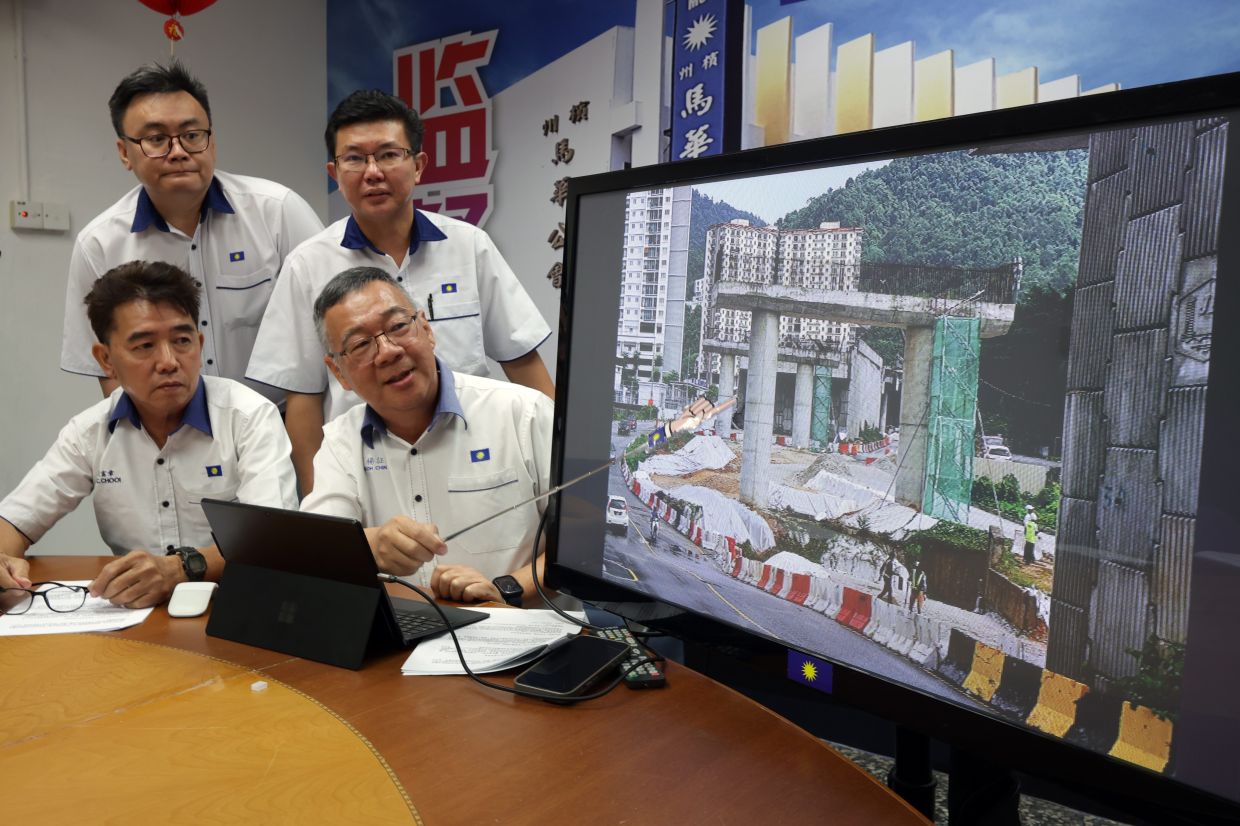
Penang's MCA division has intensified pressure on the state government to provide comprehensive documentation regarding the Air Itam-Tun Dr Lim Chong Eu Expressway bypass project, citing discrepancies between reported progress metrics and observable ground conditions. The challenge comes as the state administration claims the 6-kilometre toll-free corridor has reached approximately 89% completion, yet structural work across multiple sections remains visibly incomplete according to party assessments conducted on site in early July.
Secretary Yeoh Chin Kah has reframed the controversy as fundamentally a matter of institutional accountability rather than mere project scheduling. He emphasised that the political stakes now centre on restoring public trust in government administration and project management oversight. The distinction marks a shift from technical discussions about timeline slippage to broader governance concerns, reflecting growing public frustration with infrastructure delays in the state. Yeoh's characterisation suggests that the credibility of Penang's administration—particularly regarding its capacity to deliver major capital works—has become the underlying issue driving the scrutiny.
The verification gap appears significant when examined closely. While state officials reported progress climbing from 80% in May to 89% in December, Penang MCA's July inspection found critical components across Valley Road, Changkat Tembaga and Jalan Thean Teik remained substantially incomplete. The party documented the presence of bridge piers but absence of beams and deck structures, incomplete road surfacing, and pending installation of guardrails, noise barriers and mechanical-electrical systems across numerous sections. These observations suggest a substantial mismatch between percentage-completion figures and physical construction reality, raising questions about how progress metrics are being calculated and reported.
This discrepancy has prompted Yeoh to issue a formal seven-day ultimatum for the state government to produce payment records, consultant certification documentation and comprehensive project assessment reports. The timeframe serves as both a pressure tactic and a test of governmental willingness to open its records to public scrutiny. Should authorities fail to comply, Penang MCA has signalled its intention to escalate the matter to the National Audit Department and the Malaysian Anti-Corruption Commission—moves that would transition the dispute from political criticism to formal investigation by federal oversight bodies. Additionally, the party plans to establish a dedicated monitoring committee to track future progress claims and ensure compliance with stated timelines.
Understanding the project's broader significance provides essential context for the controversy. The bypass constitutes Package Two of Penang's ambitious undersea tunnel and three paired roads development, a transformative infrastructure initiative designed to address chronic traffic congestion in the northern corridor. The 6-kilometre corridor will ultimately connect Lebuhraya Thean Teik in Bandar Baru Air Itam with the existing Tun Dr Lim Chong Eu Expressway through an integrated network of elevated viaducts, underground tunnels and surface-level roads. Upon completion, the facility is projected to benefit approximately 300,000 residents across Air Itam, Bandar Baru Air Itam and Paya Terubong by substantially reducing commute times and alleviating intersection congestion.
The project timeline has already slipped considerably from original expectations. Initial completion was originally scheduled for 2024, but the contractor has received two separate time extensions. The latest revised deadline now stands at April 12, 2027—representing a potential delay of three years relative to the original completion target. For a capital project of this scale and cost, such extensions carry significant implications for government budgeting, opportunity costs and public confidence in procurement processes. The repeated postponements suggest either initial planning underestimated project complexity or unforeseen technical challenges emerged during construction phases.
Countering Penang MCA's criticism, Paya Terubong assemblyman Wong Hon Wai provided more optimistic assessment of construction status. Wong reported that current progress has reached 91% as of late June, with the contractor providing assurances regarding the April 2027 completion target. He detailed scheduled beam launches on the Gelugor section between July and August, with the remaining six beams scheduled for the fourth quarter. Bridge beam work on the Bandar Baru Air Itam side has reportedly concluded, though Wong acknowledged that deck slab and parapet works remain in progress and constitute necessary prerequisites before authorities can consider opening the corridor to traffic.
Wong's additional clarification regarding the post-construction approval process carries particular importance for public understanding of timelines. Even upon structural completion, the relevant government agency must conduct a Road Safety Audit before the Public Works Department can formally advise on opening dates. This bureaucratic process, while essential for public safety assurance, introduces additional delay between construction finishing and actual traffic commencement. This distinction between construction completion and operational opening represents a critical point of potential miscommunication between government officials and the public, where percentage-completion claims may reference construction progress rather than overall project availability.
The dispute illuminates broader governance challenges affecting Southeast Asian infrastructure delivery, particularly in Malaysian states attempting to execute complex urban development initiatives. Questions about progress reporting methodology, validation mechanisms for completion percentages and transparency of procurement documentation resonate beyond Penang's immediate context. Regional observers increasingly scrutinise how governments track and publicly communicate infrastructure progress, recognising that accurate reporting mechanisms strengthen democratic accountability while also improving future project planning. The Air Itam bypass controversy therefore carries implications for how Malaysian states structure their infrastructure governance frameworks moving forward.
For Penang residents and regional stakeholders, the controversy underscores the importance of independent verification in major infrastructure projects. The gap between claimed and observed completion rates—whether ultimately explained by differences in calculation methodology or genuine discrepancies—demonstrates why transparency mechanisms, public oversight and third-party monitoring constitute essential elements of responsible project administration. Should Penang MCA's concerns prove substantiated, the revelation would necessitate comprehensive review of project management practices and reporting systems across the state's infrastructure portfolio. Conversely, if the state successfully documents the accuracy of its progress claims, the exercise itself would establish valuable precedent for transparent government-contractor communication.

