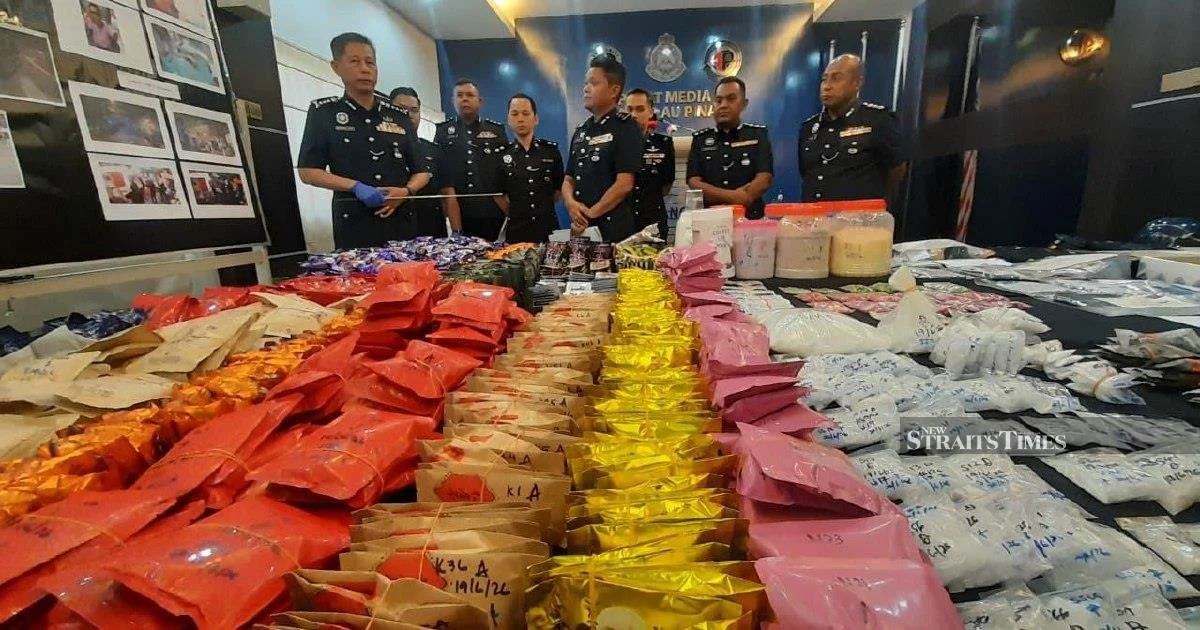
Law enforcement authorities in Penang have successfully disrupted what officers describe as a substantial narcotics manufacturing and distribution network following targeted operations at a residential condominium in Butterworth. The operation culminated in the arrest of two individuals believed to be operating the illicit enterprise together, along with the recovery of controlled substances valued at RM9.7 million—one of the larger drug seizures reported in the state in recent months.
The investigation, which involved coordination between multiple police units, initially identified suspicious activity at the condominium complex. Acting on intelligence gathered through surveillance and community tip-offs, officers executed search warrants at the premises, discovering evidence of systematic drug processing operations. The scale of the discovery suggests the organisation had moved beyond small-scale trafficking to establish what amounts to a dedicated manufacturing facility, indicating a level of operational sophistication that required significant capital investment and logistical coordination.
The arrested couple was detained for questioning and further investigation into their respective roles within the operation. Police have not yet released detailed information about their identities, background, or how long the operation had been running. However, the fact that both individuals were operating the enterprise together raises questions about recruitment patterns within organised crime networks and how romantic or family relationships facilitate involvement in serious drug-related activities—a recurring pattern observed in drug investigations across Malaysia and the broader region.
The volume of drugs recovered during the raid underscores the growing challenge facing Malaysian law enforcement agencies, particularly in high-density urban and suburban areas. Penang's geographical position as a major port and its relatively proximity to Thailand and other drug-producing regions make it an attractive location for trafficking organisations seeking to establish processing and distribution hubs. The state has long struggled with drug-related crime, with seizures and arrests occurring with troubling frequency despite enhanced enforcement efforts.
The RM9.7 million valuation places this seizure among the more significant recent busts, though Malaysian authorities have documented even larger hauls in past years. The street value assigned to drug seizures typically reflects retail-level pricing, making the actual quantity of substances involved substantial. When converted to pure drug weight, such seizures represent hundreds of kilograms of material in various stages of processing, suggesting this operation catered to a wide geographical distribution network rather than serving localised demand.
Regional drug enforcement experts note that condominium-based operations represent a particular enforcement challenge because they blend into normal residential activity and allow operators to maintain the appearance of legitimate occupancy. The relatively anonymous nature of large residential complexes, combined with transient occupancy patterns, provides cover for criminal operations. Building management may lack the resources or incentive to identify suspicious activity, and neighbouring residents often remain unaware of activities occurring behind closed doors.
The investigation reflects ongoing efforts by Penang police to combat organised drug trafficking, an issue that intersects with public health, community safety, and border security concerns. Drug-related crime typically involves networks extending beyond individual cities, with supply chains often tracing back to regional production centres and distribution chains reaching consumers across multiple states. Dismantling such operations requires sustained intelligence work and inter-agency cooperation at both state and federal levels.
For residents across the Klang Valley and other major Malaysian urban centres, such operations serve as a reminder of the hidden criminal infrastructure operating within residential areas. Condominiums and apartment complexes have become preferred locations for drug manufacturing precisely because they offer anonymity that detached houses cannot provide. The discovery prompts questions about building security protocols and the feasibility of detecting suspicious activity in high-rise residential environments where residents may occupy units for extended periods without interaction with neighbours.
The two individuals now face serious drug trafficking and manufacturing charges, which carry mandatory minimum sentences and substantial prison terms under Malaysian law. The severity of penalties reflects the government's commitment to treating large-scale drug operations as priority crimes, though enforcement success rates vary considerably across different jurisdictions and depend heavily on adequate resourcing and intelligence development.
Police have indicated that investigations remain ongoing and that additional individuals may face charges as the inquiry progresses. Such announcements are typical when authorities identify a supply chain extending beyond the immediate operational hub. Distribution networks usually involve multiple actors occupying different roles—manufacturers, packagers, local distributors, and street-level dealers—meaning that dismantling the entire operation may require several waves of arrests across different locations.
The Butterworth discovery adds to a growing body of evidence suggesting that organised drug operations in Malaysia are becoming increasingly sophisticated and capitalised. Rather than relying solely on importation from neighbouring countries, some groups now establish processing facilities domestically, allowing greater profit margins and reduced supply chain vulnerabilities. This shift in operational patterns represents a concerning development for law enforcement, as it suggests deepening roots and greater integration of organised crime into the economy.
The case also highlights the importance of community vigilance in identifying suspicious activity. Unusual traffic patterns, sealed windows, security measures inconsistent with normal residential use, and other observable indicators often provide the initial leads that trigger formal investigations. Public awareness campaigns encouraging residents to report suspicious activity have contributed to several successful busts, creating an additional layer of pressure on criminal organisations seeking operational security.