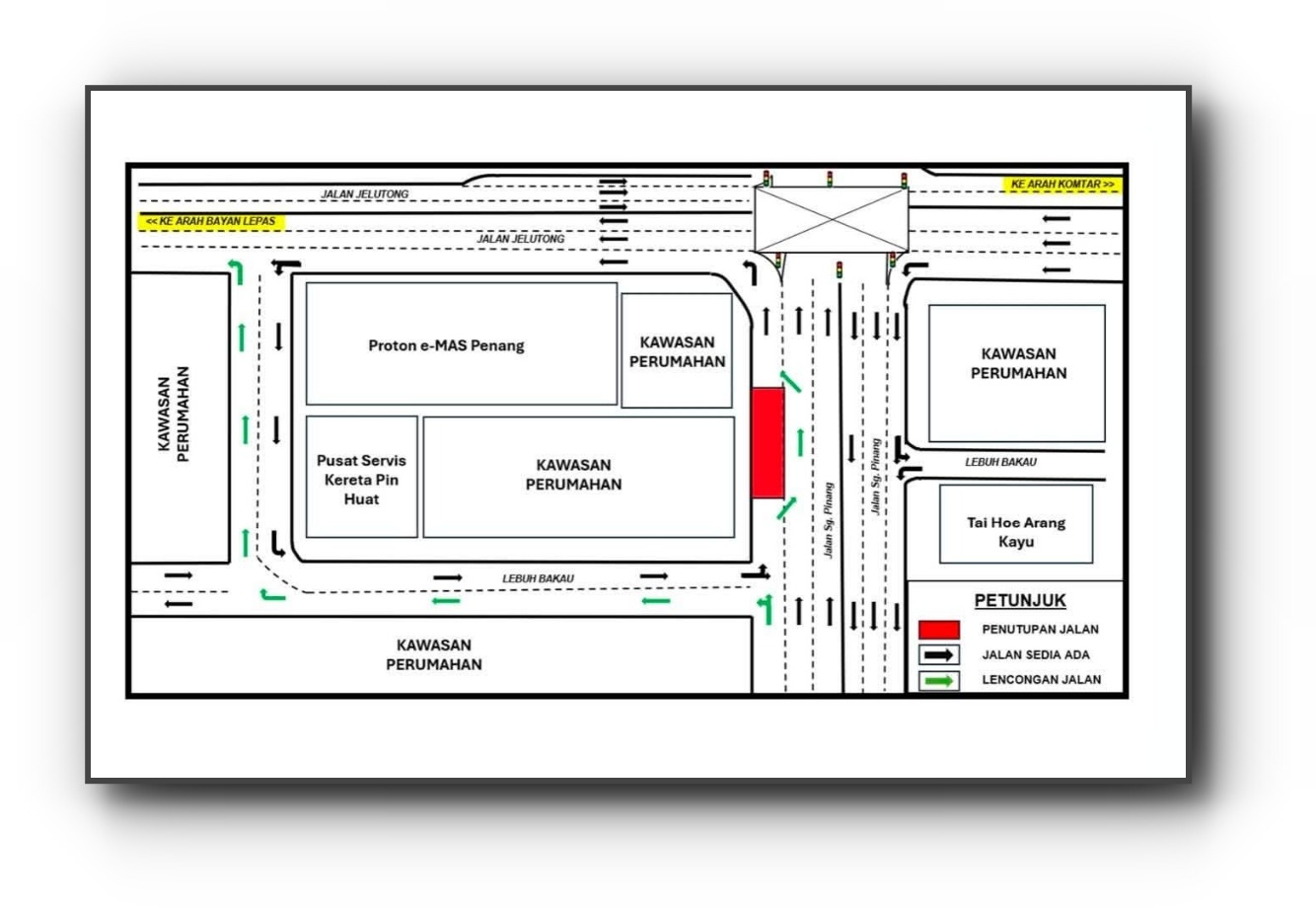
Motorists commuting through George Town's Sungai Pinang district face a week-and-a-half of traffic disruption as utility infrastructure work forces authorities to seal off one lane of a strategically important arterial road. The leftmost lane of Jalan Sungai Pinang heading towards Jalan Jelutong will be taken out of service from 9 am tomorrow through 11.59 pm on September 6 to allow Tenaga Nasional Bhd (TNB) to relocate utility lines in the corridor.
Sungai Pinang state assemblywoman Lim Siew Khim announced the closure detail through a social media statement on Tuesday evening, confirming that the affected section runs between the Lebuh Bakau junction and the Jalan Sungai Pinang-Jalan Jelutong traffic light intersection. The precise timing of the work—a full 10-day closure operating 24 hours daily—underscores both the scope of TNB's relocation project and the coordination required between the utility provider and state authorities to execute such infrastructure modification with minimal disruption to the broader transportation network.
For the Malaysian road-user community, utility relocation projects represent a double-edged reality. While essential to maintaining aging underground and overhead infrastructure that powers homes and businesses, the construction phases inevitably compress traffic flow into fewer lanes, creating congestion hotspots during peak commuting hours. In George Town's context, where traffic during morning and evening rush periods already faces pressure from the density of commercial activity and residential zones converging in the city proper, losing even a single lane can cascade into significant delays along parallel routes.
The state government's mitigation strategy centres on offering commuters an approved alternative corridor. Lim indicated that motorists heading towards Jalan Jelutong from the affected segment should redirect themselves onto Lebuh Bakau, which will serve as the primary bypass route during the closure window. This diversion, while adding marginal distance to some journeys, preserves reasonable connectivity for those whose usual commute involves traversing this section of Sungai Pinang. The retention of the three remaining lanes—middle and right—means through-traffic can still flow, albeit at reduced capacity and with tighter lateral spacing.
Safety considerations loom as a central concern in any major road works, particularly in an urban setting where pedestrian activity and side-street access demand careful traffic management. Lim, who holds the additional portfolio of state Social Development, Welfare and Non-Islamic Religious Affairs Committee chairman, explicitly urged road users to maintain heightened alertness in the work zone. The deployment of safety signboards, traffic cones, and deployed flagmen represents standard practice, yet the presence of these measures signals to motorists that the area presents non-standard driving conditions and requires concentration and patience.
Tenaga Nasional Bhd's decision to undertake these utility relocations speaks to broader infrastructure renewal patterns across Malaysian urban centres. Utility companies periodically must reposition buried cables and overhead lines to accommodate urban expansion, reduce congestion in existing conduits, or replace aging installations nearing end-of-life. In a city as developed as George Town, where infrastructure layers accumulated across centuries must coexist with modern demands for power distribution, such relocation work becomes periodic necessity rather than exceptional event.
For Malaysian businesses operating along or near Jalan Sungai Pinang, the 10-day closure presents logistical considerations. Delivery schedules may require adjustment; foot traffic to retail establishments could diminish if customers perceive access as inconvenient; and commercial vehicles serving the corridor will encounter slower transit times. Larger enterprises often coordinate with municipal authorities when major road works threaten operations, negotiating temporary access arrangements or timing modifications. Small businesses, however, frequently absorb such disruptions as unavoidable costs of urban operation.
The timing of the closure—commencing immediately rather than following an extended notice period—suggests that either the work was scheduled well in advance with minimal public visibility, or that TNB determined rapid execution more efficient than prolonged partial obstruction. From a traffic management standpoint, completing a defined project in a compressed 10-day window concentrates inconvenience temporarily rather than stretching disruption across weeks of lane restrictions, partially open facilities, and shifting work zones.
Penang's transportation authorities face perpetual balancing between maintaining infrastructure and preserving mobility, a calculus growing more complex as population density and vehicle numbers continue expanding. The Sungai Pinang corridor sits within established traffic flows that feed central George Town, making any disruption there ripple across the broader city network. Motorists should anticipate extended travel times during the closure window and allow additional buffer time for journeys involving this route, particularly during conventional peak-traffic periods.
As utility infrastructure work of this nature has become routine in Malaysian cities, the state government's transparent communication—specific dates, affected section, alternative routes, and safety measures—represents appropriate public-service practice. Residents and road users who monitor official announcements from state assemblypersons and municipal authorities gain advance warning, enabling them to adjust commuting patterns preemptively. For those dependent on Jalan Sungai Pinang's daily capacity, the 10-day window arrives as a known constraint rather than a surprise obstruction.

