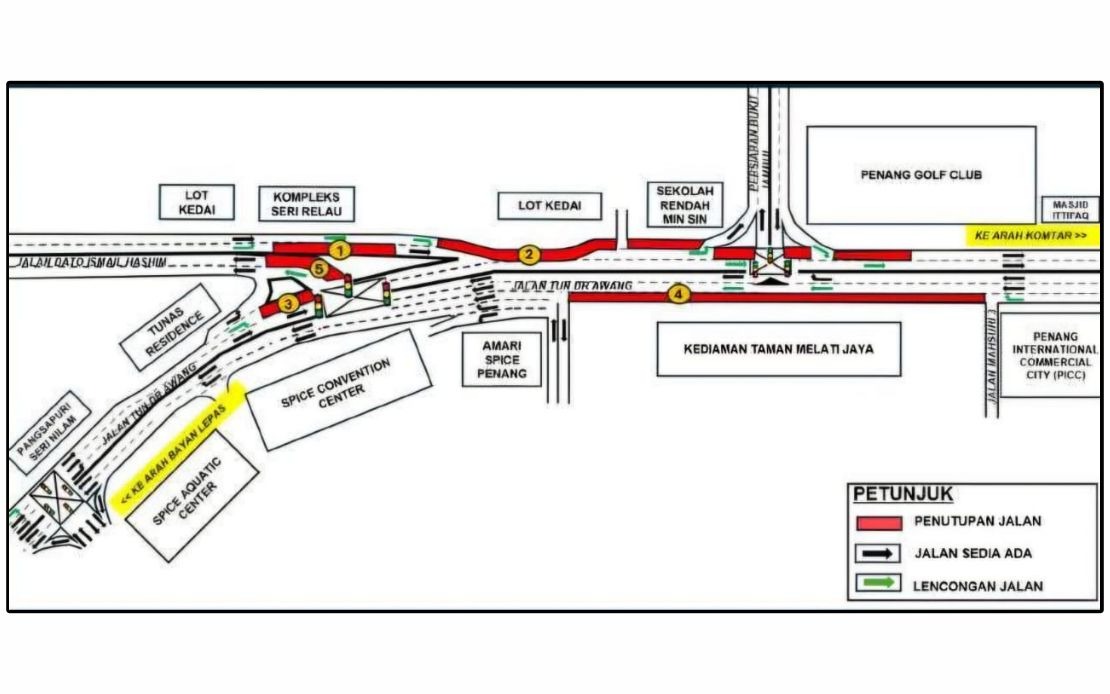
Residents and commuters in George Town will navigate revised traffic patterns along two key corridors from August 20 through October 31 as Malaysia Rapid Transit Corporation Sdn Bhd (MRT Corp) moves forward with preliminary construction for the Mutiara Line Light Rail Transit project. The 72-day initiative focuses on the stretch connecting Sri Relau Complex to Penang Golf Club, where drainage improvements and road widening will take place across both Jalan Tun Dr Awang and Jalan Dato Ismail Hashim.
The construction schedule reflects a measured approach to urban infrastructure development in one of Peninsular Malaysia's most congested city centres. Rather than implementing round-the-clock disruptions, MRT Corp has structured the closures to occur during daytime hours only, from 8:30 am to 4:30 pm daily, potentially minimising impact on evening peak-hour traffic and allowing recovery periods during early morning and night-time operations. This staging indicates coordination between the transit corporation and Penang's traffic management authorities to balance development needs with economic and social continuity.
The specific road segments targeted for closure reveal the project's phased nature under Package CMC1 of the broader Mutiara Line initiative. The right lane of Jalan Dato Ismail Hashim in front of Sri Relau Complex heading towards Komtar will be affected, alongside the left lane stretching from shop lots adjacent to SJK (C) Min Sin through to the Penang Golf Club, also in the Komtar direction. Additionally, traffic lights at the intersection of Jalan Dato Ismail Hashim and Jalan Tun Dr Awang will experience left-lane closures towards Komtar, while the leftmost lane on Jalan Tun Dr Awang near Taman Melati Jaya heading towards Bayan Lepas joins the affected network.
For Malaysian motorists accustomed to navigating Penang's intricate street layout, understanding which lanes remain passable becomes crucial for journey planning. MRT Corp's assurance that other lanes will remain open attempts to preserve at least partial traffic flow, though cumulative congestion effects are likely inevitable given the urban context. The multiple simultaneous closures across interconnected routes suggest that traffic will consolidate onto narrower passages, potentially affecting journey times across a broader geographic area than the immediate work zones.
The Mutiara Line project itself represents a significant expansion of Penang's public transport infrastructure, addressing long-standing concerns about vehicular congestion and air quality in this historic port city. As Malaysia's second-largest metropolitan area, Penang has increasingly struggled with traffic volumes that outpace road capacity, making rail-based solutions strategically important for regional economic competitiveness and quality of life. The preliminary works now commencing lay essential groundwork for what will eventually connect multiple districts and reduce dependency on private vehicles.
MRT Corp's operational readiness to manage the impacts reflects lessons learned from previous transit projects across Malaysia. The deployment of signboards, traffic cones, and flagmen at affected locations demonstrates a commitment to active traffic management rather than passive reliance on signage alone. Stationing personnel at these points addresses the critical gap between published closure information and real-time driver comprehension, particularly important in a multicultural, multilingual city where not all motorists may equally absorb English-language announcements.
For business operators along these corridors, particularly those in Sri Relau Complex and surrounding commercial precincts, the three-month disruption warrants advance planning to manage customer access and delivery logistics. The daytime-only closure window may offer some respite for evening retail operations, but the potential for reduced foot traffic and increased delivery costs during construction could strain smaller enterprises. This dimension of large infrastructure projects often receives insufficient attention in official communications, though it meaningfully affects ground-level economic activity.
The contact channels established by MRT Corp—the 1-800-88-6782 careline and [email protected] email address—attempt to centralise information requests and complaint management. However, the effectiveness of these channels depends on responsive staffing and genuine problem-solving capacity. Previous major construction projects in Malaysian cities have sometimes struggled with inconsistent customer service across communication platforms, potentially leaving motorists without timely solutions to unexpected congestion.
From a regional perspective, Penang's transit modernisation carries implications beyond the island itself. As one of Southeast Asia's primary manufacturing and logistics hubs, any impediment to traffic flow affects supply chains serving businesses across Malaysia and regional exporters. The Mutiara Line project therefore serves dual purposes: enhancing local mobility while preserving Penang's competitive position as a transportation and commerce centre. Efficient project execution during this preliminary phase sets precedent for later construction stages.
Motoring behaviour during the closure period will likely test community cooperation and traffic discipline. While MRT Corp advises caution and directional compliance, actual driver compliance with temporary signage varies considerably in Malaysian urban contexts. The presence of flagmen provides human intervention points where confusion can be addressed immediately, though their effectiveness depends on adequate training and communication clarity. Instances of drivers ignoring closures or creating unscheduled alternative routes have occurred in previous Malaysian construction projects, necessitating robust enforcement mechanisms.
The August to October timeline positions the project work during Peninsular Malaysia's northeast monsoon transition period, when weather variability could affect construction schedules and drainage work efficacy. While the preliminary phase should be less weather-sensitive than later structural works, any rainfall-induced flooding or material transport delays could extend the closure period beyond the current 72-day projection. Contingency planning for extended timelines remains unclear from available statements.
Looking forward, successful execution of this preliminary phase will facilitate transition to main construction activities under subsequent contract packages. The current works establish baseline conditions and infrastructure prerequisites that later stages depend upon. Penang residents should view the coming months as investment in long-term transport capacity, though immediate frustration with congestion remains understandable. Balancing short-term inconvenience against multi-year benefits defines the practical calculus of urban infrastructure development in growing Southeast Asian cities.

