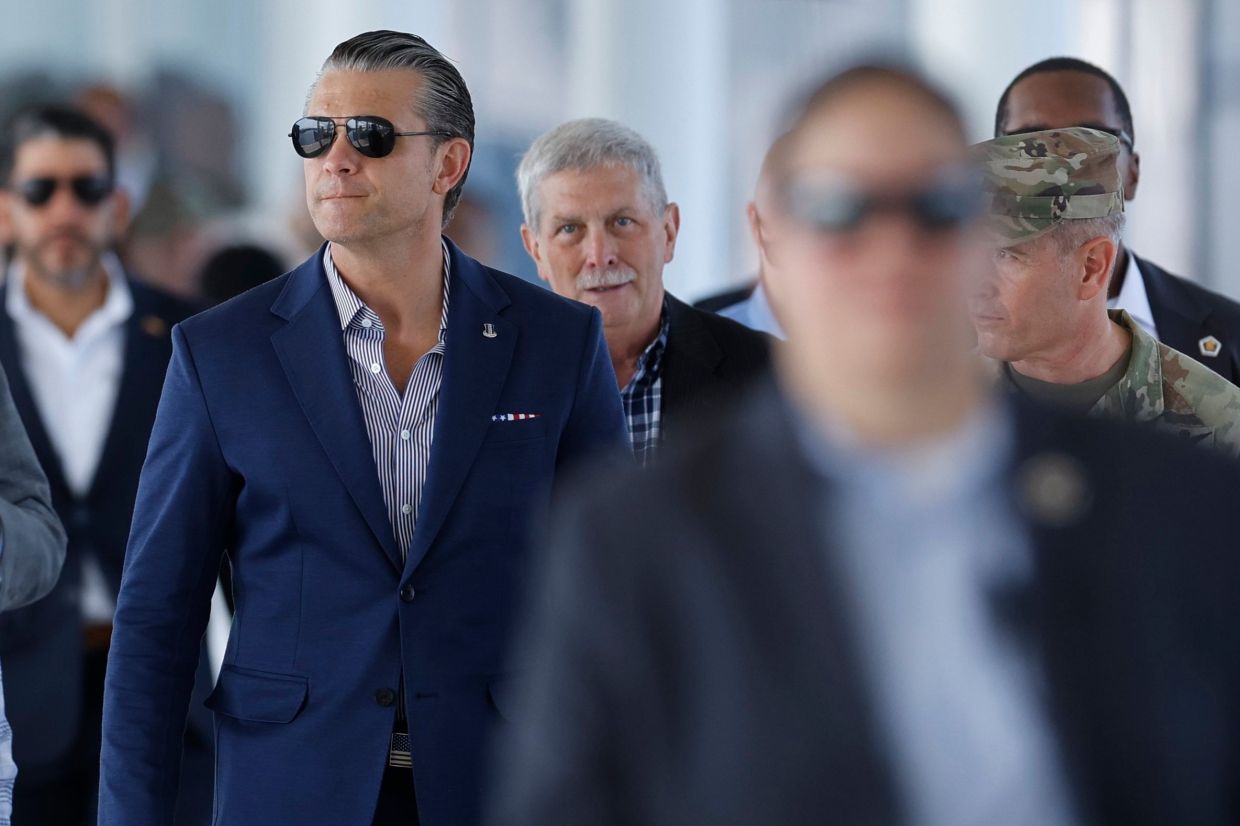
Unnamed officials within Washington's defence establishment have suggested that US Defence Secretary Pete Hegseth's tenure is increasingly precarious, with his position described as hanging by a thread amid mounting political and strategic pressures. The sources, speaking on condition of anonymity, attributed the threat to his job security to unresolved complications regarding Iran policy and a barrage of adverse media coverage that has eroded his standing. The timing of this uncertainty could not be more consequential, arriving precisely when military-to-military relations between Washington and Beijing have begun showing tangible signs of recovery following months of deliberate diplomatic effort by both capitals.
The improvement in US-China defence ties represents one of the more significant diplomatic achievements of Donald Trump's second term, with credible assessments suggesting military relations have reached their strongest point in over a decade. This progress reflects substantive engagement occurring at virtually every institutional level within both armed forces, extending far beyond ceremonial exchanges or symbolic gestures. Hegseth himself publicly affirmed this trajectory weeks after Trump and Xi Jinping concluded their summit in Beijing in May, declaring that bilateral military relations had entered genuinely improved terrain and that the two leaders' commitment to constructing a stabilised relationship extended meaningfully to their armed forces.
The Defence Department has been actively advertising this progress through official statements and strategic signalling. When senior US defence officials recently convened with Chinese vice-minister for foreign affairs Ma Zhaoxu in Washington, Alvaro Smith, the deputy assistant defence secretary responsible for China, Taiwan and Mongolia affairs, emphasised that Defence Secretary Hegseth was leading a concerted initiative to resurrect and rehabilitate military communication channels that had deteriorated over previous years. Smith's public remarks underscored Pentagon confidence that the bilateral relationship was advancing along a constructible trajectory under Hegseth's stewardship, making current speculation about his imminent departure particularly disruptive to carefully calibrated diplomatic momentum.
Chinese academic analysis provides sobering perspective on the potential consequences of Hegseth's removal. Zhao Minghao, who holds a professorship at Fudan University's Institute of International Studies, suggested that Trump may require a sacrificial figure to shoulder responsibility for complications surrounding Iran policy, a scenario that could unhappily align with preparations for upcoming US midterm electoral contests, which traditionally precipitate cabinet realignments. Zhao emphasised that if Hegseth departs, the institutional memory and established working relationships he has cultivated with Defence Minister Dong Jun would require time-consuming reconstruction, pointing to previous bilateral meetings in Malaysia and during Trump's Beijing visit as evidence of carefully developed professional rapport.
The prospect of Hegseth's departure presents genuine complications for military-to-military communication, since establishing effective defence dialogues between major powers requires sustained personal relationships and institutional continuity. Each personnel transition necessitates renewed familiarisation with counterpart priorities, negotiating positions, and operational preferences—a recalibration process that consumes months and introduces opportunities for miscommunication or misunderstanding precisely when strategic clarity becomes essential. For Malaysia and neighbouring Southeast Asian states dependent on stable great-power equilibrium, disruptions to US-China military dialogue carry implications beyond the bilateral relationship, potentially affecting regional security architecture and confidence-building frameworks.
However, several informed observers cautioned against assuming that Hegseth's potential exit would fundamentally derail the military relationship. Additional Pentagon sources characterised current US-China defence engagement as functioning exceptionally well, with one assessment suggesting that replacing Hegseth would produce minimal practical disruption to military-to-military operations unless his successor harboured aggressive ideological opposition toward China. This analysis suggests that institutional momentum and presidential-level commitment may prove sufficiently robust to survive individual personnel transitions, particularly given Trump's evident personal investment in the relationship.
A significant variable in determining continuity concerns the likely trajectory of Ely Ratcliffe Colby, the deputy defence secretary who participated in recent discussions with Ma and has evidently impressed Chinese counterparts through his intellectual approach to strategic questions. According to sources familiar with Beijing's assessments, Chinese officials regard Colby favourably, particularly following his reported characterisation of Taiwan as falling outside vital American existential interests—a formulation that contrasts sharply with more hawkish Pentagon positions and apparently resonates with Beijing's strategic calculations. Should Colby assume enhanced responsibilities or succeed to Hegseth's position, Chinese officials evidently calculate that continuity in defence engagement would advance more smoothly.
The Taiwan dimension of US-China relations adds particular complexity to assessments of Hegseth's vulnerability and potential replacement scenarios. While the United States maintains no formal diplomatic relations with Taiwan and officially adheres to the one-China framework that most nations accept, American law simultaneously obligates Washington to provide Taiwan defensive military capabilities and explicitly opposes any attempt at forcible reunification. Beijing, which views Taiwan as an inseparable territorial component and has never relinquished the possibility of military coercion, remains extremely attentive to shifts in American defence leadership that might signal changing commitment levels to this delicate equilibrium. Personnel uncertainty at the Pentagon therefore reverberates through Chinese strategic planning in ways that extend well beyond routine bureaucratic transitions.
Zhao's assessment suggested that maintaining Colby within Pentagon structures would signal continuity in defence exchanges and underscore American commitment to the strategic stability framework that Trump and Xi have embraced as the foundation for improved bilateral military relations. The broader foundation supporting improved engagement derives from both leaders' explicit agreement to pursue a relationship premised on strategic stability and mutual restraint, with explicit implications for revitalising defence-sector communication channels that atrophied during the previous administration. Working-level military talks between American and Chinese defence institutions have resumed along multiple tracks, driven partly by this high-level commitment to relationship restoration and partly by recognition that inadvertent escalation spirals require robust communication mechanisms.
The anticipated visit of Xi Jinping to Washington next month represents a crucial diplomatic occasion that will likely feature prominent agenda items concerning defence relationship strengthening. Chinese strategic calculations presumably factor in whether American defence leadership transitions might disrupt the preparations for or trajectory of this state visit. That Trump himself evidently prioritises building an improved defence relationship with China provides some confidence that institutional disruptions, however unfortunate, would not reverse this directional commitment. For the region, particularly Southeast Asian nations benefiting from relative great-power restraint, the stabilisation of US-China military dialogue offers more promising foundations than periods of wholesale rivalry and strategic competition.
The uncertainty surrounding Hegseth's immediate future highlights the inherent fragility of diplomatic progress dependent upon individual personalities and institutional relationships rather than formalised agreements or structural commitments. While Washington and Beijing have constructed impressive progress over recent months, the relationship remains vulnerable to disruptive personnel changes that interrupt institutional memory and established working rhythms. Whether American defence leadership transitions ultimately prove destabilising depends substantially on whether the presidential-level commitment to improved relations proves sufficiently anchored to survive individual officeholder departures—a question that will likely obtain clearer answer within coming weeks as speculation about Hegseth's tenure reaches resolution.

