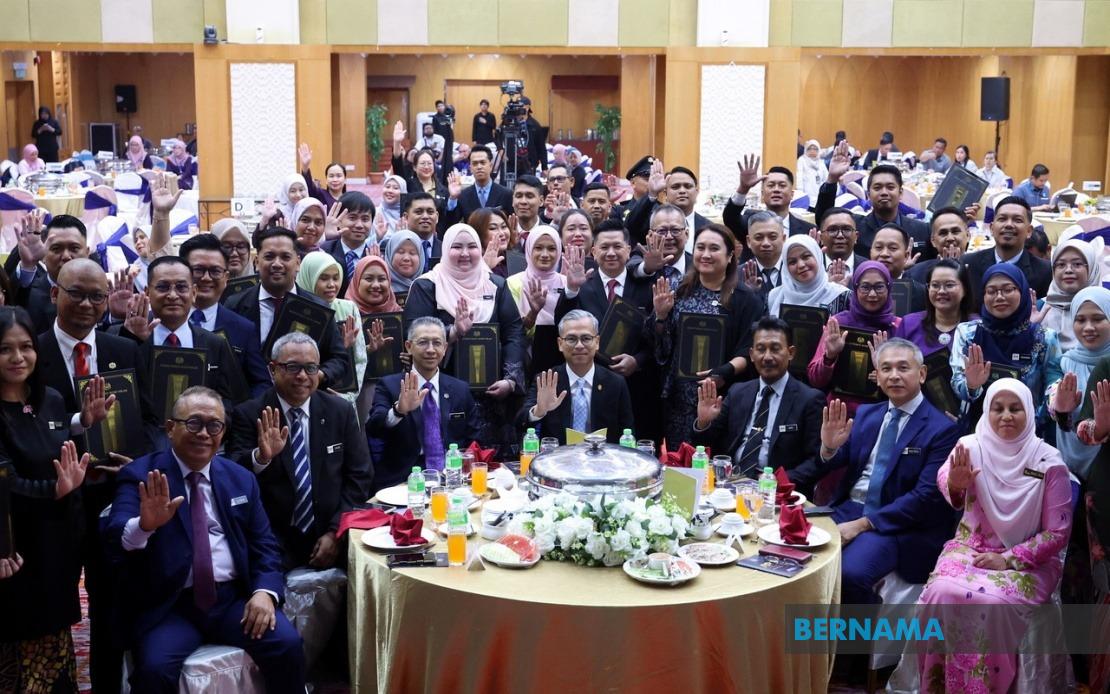
The MADANI Government is firmly committed to ensuring that national economic advances genuinely improve the living standards of everyday Malaysians, according to Communications Minister Datuk Seri Fahmi Fadzil. Speaking during an official ceremony in Kota Kinabalu, Fahmi articulated a vision where macroeconomic success becomes meaningful only when it reaches the wallets and pockets of citizens across the country's diverse regions.
While Malaysia's economic indicators paint an encouraging picture—with growth visible in investment flows, government revenue, foreign reserves, gross domestic product expansion, and trade performance—Fahmi argued that these headline figures matter little if they fail to improve how ordinary people experience their economic circumstances. The minister's remarks reflect a deliberate policy pivot toward what officials call the "people's economy," a framework that measures governmental success not merely by statistical indicators but by tangible improvements in citizen welfare.
The Communications Minister illustrated his point through the government's approach to fuel subsidies, specifically referencing the BUDI MADANI retargeting scheme. This programme exemplifies the kind of targeted policy intervention that the Cabinet, under Prime Minister Datuk Seri Anwar Ibrahim, considers essential. Rather than applying uniform subsidy approaches across the nation, Fahmi emphasized that government needs to account for geographic and local realities when designing economic policies.
Sabah and Sarawak present particularly compelling cases for this localized economic thinking. Both states face unique challenges that distinguish them from peninsular Malaysia, most notably the considerable distances between districts that necessitate frequent travel for residents. These geographic realities fundamentally shape how citizens experience the cost of living and economic accessibility. When subsidy programmes fail to account for such regional peculiarities, they inadvertently create disparities in how economic benefits distribute across the country.
Fahmi stressed that excellence achieved at the national level must demonstrably cascade down to benefit individual citizens. The government's approach thus requires balancing headline economic management with street-level realities—ensuring that GDP growth, trade surpluses, and investment inflows translate into concrete improvements that citizens notice when purchasing fuel, food, or paying transport costs. This people-centric economic philosophy positions the Cabinet as attentive to implementation challenges that technical economists might overlook.
Beyond policy design, Fahmi identified a critical communication challenge confronting the government. Ministries and government agencies bear responsibility for clearly explaining policies and programmes to the public in ways that prevent misunderstanding or confusion. Poor communication about subsidy mechanisms, eligibility criteria, or regional variations can undermine even well-designed policies, leaving citizens frustrated and sceptical of government intentions. The minister's emphasis on transparent policy communication reflects recognition that economic confidence depends partly on citizens understanding how government decisions affect them.
The remarks come as the MADANI administration navigates the delicate balance between pursuing fiscal responsibility and ensuring equitable distribution of economic gains. Malaysia's economy has demonstrated resilience, yet inequality concerns persist across regions and demographic groups. By framing economic success through the lens of citizen experience rather than purely macroeconomic aggregates, Fahmi signals that the government acknowledges these distributional challenges.
For Malaysian citizens, particularly those in peripheral regions like Sabah and Sarawak, this emphasis on people-centered economics carries significance. It suggests that future policy decisions will increasingly consider how national programmes affect specific communities with distinct geographic, economic, and social characteristics. Rather than applying one-size-fits-all solutions, this approach requires ministries to understand local contexts and tailor interventions accordingly.
The statement also reflects broader Southeast Asian trends toward inclusive growth models. Regional governments increasingly recognize that conventional development metrics fail to capture citizen satisfaction or equity outcomes. As Malaysia competes regionally for talent, investment, and social stability, demonstrating commitment to translating growth into widespread benefit becomes strategically important. Citizens who experience economic improvement directly prove more supportive of government initiatives and less susceptible to opposition messaging about governance failures.
Moving forward, the MADANI Government's success will likely hinge on its ability to deliver on this people's economy promise. This requires sustained effort across multiple fronts: designing policies sensitive to regional variation, communicating clearly about programme details and impacts, monitoring implementation to ensure benefits actually reach intended beneficiaries, and adapting programmes when evidence shows they underperform. The framework Fahmi articulated provides a useful standard against which citizens can evaluate government performance—not merely whether Malaysia's economy grows, but whether that growth genuinely improves their daily lives across the nation's diverse regions.

