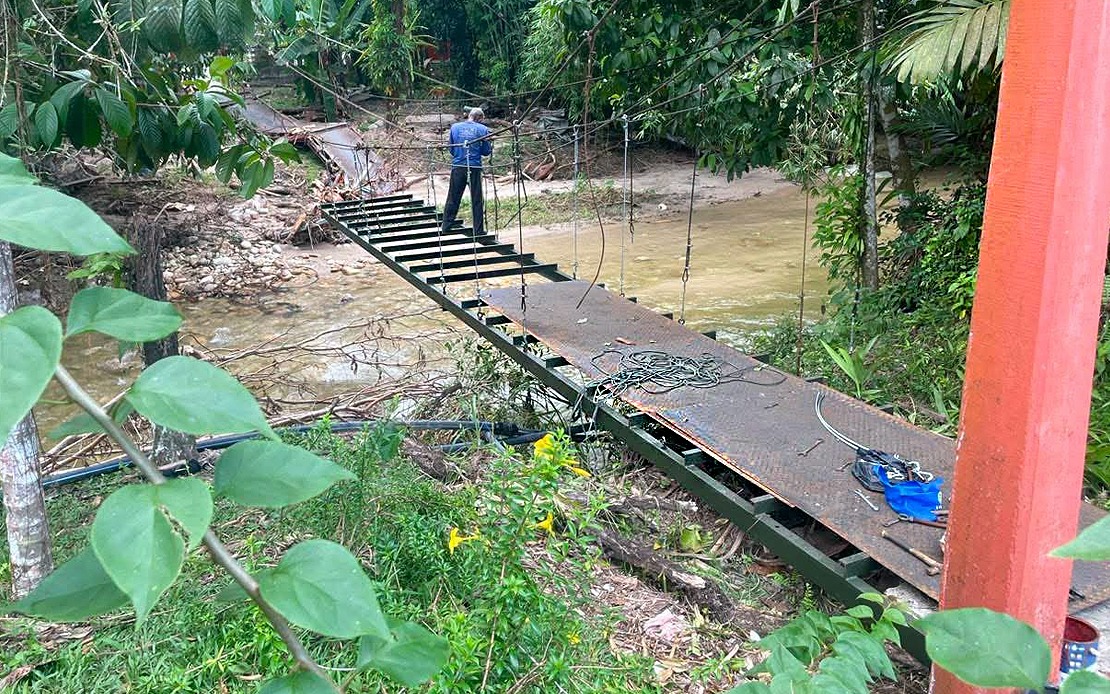
The Perak state government has moved swiftly to address infrastructure damage inflicted on Kampung Ulu Geruntum when a devastating water surge destroyed the village's primary bridge on June 19. The disaster left more than 50 residents stranded and cut off from essential services, prompting authorities to declare an emergency response. Today, state leadership confirmed a substantial RM500,000 allocation to construct a permanent concrete bridge, representing a long-term solution to restore the community's connectivity and normalcy after weeks of disruption.
Sandrea Ng Shy Ching, the State Housing and Local Government Committee chairman and Teja assemblyman, announced the funding commitment through a public statement. She emphasised the importance of completing ongoing remedial work before construction of the new bridge begins, indicating a phased approach to reconstruction. The acknowledgment of agency efforts on the ground underscores the coordinated nature of the response, involving multiple government departments working to stabilise the situation before permanent repairs commence.
Immediate relief efforts have already been deployed to mitigate hardship among affected residents. From her own constituency allocation, Sandrea authorised RM45,000 specifically directed toward repairing damaged water infrastructure and restoring the water supply that was severed during the incident. This targeted intervention addresses a critical vulnerability that compounds the isolation residents faced following the bridge collapse, ensuring that essential utilities could be restored independently of the bridge reconstruction timeline.
Recognising the urgent need for temporary access, the state government simultaneously approved an emergency allocation of RM150,000 to construct a suspension bridge. This interim structure was expected to be operational by mid-July, providing a critical lifeline for residents while the permanent concrete bridge undergoes construction. The dual-track approach—securing immediate temporary access whilst planning long-term infrastructure—demonstrates pragmatic crisis management that prioritises community welfare over waiting for permanent solutions.
The June 19 incident unfolded when powerful water currents during a surge overwhelmed the existing bridge structure, destroying it completely and severing the only road link to Kampung Ulu Geruntum. The force of the flowing water proved catastrophic, and residents had no choice but to evacuate to a temporary relief centre established at Gopeng Town Hall. The event highlighted the vulnerability of rural settlements in Perak to flash flooding and water-related disasters, particularly those dependent on single access routes across water crossings.
For Kampung Ulu Geruntum specifically, the bridge collapse represented far more than infrastructure damage. The isolation it created prevented residents from accessing work, schools, medical facilities, and markets. Children unable to attend school and workers cut off from employment represented broader economic and social costs extending beyond the immediate damage. The temporary relief arrangements, while necessary, could not substitute for the normalcy of home-based living and community independence.
The allocation decisions reveal broader policy priorities within Perak's development framework. Infrastructure resilience in rural areas increasingly demands investment in redundancy—whether through dual access routes, elevated structures designed to withstand flooding, or materials more resistant to water damage than traditional designs. The decision to fund both temporary and permanent solutions reflects learning from past disasters about the necessity of layered responses that address immediate need without compromising long-term planning.
Geographically, Kampung Ulu Geruntum's location in Gopeng places it within a region historically susceptible to water-related incidents during monsoon seasons. The Perak River system and tributaries can swell dramatically, and rural communities positioned near waterways face recurring vulnerability. The bridge reconstruction investment therefore serves a preventive function for future incidents, with a concrete structure presumably designed to withstand forces that destroyed its predecessor.
The reconstruction timeline carries significance for residents' planning and expectations. With the suspension bridge targeted for mid-July completion and the permanent structure's schedule not yet publicly confirmed, residents face several months of uncertainty about when full normalcy returns. The RM500,000 allocation suggests a bridge of reasonable scale and quality, though the actual construction duration will depend on design complexity, site conditions, and contractor availability—variables that may shift the final timeline.
Beyond the immediate Kampung Ulu Geruntum situation, the incident and response carry implications for other rural Perak communities similarly vulnerable to natural disasters. The government's willingness to fund both emergency and permanent solutions establishes a precedent that may be referenced by other villages facing similar threats. However, resource constraints mean that not every vulnerable bridge can be immediately upgraded, requiring state planners to prioritise based on risk assessment and community population size.
The coordinated response also reflects the involvement of multiple administrative layers—state government policy, constituency-level allocations, and departmental execution on the ground. Sandrea's personal involvement as both a state committee chairman and local assemblyman enabled faster decision-making than might occur through purely bureaucratic channels. This combination of positions allowed her to mobilise both state and constituency resources toward a unified response.

