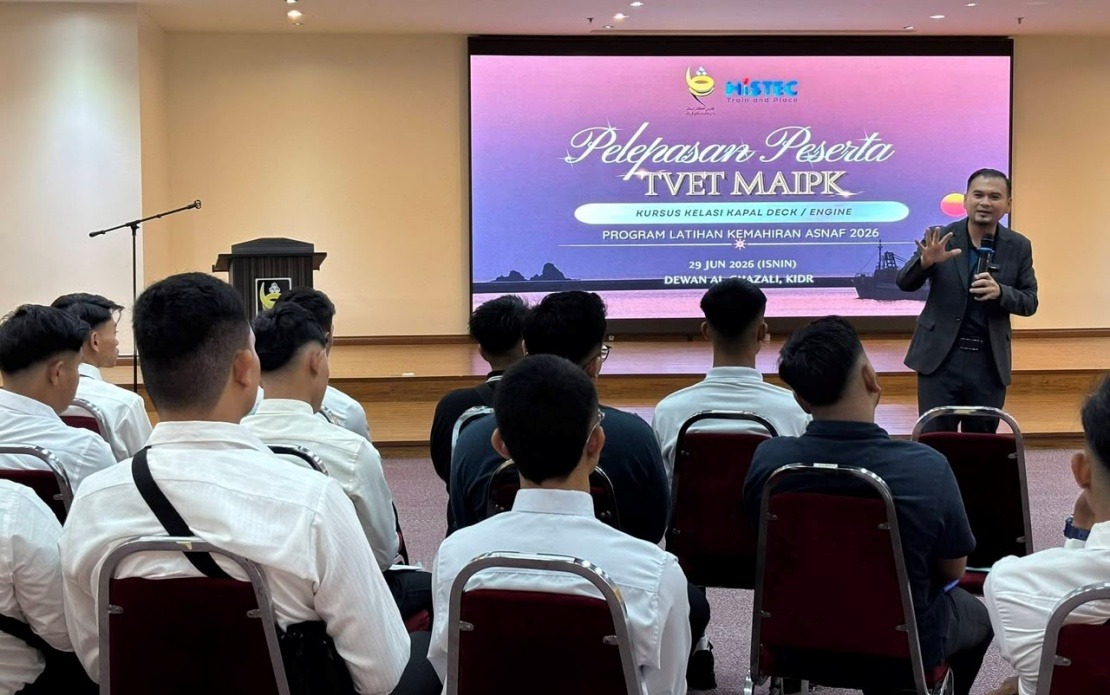
The Perak Islamic Religious and Malay Customs Council (MAIPk) has demonstrated its backing for Malaysia's vocational education agenda by pledging RM470,000 toward maritime skills development for disadvantaged young people. The funding will enable 25 asnaf participants to enrol in a specialised ship crew course covering both deck and engine operations, with each trainee receiving RM18,800 in sponsorship. This investment underscores MAIPk's wider commitment to bridging the gap between formal education and employment, particularly for communities that face systemic barriers to opportunity.
The three-month programme, delivered through Ranaco Education and Training Institute in Chukai, Terengganu, represents a structured pathway from classroom theory to hands-on maritime operations. Participants will receive comprehensive instruction in deck and engine crew functions alongside the theoretical foundations required for professional maritime work. Crucially, successful graduates will emerge with a seaman's licence—the essential credential for gainful employment in shipping, vessel operations, and related sectors. This credential-based approach ensures that training translates directly into hiring eligibility rather than remaining a generic qualification.
For Malaysia's maritime industry, which faces persistent skills shortages in technical crew roles, this initiative addresses a genuine supply-side challenge. The deck and engine crew pipeline has struggled to attract local talent, forcing operators to rely heavily on migrant workers. By funnelling underprivileged Malaysian youth into these roles through subsidised, professionally-accredited training, MAIPk is helping to localise a workforce segment that has increasingly become foreign-dominated across Southeast Asia. This has implications for both maritime safety standards and domestic employment creation.
The socio-economic dimension of this programme extends beyond simple job placement. Asnaf communities in Perak, like many underprivileged groups nationwide, often lack family connections to maritime sectors and the financial means to undertake expensive vocational courses. By removing the financial barrier through full sponsorship and providing structured placement guarantees, MAIPk is creating genuine upward mobility pathways. Graduates entering maritime employment gain access to wages and career progression that substantially exceed what many asnaf households could otherwise achieve, with long-term earning potential in vessel operations and crew management roles.
The programme's design reflects contemporary best practices in vocational education. Rather than generic skills training, the curriculum focuses on industry-specific competencies validated through professional licensing frameworks. This means employers can hire graduates with confidence that they meet international maritime standards. The combination of theoretical knowledge and practical, hands-on training mirrors the approach championed across Southeast Asia's more successful TVET systems, where labour market alignment determines programme relevance.
Placement support represents another critical element rarely evident in traditional vocational initiatives. MAIPk has committed to facilitating employment within the maritime sector immediately upon course completion, transforming training into tangible careers rather than leaving graduates to navigate job markets independently. For young people from disadvantaged backgrounds, this structured transition dramatically increases the likelihood that skills acquired will translate into sustained employment rather than underemployment or return to unemployment.
The initiative was formally launched through a send-off ceremony at Kompleks Islam Darul Ridzuan in Ipoh, with Amirudin Osman, General Manager of MAIPk's Asnaf Empowerment Division, overseeing proceedings. This institutional framing signals that the programme sits within a broader asnaf development strategy rather than operating as an isolated intervention, suggesting potential for expansion across other sectors where skills gaps exist.
From a state-level perspective, Perak's investment in maritime human capital reflects recognition that vocational pathways deserve equivalent standing to academic routes. Malaysia has long prioritised university education, resulting in credential oversupply in white-collar sectors and acute shortages in technical fields. By demonstrating concrete commitment to TVET through substantial financial investment and industry partnerships, MAIPk sends a signal that skilled maritime careers merit serious consideration among school leavers and their families.
The broader policy implications resonate across Malaysia's economic development agenda. As the country seeks to leverage its strategic maritime location and support domestic shipping and offshore industries, local talent development becomes increasingly critical. Brain drain and skills migration have depleted Malaysia's technical workforce in previous decades; initiatives like this one represent deliberate attempts to rebuild domestic capacity. For Southeast Asia more broadly, the model of religious and social institutions partnering with vocational education providers to address skills gaps offers a replicable template.
Industry sustainability also benefits from this approach. Maritime operations depend on safety cultures and institutional knowledge accumulated through experienced crews. Training young Malaysians ensures continuity of domestic maritime expertise and reduces operational risks associated with high staff turnover. Graduates entering careers supported by professional qualifications and structured mentoring are more likely to progress within maritime hierarchies, eventually contributing as experienced supervisors and trainers themselves.
The RM470,000 allocation, while significant, represents relatively modest per-unit expenditure in vocational training—under RM19,000 per participant including all curriculum, certification, and placement support costs. This efficiency suggests the model could be replicated across other skilled trades where asnaf communities face barriers to entry, from hospitality and logistics to renewable energy and advanced manufacturing. Whether other religious councils, state governments, or industry bodies follow MAIPk's lead will partly determine whether this initiative becomes a one-off success story or a blueprint for systematic skills development targeting underprivileged demographics.
Movement toward sustainable livelihoods for asnaf populations requires interventions that address both immediate poverty and long-term capability building. Skills training paired with employment guarantees represents one of the most effective mechanisms available, transforming welfare assistance into genuine opportunity creation. By coupling financial support with industry-aligned credentials and job placement certainty, MAIPk has structured an intervention likely to generate lasting returns both for participants and for Malaysia's maritime sector.

