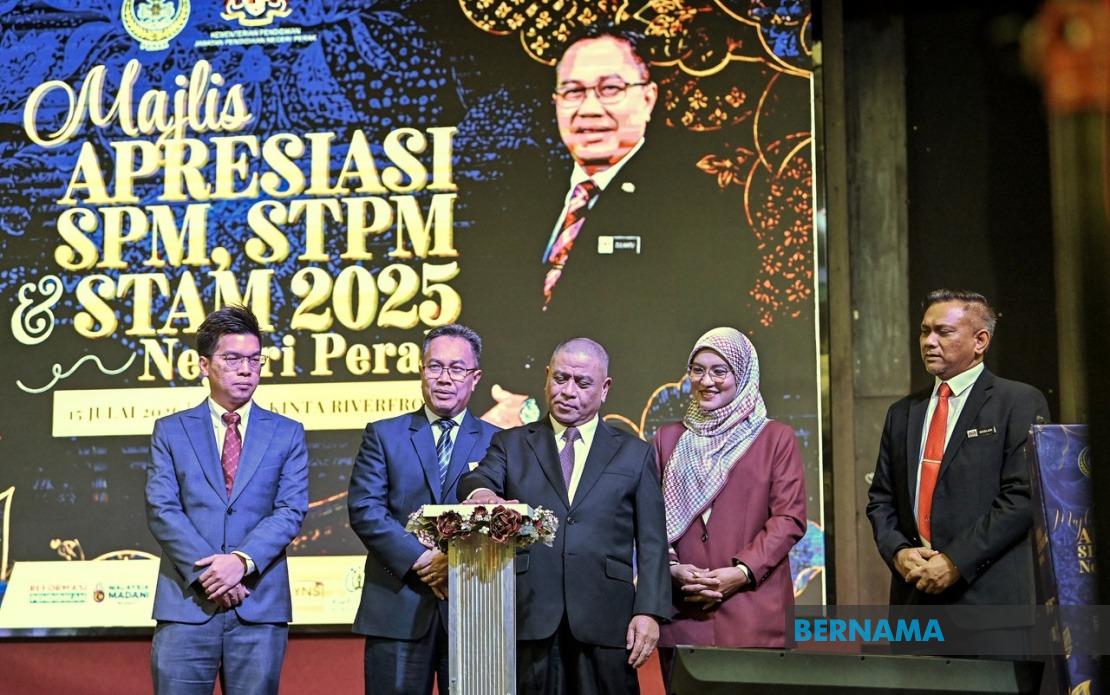
The Perak state government's Menteri Besar Scholarship has emerged as a critical financial lifeline for students pursuing tertiary education, directly alleviating the economic pressures faced by families across the state. At a recent appreciation ceremony honouring high-achieving students, recipients and government officials highlighted how the scheme combines immediate material support with longer-term investment in human capital development. The programme reflects a growing recognition among Malaysian policymakers that educational access remains fundamentally constrained by family income, particularly in states where manufacturing and agricultural sectors dominate employment patterns.
Yoong Lam, a 20-year-old graduate from Sekolah Menengah Kebangsaan Sultan Yussuff who achieved a perfect 4.00 OGPA in the Sijil Tinggi Persekolahan Malaysia (STPM), received RM1,200 per semester through the scholarship. She deployed the funds strategically across multiple educational expenses: course fees, reference materials, and supplementary tuition classes. As the eldest of two children supporting a self-employed father, Yoong Lam's experience encapsulates the reality facing many Malaysian families where parental income fluctuates seasonally and lacks formal employment protections. Her case demonstrates that even high-achieving students from modest backgrounds require institutional support to transition smoothly between secondary and higher education.
The scholarship's design addresses a structural gap in Malaysia's educational financing ecosystem. Unlike major federal schemes that concentrate resources on scholarship competitions, Perak's state-level intervention targets a broader cohort of capable students who might otherwise defer university entry or pursue underfunded fields. Muhammad Haziq Hafit, a 19-year-old from Al-Ulum Al-Syar'Iyyah Religious Secondary School in Bagan Datuk, received RM1,000 from the scheme to prepare for university entry. His planned studies in education at the University of Malaya exemplify the programme's success in channelling talent toward sectors facing persistent skills shortages. Similarly, Muhammad Taufiq Ikwan Mohammad Asri leveraged his RM1,000 allocation to fund preliminary expenses before pursuing higher education in Egypt, highlighting how modest but well-timed financial assistance enables students to access international educational opportunities.
Perak's educational performance metrics validate the broader ecosystem into which the scholarship operates. The state achieved a Grade Point Average of 4.49 across the 2025 SPM cohort, marking the highest performance in 13 years while sustaining improvements for three consecutive years. More significantly, the achievement gap between urban and rural candidates narrowed to just 0.04 points, suggesting that geographical disadvantage no longer determines educational outcomes as decisively as in previous decades. This convergence reflects coordinated interventions across multiple policy domains, each reinforcing the others' impact.
Within this ecosystem, the Tuisyen Cikgu Saarani (TCS) Programme emerged as an identifiable success factor in Perak's recent improvements. Developed by Yayasan Perak in collaboration with the Perak State Education Department, the initiative distributes specially commissioned reference materials to students pursuing SPM qualifications. The educational philosophy underlying TCS diverges from conventional tutoring by emphasising concept mastery and examination technique development through materials specifically calibrated to Perak students' demonstrated learning needs. By mapping actual pedagogical gaps rather than relying on standardised commercial textbooks, the programme achieves higher relevance and cost-efficiency.
The scope of TCS expanded substantially during 2025, reflecting lessons learned from its initial implementation phases. A total of 63,567 copies of SPM reference materials reached daily school students across Perak, with particular concentration among students identified as having high completion probability but requiring additional guided practice. The programme's extension to tahfiz schools and religious secondary institutions—Sekolah Menengah Tahfiz Darul Ridzuan and Sekolah Menengah Agama Rakyat—demonstrates institutional willingness to serve diverse educational pathways rather than privileging secular streams. This inclusiveness matters substantially in Perak, where Islamic religious education attracts proportionally more students than in peninsular Malaysia's urban centres.
The projected beneficiary population for 2026 SPM candidates approximates 25,000 students state-wide, indicating that TCS has achieved the scale necessary to influence cohort-level performance metrics. Materials developed collaboratively by experienced educators embedded in Perak's school system carry implicit knowledge about local examination patterns, teacher practises, and student learning styles that external commercial suppliers cannot replicate. This embedded expertise advantage accumulates as the programme matures, allowing continuous refinement based on outcome analysis and teacher feedback loops.
For Malaysian policymakers examining educational equity challenges, Perak's approach offers a replicable model combining targeted financial assistance with pedagogical innovation. The scholarship scheme addresses demand-side constraints—family inability to afford examination preparation—while TCS addresses supply-side inefficiencies by improving instructional quality and learning materials. Together, these interventions target both access and quality, the twin pillars of inclusive educational development. The narrow rural-urban achievement gap particularly warrants national attention, as it suggests that geography need not predetermine educational trajectories when resources and planning align strategically.
The coordination between Yayasan Perak, the State Education Department, and the Islamic Religious Department in implementing parallel interventions for different student cohorts demonstrates institutional maturity. Rather than creating redundant or competing programmes, agencies recognised complementary roles and integrated delivery mechanisms. This cross-agency approach requires sustained administrative commitment and clear performance accountability, characteristics that Perak has institutionalised through regular monitoring and public reporting of results.
Beyond immediate individual outcomes, these programmes generate systemic benefits through demonstration effects and norm-setting within educational communities. When scholarship recipients publicly credit their achievements partly to government support, and when students in religious schools access identical quality materials as those in secular schools, cultural perceptions of educational equity strengthen. Families observing improved prospects for their children develop greater investment in academic preparation, creating positive feedback loops that raise average effort and achievement across entire cohorts.
The scheme's modest award amounts—RM1,000 to RM1,200 per semester—belie their practical significance in contexts where household incomes remain modest and education competes with immediate consumption needs. A 20-year-old from a family with self-employed father faces genuine choices between purchasing required textbooks versus contributing household income. By removing this binary choice even partially, scholarships preserve educational pathways and accumulate human capital gains that compound over decades of economic activity. For Perak specifically, strengthening the educational pipeline directly supports workforce development in manufacturing and technical sectors where the state maintains competitive advantages.
Government officials' explicit commitment to expanding these interventions suggests recognition that current investment levels remain below optimal resource allocation points. As Malaysian demographics shift toward smaller youth cohorts, competition for talent intensifies and the economic returns to educational investment increase sharply. States that build reputation for supporting educational excellence and equity attract and retain talented individuals across professional sectors. Perak's evident commitment to this domain contributes to broader human capital development essential for navigating economic transitions away from commodity dependence.

