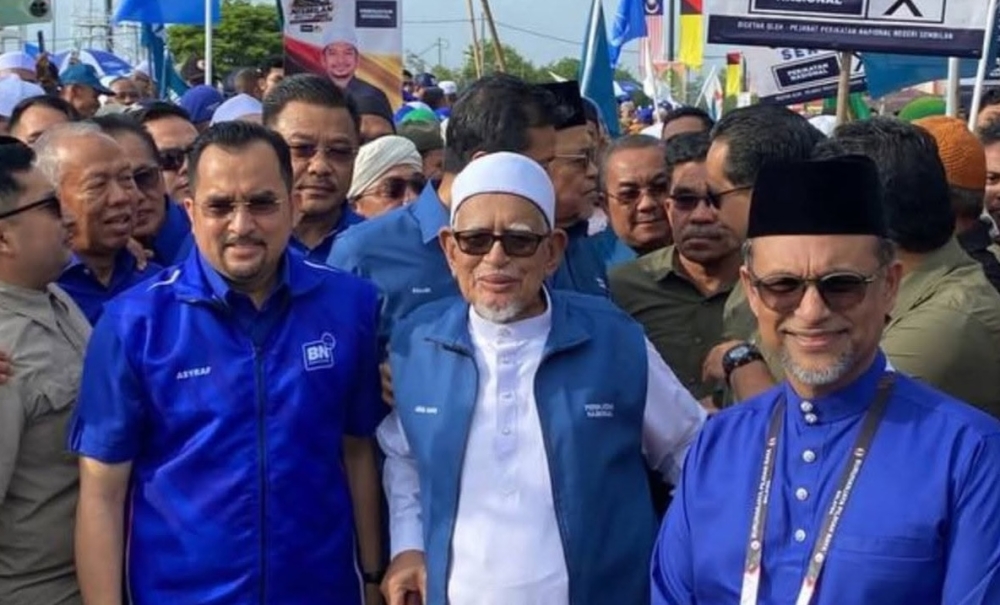
PAS president Tan Sri Abdul Hadi Awang said Perikatan Nasional (PN) and Barisan Nasional (BN) will campaign for each other in the upcoming Negeri Sembilan state election, reinforcing the electoral partnership between the two coalitions in a significant test of their political alignment ahead of other state polls.
The commitment to conduct joint campaigning represents a continuation of the cooperative arrangement that has defined Malaysian politics since the 2023 general election. Rather than contesting separately or positioning themselves as rivals, the two coalitions have opted for a unified approach that seeks to maximise their combined electoral appeal in the central state. This strategy reflects broader calculations about vote-splitting and the need to present a united front against opposition parties seeking to capitalise on divisions within the ruling coalitions.
Negeri Sembilan's election carries symbolic weight across the region. The state, nestled between the federal territories and more urbanised areas, has historically served as a bellwether for national political trends. Its composition of mixed urban, suburban, and rural constituencies means candidates must appeal to diverse voter demographics—from factory workers and civil servants in towns like Seremban to farmers and rural communities in outlying districts. A strong showing by either PN or BN could reverberate through subsequent state elections scheduled across Malaysia in coming months and years.
The announcement underscores how far Malaysian coalition politics has evolved. Rather than the adversarial zero-sum competition that characterised earlier electoral cycles, the current landscape features fluid partnerships where national alliances agree to collaborate at state level even when members may hold differing policy positions. For PAS specifically, this represents a notable shift, given the party's historical positioning as an opposition force in many states and its ideological distinctions from conventional BN partners.
Campaign coordination between two coalitions introduces both opportunities and complications. Unified messaging can reinforce key policy platforms and present a sense of governmental stability and continuity. However, it also risks voter confusion about which party merits their vote, particularly in mixed constituencies where both PN and BN field candidates. Voters in Negeri Sembilan will need to distinguish between individual candidates' qualifications and local track records rather than relying on broad coalition branding.
The arrangement signals confidence that combined support from PN and BN grassroots machinery, volunteers, and political networks can deliver election victory. Both coalitions maintain significant organisational capacity in Negeri Sembilan through their respective member parties. BN's presence through MCA, MIC, and UMNO components offers established networks, while PN brings support from PAS, Bersatu, and other constituent organisations. Joint rallies and coordinated campaign events would theoretically amplify messaging reach across the state's constituencies.
For Southeast Asian observers, this cooperation model illustrates how Malaysian politics has adapted to fragmented voter preferences and the decline of single-dominant parties. Rather than winner-take-all outcomes, Malaysia now features coalition-building where maintaining unity amongst partners often proves as important as defeating opponents. This necessitates compromise, shared credit-claiming, and negotiated power-sharing arrangements that can strain relationships but also distribute political risk.
The timing of this announcement provides clarity to political operatives and voters alike about campaign expectations. With planning horizons shortened and intensity increasing as election day approaches, early confirmation of coalition strategy allows candidates and party workers to mobilise accordingly. It also shapes voter perception of viability and momentum—coalitions that coordinate their campaigns typically project confidence, while divided approaches sometimes signal weakness or unresolved internal conflicts.
Negeri Sembilan's electoral outcome will likely influence how PN and BN approach subsequent state elections in other territories. Should the joint campaign strategy deliver decisive victories, expect similar coordination attempts elsewhere. Conversely, disappointing results might prompt either coalition to reconsider partnership terms or campaign tactics. The state thus becomes a testing ground for broader Malaysian electoral strategy that may ripple across the federation.
For Malaysian voters in Negeri Sembilan, the joint campaign presents both clarity and complexity. They can expect sustained, high-visibility political engagement as both coalitions deploy resources and messaging. However, distinguishing between substantive policy differences and rhetorical positioning will require careful attention to individual candidates' records and local concerns rather than accepting coalition-level narratives at face value. The state election ultimately remains fundamentally about which candidates and parties can best serve Negeri Sembilan's residents, regardless of higher-level coalition arrangements.

