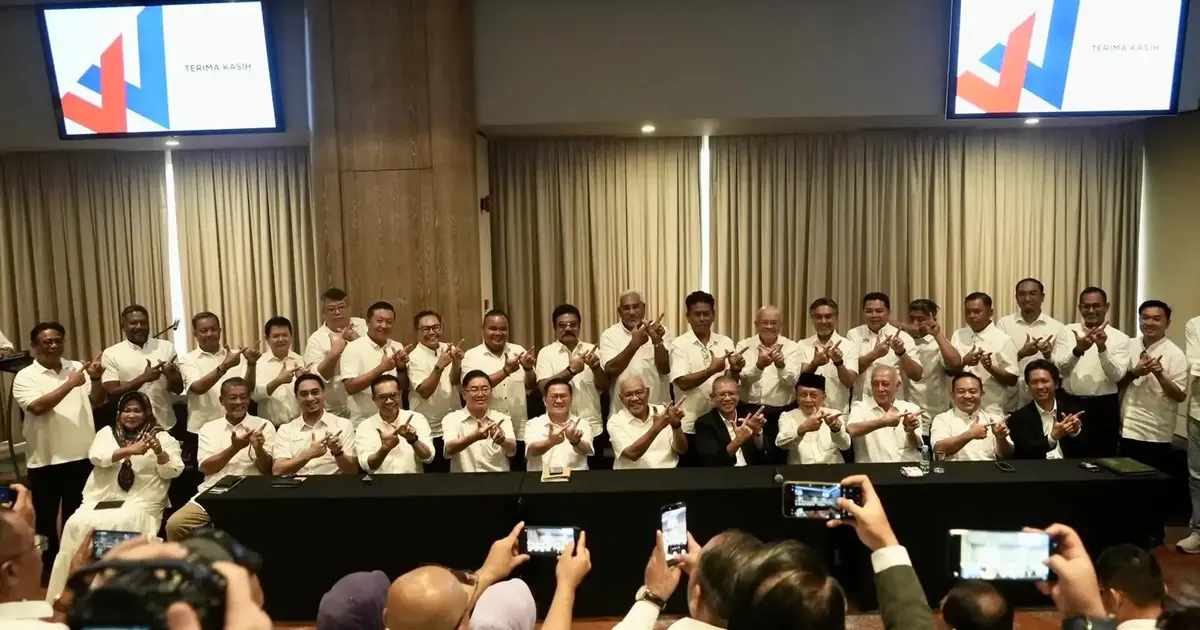
The admission of Wawasan into Perikatan Nasional has been settled through a majority vote at the coalition's Supreme Council, according to Sanusi Md Nor, the PN election director. The clarification comes amid lingering tensions within the bloc over the controversial expansion move, particularly following dissent voiced by Bersatu, one of PN's principal members.
Sanusi's statement underscores the formal decision-making process that PN leadership deployed to incorporate Wawasan, a political entity that had not previously been part of the coalition's core structure. By invoking the Supreme Council's authority and the backing of a majority vote, PN leadership signalled that the move, while contested, carried sufficient support among the coalition's key stakeholders to proceed despite internal resistance.
Bersatu's objections to Wawasan's entry into PN represent a significant fissure within what has been positioned as a unified opposition-turned-governing coalition. The party's reluctance likely stems from concerns about representation, resource allocation, or ideological alignment within the expanding bloc. In Malaysian coalition politics, where every seat and every voice carries weight in parliamentary arithmetic and in negotiating ministerial positions, the addition of new members can trigger disputes over the distribution of influence and opportunities.
The reliance on a majority vote mechanism reflects PN's attempts to establish democratic governance norms within its structures, at least in formal terms. However, such procedural victories often mask deeper strategic calculations. Wawasan's admission signals that PN leadership—likely centred around PAS and PKR—viewed the expansion as strategically beneficial, whether for broadening electoral appeal, securing additional parliamentary representation, or positioning the coalition favourably ahead of future political realignments.
For Malaysian political observers, Bersatu's unhappiness with the outcome reveals the precarious nature of grand coalitions. After the 2022 elections, when various parties scrambled to form government, consensus-building became increasingly strained. When larger partners can override the preferences of smaller members through majority voting, it raises questions about whether coalition members retain meaningful veto power or must simply acquiesce to leadership decisions.
Wawasan's integration into PN carries implications for regional politics as well. How Perikatan Nasional manages its internal diversity will influence its credibility as an alternative governing force in Southeast Asia's most complex multi-party democracy. Coalition stability and demonstrated internal democracy matter not only domestically but also in how international observers assess Malaysia's political maturity and governance capacity.
The episode also illustrates the ongoing tension between procedural legitimacy and substantive consensus in Malaysian politics. While a majority vote provides technical justification for a decision, it does not necessarily resolve the grievances of the minority or prevent future disputes from resurging. Bersatu's recorded objection creates a documentary trail that could be invoked later if Wawasan's membership proves divisive or if the coalition experiences electoral setbacks that Bersatu members might attribute to the expansion.
From a broader Southeast Asian perspective, this dispute within PN mirrors similar challenges faced by large political coalitions across the region. As parties attempt to build broader platforms to compete in an increasingly fragmented electoral landscape, maintaining coalition discipline while accommodating diverse interests becomes exponentially more difficult. The Malaysian case demonstrates how even procedural clarity cannot fully eliminate the friction inherent in coalition management.
Sanusi's public reaffirmation of the decision's legitimacy through majority vote also serves to close off further debate within PN structures, at least formally. By anchoring the decision in the Supreme Council's collective judgment rather than any single leader's preference, the coalition's hierarchy sought to present the outcome as institutionally sound and collectively endorsed. This framing attempts to bind dissenters like Bersatu to the result through appeals to democratic process and collective responsibility.
Looking ahead, the durability of Wawasan's membership within PN will likely depend on whether the coalition can stabilise its internal relationships and maintain sufficient electoral viability to justify the expansion to sceptical members. If PN faces significant political reverses or internal conflicts intensify, the admission of Wawasan could become a focal point for broader recriminations about coalition management and strategic direction.
The incident ultimately reflects a fundamental challenge in Malaysian politics: how to build stable governing coalitions in an environment where party fragmentation, shifting alliances, and the calculation of electoral advantage constantly test the bonds holding partners together. For Malaysian voters and observers monitoring PN's evolution, the handling of this internal dispute provides revealing insight into how the coalition manages disagreement and exercises power among its members.