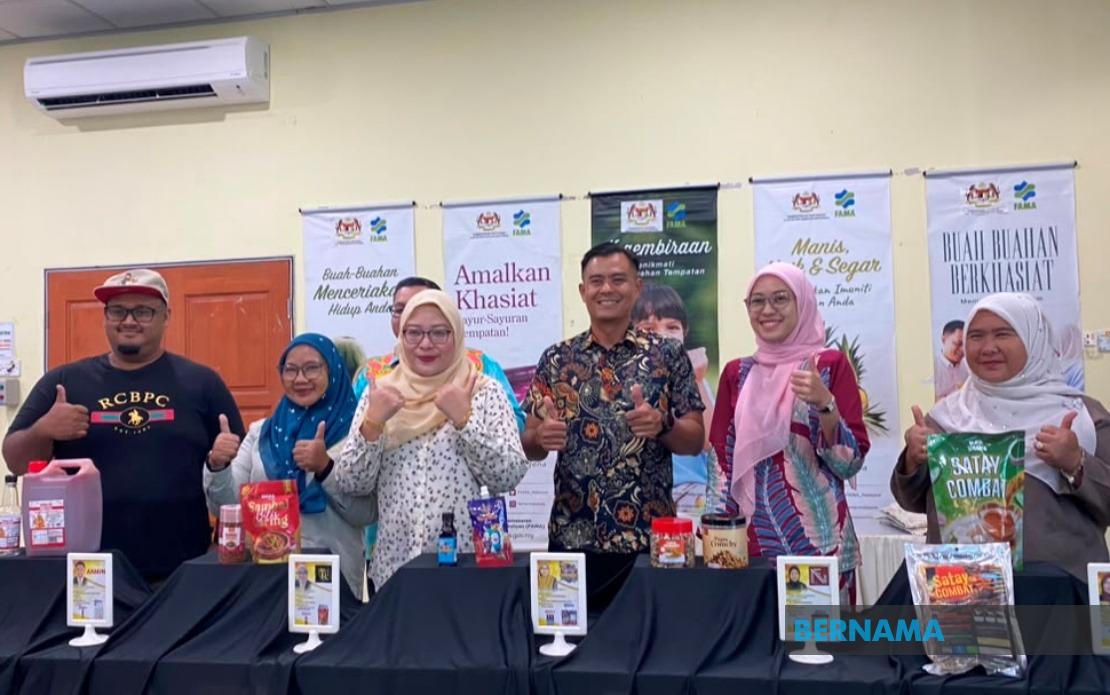
The Perlis branch of the Federal Agricultural Marketing Authority (FAMA) has stepped up its support for the state's agro-food sector by channelling RM510,500 in grants to nine entrepreneurs operating within the Agro-Food and Agro-Based Industry (IMAT) space. The funding disbursement, which took place on July 30, represents a targeted intervention designed to address key bottlenecks that small and medium-sized players face when competing in Malaysia's increasingly sophisticated agricultural marketplace.
According to FAMA Perlis director Mohd Anzara Azizan, the grant allocation was distributed across four distinct support mechanisms, each targeting different facets of business development. The largest portion, RM392,000, was allocated through the Agro-Tourism Grant scheme, positioning rural and agricultural entrepreneurs to tap into Malaysia's growing domestic and regional tourism market. A further RM83,500 went to the Product Image and Packaging Improvement Grant, acknowledging the reality that modern consumers place significant weight on visual presentation and brand perception when selecting agro-products. The remaining funds were split between the KSHOPPE Outlet Improvement Grant at RM25,000 and the Marketing Equipment Support Grant at RM10,000, both of which address the operational and infrastructure gaps that often constrain growth among emerging agribusiness ventures.
The emphasis on product packaging and branding reflects a strategic shift within FAMA's approach to agricultural development in Perlis. Rather than providing passive subsidies, the authority is investing in what might be termed the "commercialisation layer" of agro-entrepreneurship, recognising that small producers often struggle less with production capability and more with the ability to project professional image and access premium market segments. By improving how products are presented to consumers, FAMA hopes to unlock price-point advantages and expand sales channels beyond traditional wet markets into modern retail environments and e-commerce platforms.
Mohd Anzara highlighted that these grant initiatives form part of the broader IMAT Market Development and Product Matching Project, a programme specifically designed to nurture Stage One through Stage Three small and medium enterprises. This targeted classification system allows FAMA to calibrate its support intensity according to where each business sits in its development trajectory, ensuring that early-stage operators receive foundational assistance while more mature ventures gain access to scaling opportunities. The tiered approach reflects international best practice in agricultural development policy, where one-size-fits-all support rarely produces optimal outcomes across diverse business contexts.
Data released by the Perlis FAMA office reveals encouraging momentum within the state's agro-food sector. The 319 IMAT entrepreneurs currently registered with FAMA recorded combined sales of RM4.8 million as of the grant announcement date, representing a substantial 30 per cent year-on-year increase. This growth trajectory suggests that FAMA's previous interventions and advisory services are yielding tangible results, validating the investment in grant-based support mechanisms. The 30 per cent expansion outpaces typical small business growth rates in Malaysia and indicates that targeted assistance, when combined with entrepreneurial effort, can generate meaningful economic activity at the grassroots level.
The sales increase carries particular significance for Perlis, a relatively small state in Malaysia's northern corridor that historically has relied heavily on agriculture and related industries. For a state where agro-food entrepreneurship represents one of the few viable pathways to rural income generation and employment retention, the demonstrated growth helps counter the narrative of agricultural decline and rural economic marginalisation that has characterised much development discourse in Malaysia over recent decades. When properly supported, the agro-food sector can function as an anchor for rural prosperity and community stability.
Beyond the grant distribution itself, FAMA Perlis has undertaken to play an active market stewardship role. Mohd Anzara indicated that the authority monitors both marketing practices and pricing strategies among the entrepreneurs it supports, ensuring that competitive advantages are not achieved through predatory pricing that would ultimately prove unsustainable or that undermine the sector's collective reputation for fair dealing. This oversight function addresses a persistent weakness in agricultural markets where information asymmetries and fragmented supply chains can allow unfair competition to undermine ethical business practices.
The director revealed that FAMA currently offers approximately nine distinct grant and support services tailored to IMAT entrepreneurs, a suite of programmes that extends well beyond the four schemes mentioned in connection with the recent Perlis distribution. This diversity of offerings suggests that FAMA recognises the multifaceted nature of modern agro-entrepreneurship, which increasingly requires competencies spanning production, marketing, digital engagement, and supply chain management. The availability of multiple pathways for assistance increases the likelihood that entrepreneurs with different needs and circumstances can find relevant support.
Mohd Anzara's appeal for greater uptake of available FAMA services points to a common challenge in agricultural development: the gap between supply of support and awareness or utilisation of that support. Many small producers, particularly those operating in rural areas or with limited formal business training, remain unaware of available grant schemes or lack the confidence to navigate application procedures. Addressing this awareness gap through targeted outreach, simplified application processes, and perhaps peer-to-peer learning networks could unlock significantly more productive activity than the current utilisation rate suggests. The RM510,500 distributed to nine entrepreneurs in Perlis may represent only a fraction of the total grants available across FAMA's nationwide operations, suggesting substantial untapped potential for agricultural entrepreneurship development.

