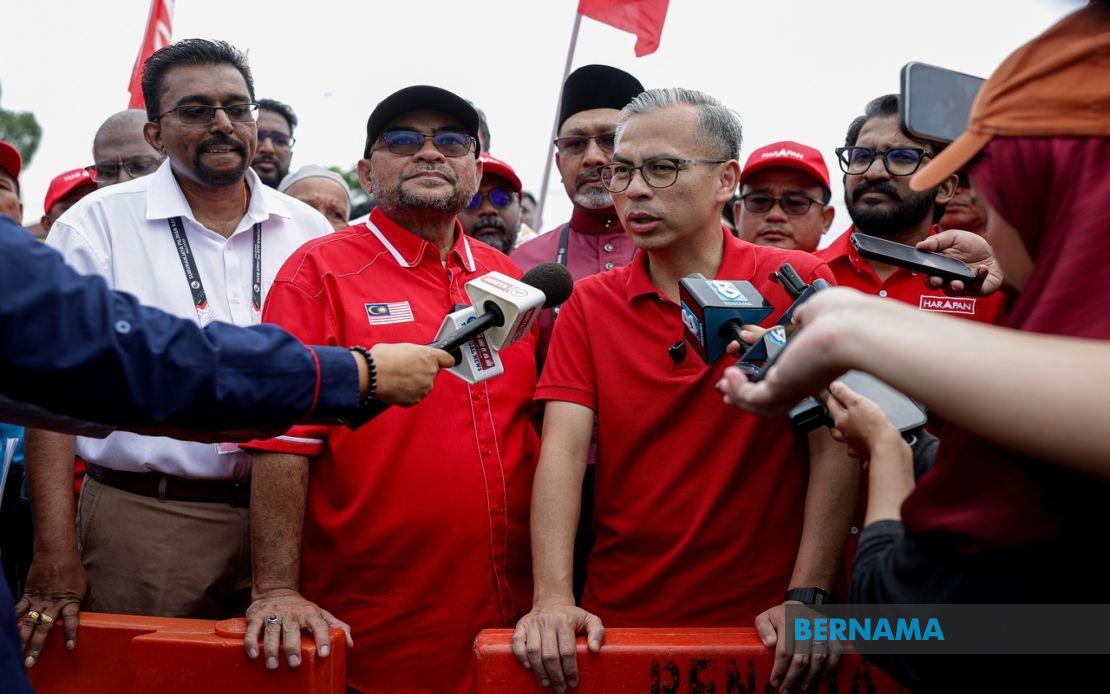
Pakatan Harapan's strategy for the Negeri Sembilan state election centres squarely on showcasing the accomplishments of the outgoing administration under Menteri Besar Datuk Seri Aminuddin Harun, with party communications machinery emphasising continuity and proven governance. The coalition's messaging, articulated by Communications Minister Datuk Seri Fahmi Fadzil following candidate nominations in Jempol, frames the upcoming contest as a referendum on the state's economic trajectory and institutional stability over the past seven years.
Since assuming office in 2018, Aminuddin's administration has compiled a portfolio of achievements that the coalition intends to leverage across the campaign. These include substantially higher zakat collection revenues, augmented state government income from various sources, and notably the continuous attraction of foreign direct investment into Negeri Sembilan. The centrepiece of the economic argument is the development of new port infrastructure, a flagship project intended to demonstrate the administration's capacity to attract major capital and create regional economic opportunity. This litany of deliverables forms the empirical foundation of PH's electoral pitch—that replacing a functioning administration invites unnecessary economic and institutional risk.
The strategic logic underlying this approach reflects broader truths about incumbent advantage in Malaysian state politics. Voters confronted with a choice between maintaining a demonstrably functional status quo and embracing uncertainty typically gravitate toward continuity, particularly when the economic rationale is reinforced with concrete projects and fiscal metrics. For a state like Negeri Sembilan, which lacks the strategic economic heft of Selangor or the resource wealth of Sarawak, the ability to consistently attract foreign capital and grow the revenue base represents a significant political asset. Fahmi's emphasis on these tangible outcomes rather than ideological positioning reflects a deliberate choice to contest the election on ground favourable to the incumbent.
Aminuddin, colloquially known as Tok Min within political circles, occupies a position of relative stability within Negeri Sembilan's political landscape—a contrast to the more volatile contestations unfolding elsewhere. This stability translates into institutional capacity to execute policy over extended timeframes, a characteristic reflected in the port development project and the systematic expansion of revenue streams. For voters weighing governance quality against partisan alternatives, such demonstrated administrative competence carries material weight, particularly in states where infrastructure deficits remain pronounced and economic diversification remains incomplete.
The electoral geography of the contest underscores the granular nature of Malaysian state politics. The four constituencies under examination within the Jempol parliamentary area—Serting, Palong, Jeram Padang, and Bahau—present varied competitive dynamics. In Jeram Padang, a four-cornered fight pits PH candidate G. Manivannan, a lawyer serving as political secretary to Prime Minister Datuk Seri Anwar Ibrahim, against the incumbent Datuk Mohd Zaidy Abdul Kadir of Barisan Nasional, alongside challengers from Perikatan Nasional's Bersatu component and Asli, represented by the sole Orang Asli candidate Dayana Dal. Manivannan's positioning emphasises employment creation and economic opportunity expansion for younger constituents, translating the state-level narrative of investment and growth into localised economic promise.
The contests in Serting and Palong assume three-cornered configurations involving PH, Barisan Nasional, and Bersatu competitors, creating complex vote distribution scenarios where incumbent performance narratives intersect with fractured opposition support. Bahau presents a binary contest between PH's incumbent Teo Kok Seong of the Democratic Action Party and Barisan Nasional's Chong Fui Ming representing the Malaysian Chinese Association, offering the clearest direct comparison between coalitional governance models. This structural variation across constituencies requires tailored messaging that simultaneously reinforces the state-level continuity argument while addressing specific local preoccupations and competitive dynamics.
Fahmi's exhortation to all parties to maintain campaign standards and avoid incitement reflects the institutional fragility that persists despite Malaysia's formally stable democratic architecture. The invocation of the three Rs—religion, race, and rulers—as boundaries for acceptable discourse acknowledges the latent sectarian and communal tensions that periodically erupt into electoral contestation. This appeal for responsible campaigning from the Communications Minister carries particular weight given his portfolio responsibility, though its effectiveness depends upon voluntary compliance from political actors motivated by victory rather than institutional preservation.
The regulatory framework governing the contest establishes July 28 for early voting with polling day scheduled for August 1, providing a compressed two-week campaign window. This condensed timeline privileges incumbent candidates and established party machinery capable of rapid resource mobilisation over insurgent challenges requiring extended organising periods. For Pakatan Harapan, the brevity of the campaign period favours rapid communication of the administrative continuity narrative across existing media infrastructure, reducing the time available for opposition parties to construct alternative frames or expose potential vulnerabilities in the incumbent record.
The electoral stakes for Pakatan Harapan extend beyond Negeri Sembilan's borders, as state-level performance carries signal value for national coalition cohesion and Prime Minister Anwar Ibrahim's broader political positioning. Negeri Sembilan represents relatively secure PH-aligned territory compared to more volatile states where the coalition faces existential contestation, making loss of administrative control strategically damaging to perceptions of the coalition's governing competence and political trajectory. Conversely, a decisive PH victory would reinforce the narrative of an administration consolidating support and executing an effective governance agenda, strengthening Anwar's hand in intra-coalition negotiations and demonstrating capacity to retain state-level footholds.
The broader context of Malaysian federalism creates incentive structures wherein state-level performance directly impacts national political calculations. Negeri Sembilan's relatively homogeneous demographic and economic profile provides a cleaner governance laboratory than more complex polities, making the state's political verdict potentially instructive for competitive dynamics elsewhere. Should PH successfully argue that administrative continuity and economic performance constitute decisive electoral factors, the model becomes exportable to other state contests where similar governance arguments can be mounted.
The opposition's counter-narrative remains partially obscured by the structural fragmentation of anti-PH sentiment across Barisan Nasional, Perikatan Nasional, and minor parties. This dispersal of opposition support, evident in the multiple three- and four-cornered contests, strategically advantages the incumbent coalition by preventing coherent alternative governance proposition. Without a unified opposition frame offering clear administrative alternative, voters confronted with Fahmi's reiteration of economic achievements face difficulty assembling compelling reasons to disrupt institutional continuity. Whether this structural advantage proves decisive depends on whether opposition parties can construct narratives transcending incumbent performance claims, focusing instead on accountability mechanisms, corruption concerns, or alternative economic visions.

