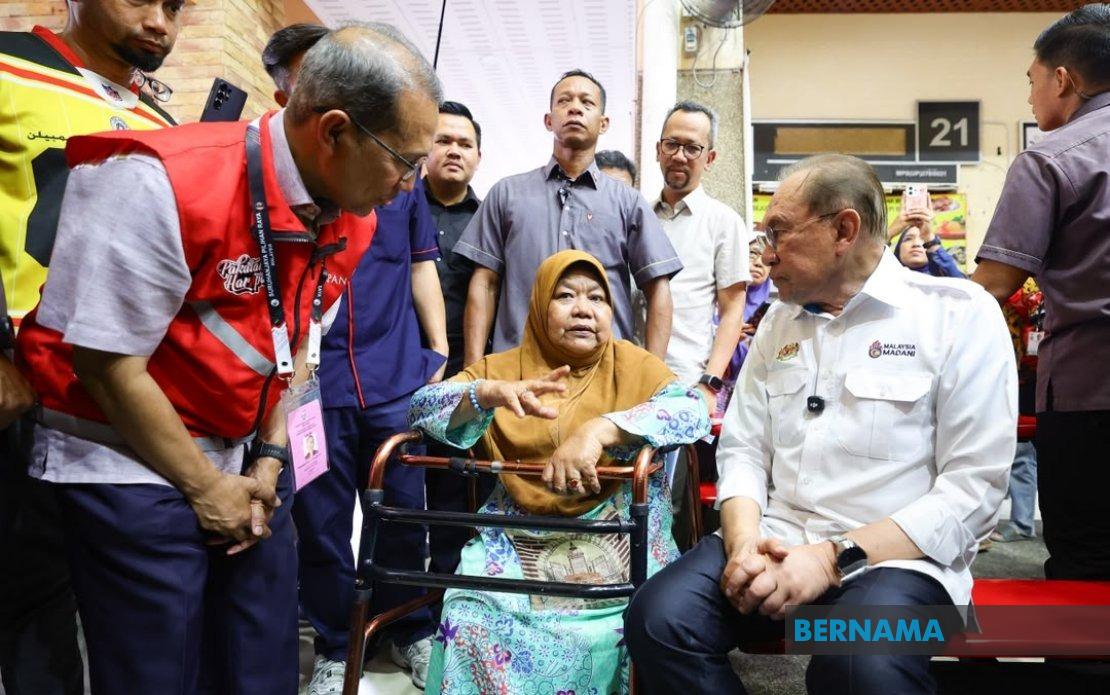
Prime Minister Datuk Seri Anwar Ibrahim has presented the reciprocal river widening and deepening projects unfolding across Negeri Sembilan as a compelling demonstration that the Pakatan Harapan (PH)-led state administration possesses both the competence and commitment to channel development benefits directly to ordinary people. Speaking at a grassroots engagement session in the Ampangan district, Anwar framed these infrastructure initiatives not merely as flood mitigation measures but as embodiments of a governance philosophy centred on transparency and public welfare, a message calculated to resonate with voters ahead of the 16th Negeri Sembilan State Election scheduled for August 1.
The reciprocal project model that Anwar highlighted represents a distinctive approach to resource management gaining traction within PH-administered states. Under this framework, sand and materials extracted during river maintenance and improvement work are harvested and monetised, with the proceeds funnelled back into sustaining and upgrading the waterways themselves. This circular economic model simultaneously addresses the state's chronic flooding vulnerabilities—a persistent infrastructure challenge that has plagued Negeri Sembilan communities for years—whilst ensuring that financial benefits circulate within local economies rather than being siphoned away through conventional commercial arrangements.
The Ampangan area project, which formed the centrepiece of Anwar's remarks, exemplifies this philosophy in practice. By deploying the reciprocal methodology, the Negeri Sembilan government has shifted from reactive flood management to a sustainable model where environmental stewardship generates its own financing mechanisms. For residents accustomed to watching development resources flow toward politically connected contractors or distant urban centres, the promise of locally-generated capital reinvested in community infrastructure addresses a fundamental grievance that has long animated electoral contestation in Malaysian states.
Anwar's emphasis on integrity-based governance carries particular weight in the Malaysian political context, where patronage networks and resource misallocation have historically undermined public confidence in state institutions. By explicitly tethering the Ampangan projects to transparent resource management, he positioned PH's stewardship as a departure from the extractive governance patterns that characterised earlier administrations. This framing resonates especially in semi-rural constituencies like Ampangan, where residents witness both the tangible benefits of improved infrastructure and the mechanisms through which those benefits materialise.
The Prime Minister buttressed his argument by invoking his own involvement in a Port Dickson hotel development initiative, recounting how that project incorporated provisions for the local fishing community's welfare, encompassing educational assistance and housing improvements. Though brief, this anecdote served to establish Anwar's personal track record of community-conscious deal-making, suggesting that his commitment to balancing development with social equity extends beyond campaign rhetoric into demonstrated practice across his political career.
The 16th Negeri Sembilan State Election arrives at a pivotal moment for PH, which holds the state government but faces the perpetual challenge of converting administrative performance into sustained electoral support. The party is contesting all 36 seats with a coalition ticket comprising 16 PKR candidates, 11 from DAP, and nine from Amanah, a distribution reflecting the ongoing negotiation between coalition partners over territorial representation. For Malaysian observers monitoring coalition dynamics, Negeri Sembilan's electoral outcome will furnish important signals about whether PH's multi-ethnic, multi-party configuration can maintain coherence and deliver results in mid-sized state contexts.
Anwar's appeal to voters explicitly emphasised the moral and personal dimensions of electoral choice, exhorting constituents to select candidates of integrity across communal lines. His invocation of trustworthy Malays, Indians, and Chinese representatives implicitly acknowledged the communal arithmetic that shapes Malaysian electoral behaviour whilst attempting to transcend it through an appeal to individual character and competence. This rhetorical strategy attempts to elevate electoral competition beyond zero-sum communal competition toward a framework emphasising collective governance quality.
The timing of Anwar's campaign appearances in Negeri Sembilan reflects PH's recognition that the state election carries symbolic significance for its broader fortunes. As the party navigates the challenges of sustained governance and manages internal coalition tensions, demonstrating tangible developmental outcomes in states under its control becomes essential to rebuilding public confidence eroded by decades of administrative fatigue with the previous ruling coalitions. Negeri Sembilan, neither economically dominant nor politically irrelevant, functions as a testing ground where PH's governance model can be evaluated against its promises.
The reciprocal river projects that Anwar championed merit examination beyond their electoral utility, as they illustrate evolving approaches to sustainable infrastructure financing in Southeast Asian states grappling with climate vulnerability and resource constraints. By demonstrating how environmental management can generate the revenue streams necessary for its own perpetuation, Negeri Sembilan's model offers instructive lessons for other Malaysian and regional jurisdictions confronting similar flooding pressures and budgetary limitations. The viability of such approaches depends substantially on administrative capacity, transparent financial management, and political will to resist pressure to divert resources toward patronage networks—precisely the governance conditions that Anwar's campaign messaging claims PH provides.
As polling day approaches, the Negeri Sembilan election will determine whether voters accept PH's presentation of itself as a custodian of transparent, community-focused administration capable of delivering sustainable development. The reciprocal projects function both as physical infrastructure investments and as symbols of a broader governance reorientation, encapsulating Anwar's argument that PH administrations can marry development ambition with ethical resource stewardship. The verdict rendered by Negeri Sembilan voters will illuminate whether such promises, when coupled with demonstrable project implementation, sufficiently motivate electoral support to sustain PH's political trajectory through an increasingly contested domestic political landscape.

