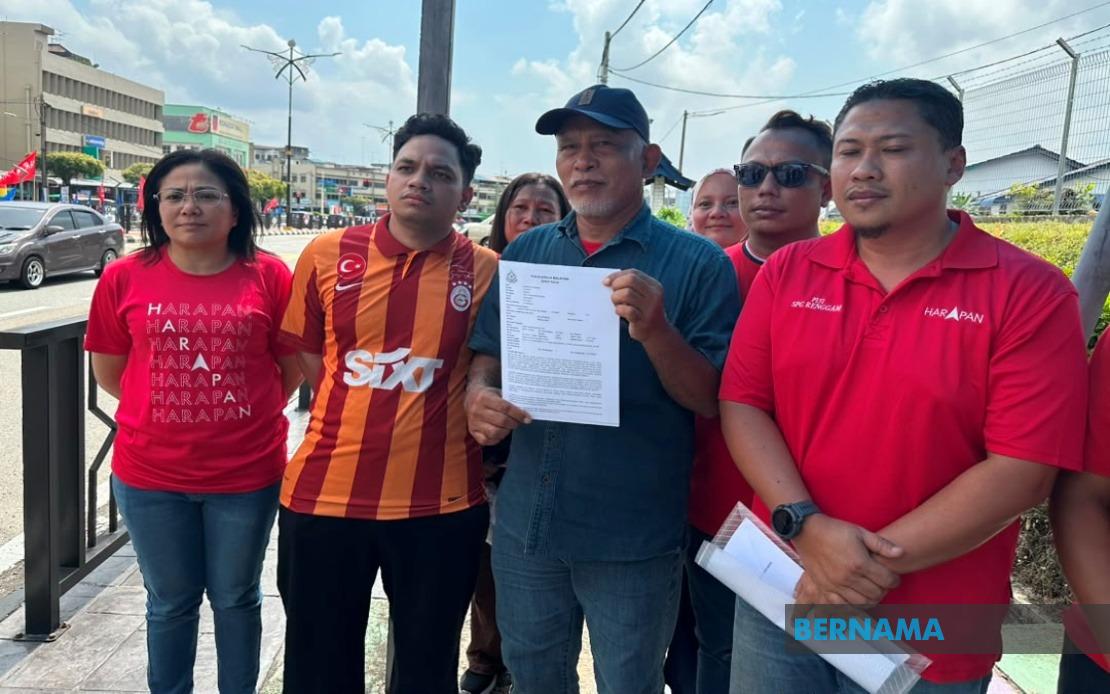
A representative of the Pakatan Harapan candidate contesting the Machap seat in the Johor state election has lodged a formal police report against Menteri Besar Datuk Onn Hafiz Ghazi at Simpang Renggam district police headquarters, alleging that vocational students were manipulated into attending campaign events designed to benefit Barisan Nasional candidates.
The complaint, filed by Khiru Nasir Rohani on July 9, centres on allegations that Technical and Vocational Education and Training (TVET) institutions and their students were instrumentalised for partisan political purposes. According to Khiru Nasir, who holds the position of deputy division chief for Simpang Renggam Amanah, there was a systematic and coordinated campaign to compel students from local TVET colleges to participate in programmes explicitly designed to mobilise electoral support for the ruling coalition's candidates.
The incident that prompted the report involved a programme held in Kluang on July 4, where vocational students were allegedly required to attend. Witnesses and organisers subsequently disclosed that the gathering functioned as an open political rally, with speeches and messaging explicitly promoting BN candidates competing in the state election. This blurs the line between educational and vocational institutions and party political machinery—a distinction that electoral law in Malaysia is designed to protect.
Khiru Nasir contended that the conduct violates multiple provisions of the Election Offences Act 1954, most critically those prohibiting undue influence on voters and the improper weaponisation of government institutions or official positions for campaign purposes. The abuse of educational authority to pressure students into attending politically charged events, he argued, constitutes a serious breach of electoral ethics and legal boundaries. Such actions undermine the principle of free and fair elections by exploiting the hierarchical relationship between educational institutions and their enrollees.
The complaint carries broader implications for how state institutions are deployed during election campaigns in Malaysia. TVET colleges, being government-funded vocational education providers, occupy a delicate position in the electoral ecosystem. Students enrolled in these institutions often come from economically disadvantaged backgrounds and may feel obligated or pressured to comply with directives from administrative authorities. This structural vulnerability makes them particularly susceptible to electoral manipulation, a concern that has featured in previous election cycles across Southeast Asia.
Khiru Nasir formally called upon three investigating agencies to undertake comprehensive inquiries into the allegations: the Royal Malaysian Police, the Malaysian Anti-Corruption Commission (MACC), and the Election Commission (EC). He emphasised that thorough investigation is essential not merely to address the immediate complaint but to reinforce institutional safeguards protecting democratic integrity. The involvement of multiple agencies reflects the layered nature of the violation—touching on electoral law, administrative conduct, and potentially corruption-related dimensions.
The timing of the complaint coincided with intensive campaigning in the lead-up to the Johor state election, where a total of 172 candidates were contesting 56 state seats with polling scheduled for the Saturday following the complaint. The state election represented a significant political moment, carrying implications for the balance of power in one of Malaysia's most populous and economically important states. The alleged misconduct thus occurred during a period of heightened political sensitivity when regulatory vigilance is particularly warranted.
The allegation reflects ongoing tensions within Malaysian electoral politics concerning the boundary between government machinery and party political operations. In many established democracies, strict rules prevent civil servants and public institutions from being deployed for campaign purposes. Malaysia's Election Offences Act 1954 contains prohibitions along these lines, yet enforcement remains inconsistent and allegations of institutional abuse recur with regularity, particularly during state and federal election campaigns.
What distinguishes this particular complaint is its focus on vocational education students as a target demographic. Unlike general voter outreach, which operates through conventional campaign channels, the alleged strategy exploited the institutional authority of TVET colleges to create a captive audience. This approach, if substantiated, would represent a deliberate circumvention of electoral norms through hierarchical institutional channels rather than voluntary political participation.
The complaint also underscores the role that oversight mechanisms play in policing electoral conduct. By filing a formal report with multiple agencies, PH has initiated a process that obligates authorities to at least acknowledge and investigate the allegations. Whether these investigations proceed with vigour or encounter obstacles remains to be seen, but the creation of an official record establishes a basis for public accountability and potential legal action should evidence support the claims.
For Malaysian voters and observers of electoral conduct, the case highlights enduring vulnerabilities in the enforcement of election law and the protection of institutional neutrality. Johor, as a state governed by BN and administered by Onn Hafiz's stewardship, presents a context where such concerns about institutional capture may be particularly acute. The outcome of investigations into these allegations will signal whether regulatory bodies take seriously their mandate to preserve electoral fairness or whether partisan advantage continues to override institutional integrity.

