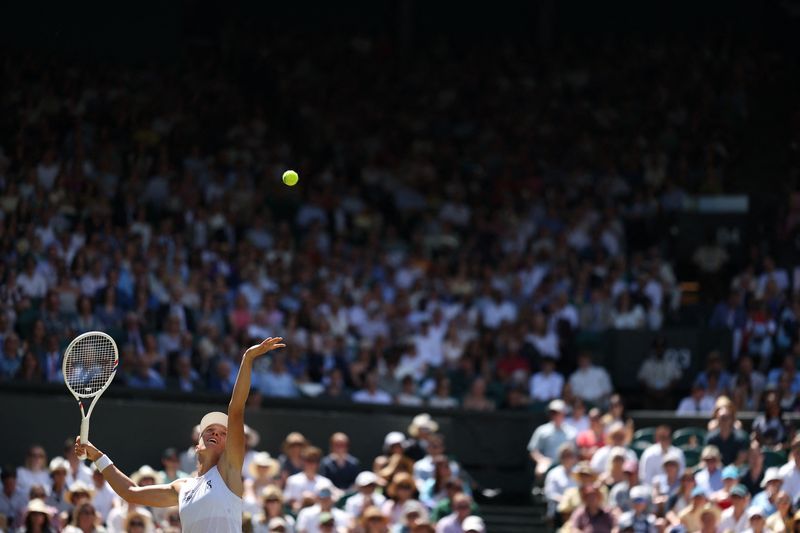
Alexandra Eala's remarkable run at Wimbledon took another giant leap forward when she dismantled defending champion Iga Swiatek in a compelling third-round encounter at the All England Club on Saturday. The rising Philippine talent prevailed 7-6(9) 6-2 under bright afternoon skies on Centre Court, delivering a comprehensive lesson in aggressive baseline tennis against one of the sport's most formidable competitors. For Eala, the victory represents far more than another tournament win—it stands as validation of years spent pursuing her dream, and a watershed moment for women's tennis in Southeast Asia.
Swiatek arrived at this year's championship carrying the weight of expectations as the tournament's third seed and defending champion. The Polish star had finally silenced doubters about her ability to compete on grass last year, ending a prolonged drought regarding her success on the sport's fastest surface. Yet her preparation this year proved disrupted by an early exit at Bad Homburg, leaving her seeking rhythm and consistency heading into the fortnight. Though she navigated past Taylor Townsend and Karolina Pliskova in her opening matches with apparent composure, meeting Eala in the third round would expose fundamental vulnerabilities in her grass-court game.
The opening set became a fierce battle of wills, with both competitors refusing to surrender ground without desperate resistance. Eala's left-handed attacking style, built on penetrating baseline strikes and willingness to take aggressive risks, created immediate problems for the defending champion. The intensity never wavered across the extended first-set tiebreak, which Eala claimed 9-7 after a gruelling exchange of heavy hitting. Swiatek's frustration became visible as she gestured sharply toward her support team in the stands and, in one moment of exasperation, struck her racket against a courtside chair. By contrast, Eala fed off the crowd's mounting enthusiasm, turning the atmosphere into a palpable source of confidence and energy.
The second set proved a far cleaner affair, with Eala's ascendancy becoming almost inevitable. The Philippine player seized control immediately, breaking Swiatek's serve twice in succession to establish a commanding 3-0 advantage. Her powerful shot-making, particularly from the baseline, allowed her to dictate rallies and force the defending champion into reactive positions. Though Swiatek managed to recover one break and showed flashes of the form that has made her a five-time Grand Slam champion, Eala never surrendered her grip on the match. A perfectly executed forehand winner sealed the victory and ensured Eala's progression to the fourth round, where she will face Italian runner-up Jasmine Paolini.
For Eala, the emotional weight of the achievement momentarily overwhelmed her composure during the on-court interview. Speaking with visible emotion, she reflected on the improbability of her journey from a young girl in the Philippines training with ruffled socks and light-up shoes, working daily after school with her brother and grandfather, to standing on Centre Court as a victor over the world's elite. She acknowledged that while such achievements might appear modest to established champions like Serena or Venus Williams, for someone from her background the accomplishment carries profound significance. The remarks resonated with the crowd, which had enthusiastically supported the underdog throughout the contest.
Yet despite the tears and expressions of gratitude, Eala's mindset remained firmly forward-focused. She quickly pivoted from celebrating the victory to discussing her approach to the next challenge, declaring that emotional satisfaction would not distract her from the serious business of competing for additional wins. This mental resilience—the ability to process a monumental achievement while immediately shifting attention to upcoming obstacles—suggests a maturity that extends beyond her years. Such psychological discipline often separates players who experience brief moments of success from those who sustain competitive excellence across multiple seasons.
The result adds intrigue to Eala's broader trajectory in professional tennis. Prior to Wimbledon, she had demonstrated competitive capability by defeating Swiatek in Miami last year, though the Polish player gained revenge at Madrid on the clay surface where Swiatek typically dominates. The fact that Eala has now prevailed on grass, a surface traditionally considered less favorable to her game style, indicates her technical arsenal remains adaptable across different playing conditions. Her success here cannot be dismissed as a one-dimensional triumph but rather represents genuine versatility and court intelligence.
The upset holds particular resonance for Southeast Asian tennis development. Philippine tennis has historically struggled to produce players capable of competing at the highest levels of the professional game. Eala's breakthrough performance demonstrates that the region can nurture world-class talent, provided proper training infrastructure and international exposure become available. Her appearance in the second week of Wimbledon will likely inspire younger players throughout the Philippines and neighboring Southeast Asian nations to pursue tennis careers with renewed conviction.
Swiatek's early exit also raises questions about her current form and trajectory on grass courts. Despite last year's title victory, the defending champion still appears to lack the instinctive comfort on faster surfaces that characterizes naturally grass-oriented players. Her aggressive shot-making remains world-class, yet her movement patterns and court positioning sometimes betray uncertainty. Against an opponent like Eala, who confidently attacks and maintains composure under pressure, such small technical vulnerabilities can multiply into decisive disadvantages. The Pole may need to fundamentally reconsider her grass-court preparation strategy for future tournaments.
Eala's journey to this moment reflects broader transformations within global women's tennis, where players from outside traditional tennis powerhouses increasingly compete at championship levels. The democratization of access to professional coaching through digital technologies and expanded international junior circuits has enabled talented young players worldwide to develop competitive skills previously restricted to those fortunate enough to train in tennis strongholds. Eala's presence on Centre Court, defeating a former Grand Slam champion, symbolizes this evolutionary shift.
Moving forward, Eala will face formidable challenges in her upcoming fourth-round match against Paolini, who reached last year's Wimbledon final. The Italian's comprehensive game and significant experience at the sport's highest level will test whether Eala can sustain her breakthrough momentum or whether Saturday's performance represented a spectacular but isolated achievement. Regardless of the outcome, Eala has already secured her place in the second week and substantially elevated her profile within professional tennis, establishing herself as an emerging talent worthy of continued attention from coaches, sponsors, and selection committees throughout Southeast Asia.

