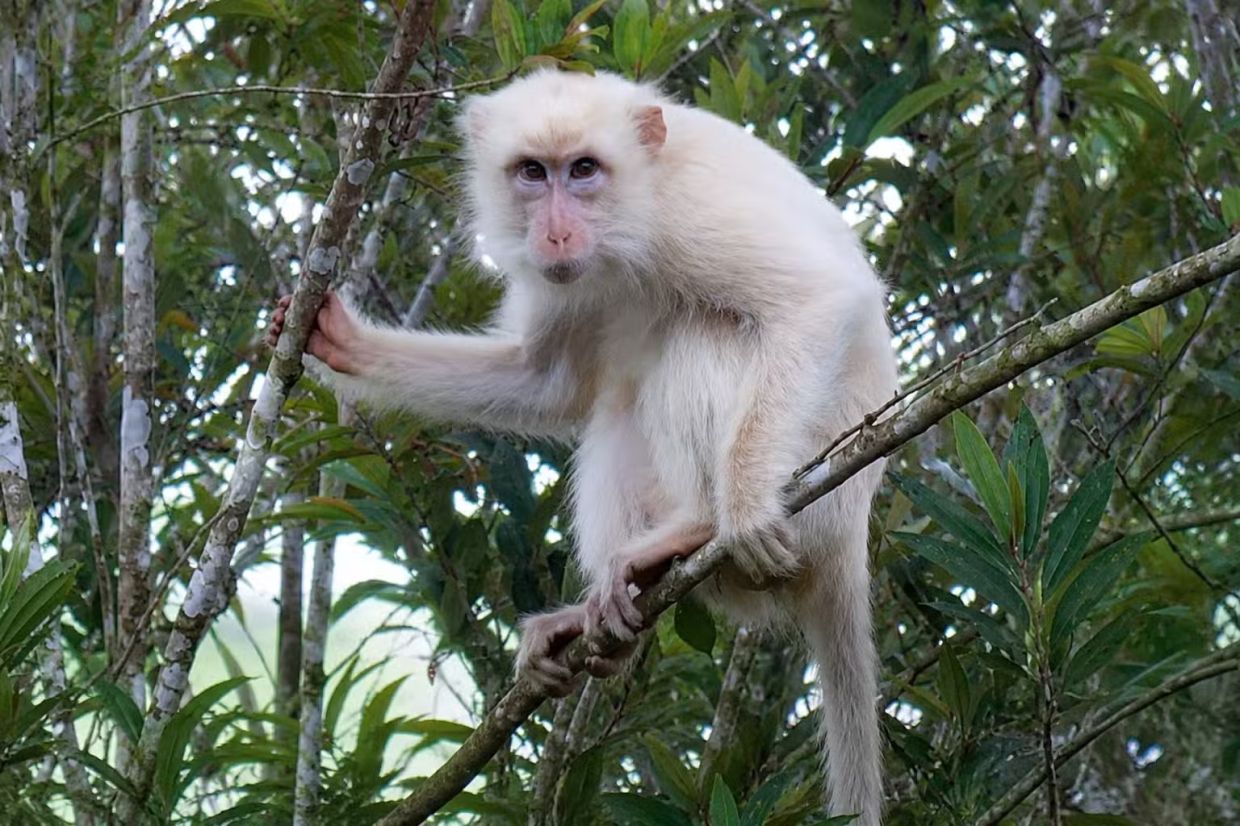
A strikingly pale macaque that has inhabited a forested region of Sultan Kudarat province in Mindanao for nearly ten years has suddenly become the focus of an intensive conservation initiative, driven by unexpected threats posed by its online fame. The animal, which stands out markedly from the typical brown colouration of its species, had long been a quietly familiar presence to nearby communities until photographs and videos began spreading across social media platforms. This publicity, while initially driven by fascination with the monkey's unusual appearance, has triggered alarm among environmental officials who recognise the dangers that widespread digital attention can pose to vulnerable wildlife.
The Department of Environment and Natural Resources Region XII, working alongside the local government of Senator Ninoy Aquino municipality, has responded by imposing protective measures that fundamentally alter public access to the animal's habitat. Understanding that visibility on social media platforms significantly increases risks of poaching, illegal capture, and commercial wildlife trafficking networks, authorities have taken the precautionary step of temporarily restricting entry to areas where the macaque is regularly observed. This defensive posture reflects growing awareness within the region that conservation in the digital age requires active management of information flows, not merely traditional habitat protection.
Scientific identification of the macaque's condition remains preliminary. The animal is classified as a Philippine long-tailed macaque, a subspecies native to the archipelago, but its striking pale appearance initially suggested albinism to casual observers. However, a field assessment conducted by composite monitoring teams from the DENR discovered that the macaque possesses brown to dark brown eyes, a characteristic that typically rules out albinism. Wildlife specialists now suspect the condition may be leucism or an alternative pigmentation disorder, though definitive diagnosis requires further scientific analysis by credentialed experts. This uncertainty underscores how even apparently straightforward biological anomalies can demand sustained professional investigation before conclusive determinations become possible.
Local residents have maintained detailed informal records of the macaque's presence extending back to 2016, observing its behaviour and movement patterns within the forest ecosystem over a span that would ordinarily allow for gradual habituation and coexistence. The macaque's habitat assessment revealed encouraging results, with secondary forest vegetation and abundant natural food sources continuing to sustain not only this individual but the broader resident macaque population. This ecological stability suggests that, absent external disruption, the animal's long-term survival in its natural environment remains feasible, provided human interference remains minimised.
The decision to close access temporarily represents a deliberate trade-off between public curiosity and species protection. Municipal authorities recognise that the macaque's sudden prominence in digital spaces has created conditions favourable to poaching networks and wildlife smugglers who can monitor social media to locate target animals. By controlling information and restricting physical access, local governments aim to deprive potential threats of actionable intelligence about the creature's whereabouts. This strategy acknowledges that in contemporary conservation contexts, managing human behaviour through access controls and information governance has become as critical as traditional environmental protection measures.
Barangay Bugso, the smallest administrative unit in which the sightings occur, is drafting local legislation designed to create permanent legal frameworks for macaque protection. This ordinance would institutionalise safeguards not merely for the individual animal but for its immediate habitat and the broader forest ecosystem within which it exists. Such local-level legal innovation represents an important decentralisation of conservation authority, empowering communities closest to wildlife to establish binding protective standards that complement national legislation. Pending the ordinance's formal adoption, unauthorised access to the sighting area remains legally prohibited under temporary administrative orders.
Planned habitat restoration initiatives reflect a holistic conservation philosophy that extends beyond protecting a single charismatic individual. The barangay intends to undertake tree-planting programmes and ecosystem rehabilitation activities designed to strengthen overall biodiversity resilience while simultaneously promoting ecotourism models that respect wildlife integrity. This approach attempts to balance legitimate community economic interests with genuine conservation objectives, creating frameworks where observing wildlife generates sustainable income without requiring destructive extraction or trafficking.
National wildlife legislation provides the foundational legal architecture supporting these localised efforts. Republic Act No. 9147, the Wildlife Resources Conservation and Protection Act, establishes comprehensive prohibitions against hunting, capturing, collecting, possessing, transporting, trading or disturbing protected species without explicit government authorisation. The DENR has reminded the public of these statutory obligations, emphasising that the macaque falls squarely within protected categories. The agency has also issued specific guidance to content creators, cautioning vloggers, photographers, journalists and social media users against publishing geotagged content or precise location information that could enable trafficking networks to target identified specimens.
The DENR XII has committed to ongoing documentation and scientific evaluation of the macaque's condition, channelling findings to the Biodiversity Management Bureau for technical assessment and specialist analysis. Parallel to this scientific work, the agency pledges sustained habitat monitoring, enhanced coordination with local stakeholders including barangay officials and community leaders, and intensified public education campaigns emphasising wildlife protection principles. This multipronged approach recognises that lasting conservation requires simultaneous action across scientific, administrative, community and educational dimensions.
The white macaque's trajectory from unremarkable local wildlife to subject of intensive protection efforts illustrates broader conservation challenges confronting Southeast Asia. Digital technology and social media, while potentially powerful tools for raising environmental awareness, simultaneously create unprecedented risks for vulnerable species by concentrating commercial and poaching interest. The Philippines' response—combining legal restrictions, habitat management, community engagement and information control—offers a model for balancing legitimate human interests with species survival. For now, the pale macaque continues inhabiting its forest domain, no longer an anonymous resident but a protected symbol of how modern conservation must navigate between visibility and vulnerability.

