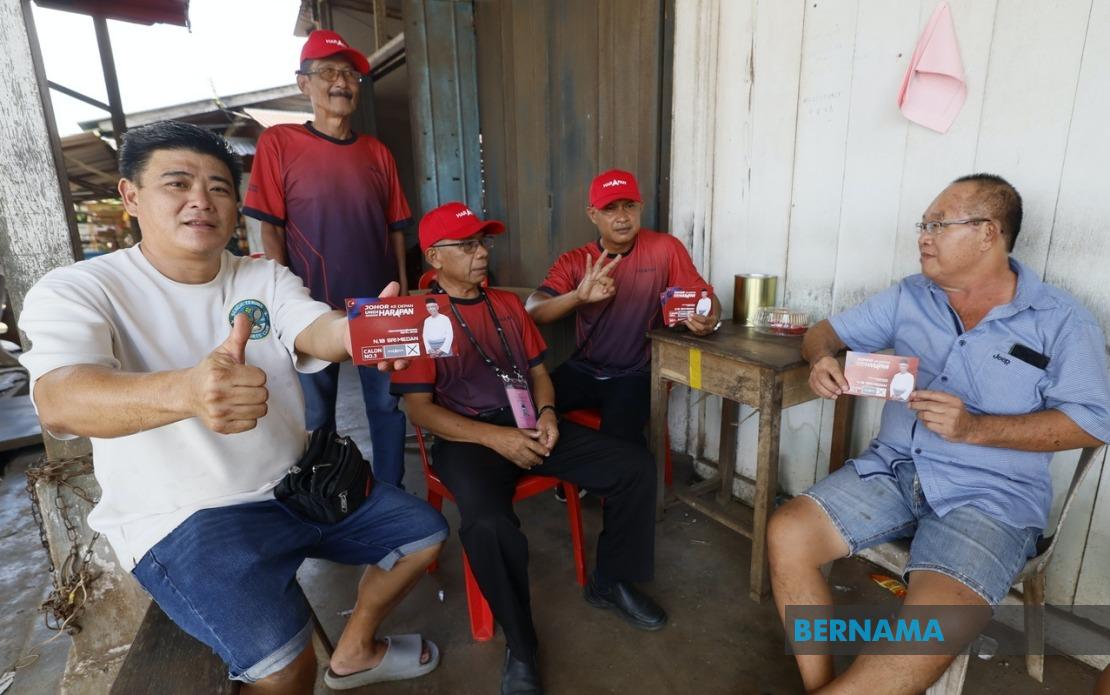
Former mathematics educator Hishamudin @ Misrin Ishak is pursuing the Sri Medan seat for Pakatan Harapan in the 16th Johor State Election with a strategy rooted in direct community engagement and practical problem-solving. Known locally as "Cikgu Misrin", the candidate has been conducting extensive walkabouts across his constituency, meeting residents to understand their pressing concerns and pledging to address them systematically. His approach reflects a deliberate shift toward grassroots politics, contrasting with the broader campaign strategies that typically dominate state elections in Malaysia's second-largest state by population.
The recurring flooding that has plagued Sri Medan residents for years stands as Hishamudin's immediate priority, signalling that his campaign will focus on tangible infrastructure solutions rather than abstract policy promises. This emphasis on flood management carries particular resonance in Johor, where monsoon seasons regularly test local government capacity and where previous administrations have faced criticism over drainage and mitigation systems. By positioning flood control as a cornerstone issue, Hishamudin is directly engaging with one of the constituency's most visible governance challenges, an approach that resonates with voter frustrations over delayed or inadequate previous interventions.
Hishamudin's professional background as an educator informs his broader vision for the constituency's development trajectory. He has committed to expanding access to Technical and Vocational Education and Training programmes, recognising that youth employment prospects remain a critical concern across Malaysian constituencies, particularly in semi-urban and rural areas where economic diversification remains limited. Beyond formal education initiatives, he has pledged to strengthen digital literacy exposure among young people, acknowledging the increasingly technology-dependent nature of Malaysia's labour market and the risks facing those without foundational digital competency.
Economic empowerment through small and medium enterprise development constitutes another pillar of his campaign platform. Hishamudin has specifically targeted the market access constraints that hamper local entrepreneurs, many of whom remain trapped within limited local demand cycles and lack the networks or resources to expand regionally or nationally. This diagnosis of SME challenges aligns with broader economic development discussions across Southeast Asia, where many small business owners struggle with distribution networks and market intelligence. His commitment to actively facilitate broader market access suggests a more interventionist approach to local economic development than typically seen in opposition campaigns.
The candidate's emphasis on balanced infrastructure development across urban, semi-urban and rural zones within Sri Medan reflects awareness of the uneven development patterns that characterise many Malaysian constituencies. Rapid urbanisation frequently leaves peripheral areas underserved, creating resentment among rural voters who feel economically marginalised despite contributing to local tax bases. By explicitly committing to equitable infrastructure distribution, Hishamudin positions himself as a counterweight to perceived urban-centric governance patterns, a message with particular appeal in constituencies where agricultural and smallholder communities retain significant populations.
Hishamudin's articulated principle of "work first, talk later" offers a implicit critique of performative politics, suggesting that his campaign will emphasise demonstrable results over rhetorical flourishes. This positioning appeals to voters fatigued by campaign promises that evaporate post-election and reflects broader frustration across Malaysian constituencies with the gap between electoral commitments and actual governance delivery. The principle also hints at administrative competence, implying that effective implementation rather than grand announcements will define his tenure if elected.
His experience as a village head provides concrete administrative credentials that strengthen his candidacy in ways that purely academic or professional backgrounds might not. Village-level governance in Malaysia involves direct problem-solving across welfare, land administration, and community development matters, experiences that translate directly to state assemblyman responsibilities. This local administrative pedigree potentially addresses voter concerns about whether opposition candidates possess the practical experience necessary to deliver tangible improvements in constituency-level services.
Critically, Hishamudin has explicitly committed to serving residents regardless of political affiliation, a stance that challenges the tribalism often characterising Malaysian electoral politics. This approach carries both strategic and principled dimensions: electorally, it softens concerns among fence-sitting voters about being marginalised should they support an opposition candidate, while principally it affirms inclusive governance ideals that transcend party loyalties. In a constituency where voter preferences remain genuinely contested, this messaging may prove consequential.
The candidate enters what is widely acknowledged as a Barisan Nasional stronghold, a contextual challenge that frames his campaign within broader competitive dynamics. Despite three days of campaigning yielding encouraging voter response, the structural disadvantages facing opposition candidates in historically BN-dominated seats remain substantial, encompassing incumbent advantage, administrative resources, and established networks. Yet Hishamudin's positioning as a "new candidate and fresh face" potentially converts these structural disadvantages into messaging opportunities, allowing him to articulate himself as an alternative to incumbent governance patterns.
The electoral landscape includes three-way competition, with incumbent Datuk Zulkurnain Kamisan of Barisan Nasional and Perikatan Nasional candidate Ahmad Rosdi Bahari fragmenting the anti-PH vote. This configuration creates complex strategic dynamics, where vote-splitting among BN and PN voters could potentially benefit the PH candidate despite the seat's historical leanings. The July 11 polling date, combined with July 7 early voting, establishes the timeline within which Hishamudin must consolidate his emerging campaign momentum into actual electoral support.
Hishamudin's campaign strategy reflects broader Pakatan Harapan efforts to position the coalition as a competence-focused, development-oriented alternative to incumbent governance, moving beyond the anti-establishment messaging that characterised earlier iterations of opposition politics. By focusing on specific deliverables—flood mitigation, TVET expansion, SME market access, and balanced infrastructure investment—rather than ideological critiques of BN governance, PH candidates in Johor are attempting to appeal to pragmatist voters prioritising concrete improvements over political change for its own sake.
The Sri Medan contest will provide meaningful data regarding opposition momentum in Johor, a state where BN has maintained electoral dominance despite periodic challenges. Hishamudin's performance will indicate whether PH's grassroots-focused, locally-rooted campaign approach successfully penetrates established BN constituencies, or whether structural advantages in these historically dominant areas remain insurmountable. The results will carry implications beyond Johor, informing broader assessments of opposition capacity to dislodge entrenched incumbent advantages across Malaysia's federal structure.

