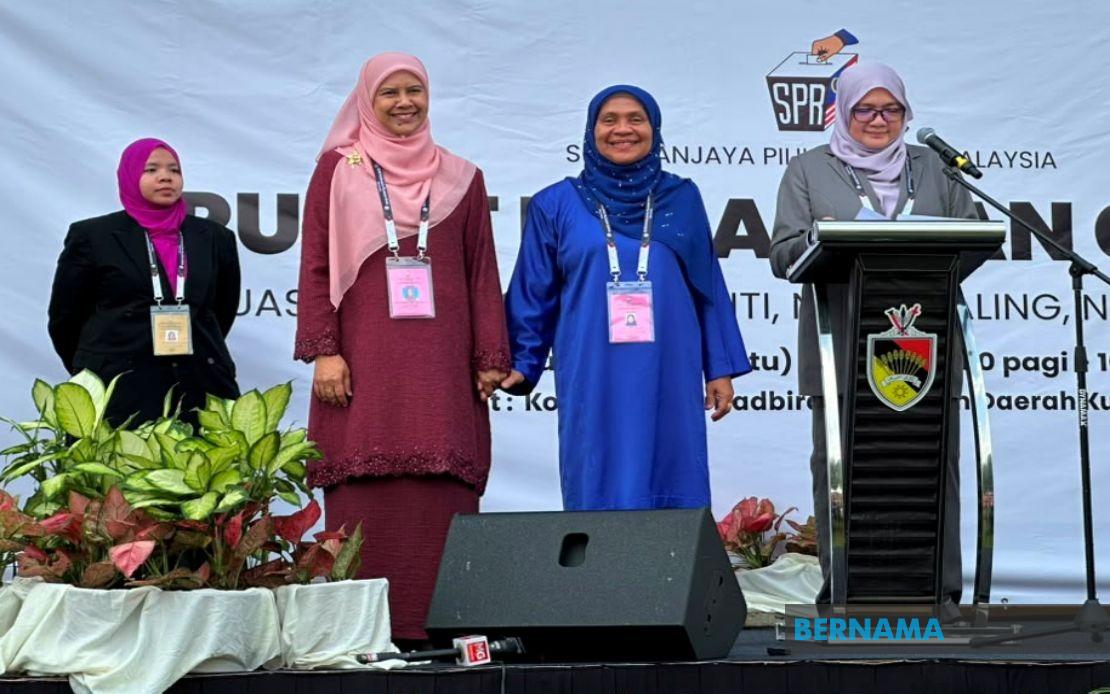
The Pilah state seat in Negeri Sembilan's forthcoming election will witness a notable all-female showdown, marking a distinctive feature of the 16th state assembly polls. Incumbent Datuk Noorzunita Begum Mohd Ibrahim, representing Pakatan Harapan, will defend her seat against Barisan Nasional's S. Leza Md Yasin in what election officials have confirmed as a direct two-candidate race. This straight fight emerged following the nomination process conclusion on July 18, with returning officer Nawal Mohammed Amin confirming both candidates' submission of papers at the Kuala Pilah District and Land Office.
The nomination timeline revealed the order of filing, with Noorzunita Begum submitting her nomination at 9.03 am, while her rival S. Leza followed at 9.09 am. This sequential filing underscores the competitive nature of the contest, though both candidates' early arrivals suggest serious preparation for the race. The absence of additional nominees for Pilah stands in contrast to several other constituencies across the state, which will see more complex electoral dynamics involving multiple parties.
Across Negeri Sembilan's electoral landscape, the state presents a varied contestation pattern reflecting the region's shifting political alignments. While Pilah remains a direct two-way race, other constituencies display different competition structures that will likely influence overall campaign strategies. The Juasseh seat will host a three-cornered contest bringing together Pakatan Harapan's Mohd Aidil Abdullah, incumbent Datuk Ismail Lasim of Barisan Nasional, and Bersatu's Mohd Zuhami Md Yusof. This configuration introduces a new dynamic, with Bersatu's participation indicating the party's continued effort to establish itself in state-level politics following its historical emergence as a splinter faction.
The Seri Menanti constituency will similarly feature a three-way competition involving Pakatan Harapan's Mohd Kamarul Arifin Mohd Wafa, sitting representative Muhammad Sufian Maradzi from Barisan Nasional, and Bersatu's Datuk Seri Megat D. Shahriman Zaharuddin. The inclusion of Bersatu across multiple constituencies suggests the party's strategic determination to challenge both major coalitions in Negeri Sembilan. Meanwhile, Senaling rounds out the three-cornered contests with Mohd Hanis Mohd Alimin from Pakatan Harapan, Mohamad Qayyum Abd Jalil representing Barisan Nasional, and Bersatu's Mohd Izzafi Khan competing for representation.
The Johol state seat presents a contrasting narrative, with only Pakatan Harapan's Mohd Zailan Mohd Munawar and incumbent Datuk Saiful Yazan Sulaiman of Barisan Nasional contesting. This straight fight mirrors the Pilah dynamics, suggesting that in certain constituencies, political competition consolidates around the two major coalitions, leaving third parties without viable candidacy opportunities. The differing contest structures across the five constituencies under examination reflect broader patterns in Malaysian state politics, where coalition strength and local political organization determine whether elections become bipolar or multipolar affairs.
High-level political engagement characterized the nomination proceedings, with Pakatan Harapan deploying substantial ministerial presence to support its candidates. PKR Wanita chief Fadhlina Sidek, serving as Education Minister, accompanied party nominees during the nomination process. Her presence demonstrated the coalition's commitment to maximizing political symbolism around the candidacy submissions. Additional support came from Angkatan Muda Keadilan vice-chief Dr Mohammed Taufiq Johari, who holds the Youth and Sports Minister portfolio, alongside Deputy Investment, Trade and Industry Minister and Bayan Baru MP Sim Tze Tzin. This concentration of federal ministerial figures signaled Pakatan Harapan's intention to project strength and federal relevance during state-level proceedings.
Barisan Nasional similarly mobilized senior figures to accompany its candidates through the nomination process, though drawing from different political constituencies. Deputy Home Minister and UMNO Supreme Working Council member Datuk Seri Dr Shamsul Anuar Nasarah coordinated Barisan Nasional's nomination activities. His participation was supplemented by Perak Menteri Besar and Perak UMNO chairman Datuk Seri Saarani Mohamad, indicating cross-state coalition coordination. This inter-state positioning suggests that both coalitions view Negeri Sembilan as part of a broader peninsular political narrative, particularly given Perak's geographical proximity and shared electoral constituencies.
The timing of the Negeri Sembilan state election reflects Election Commission scheduling, with early voting designated for July 28 and general polling set for August 1. This calendar creates a compressed campaign period, requiring candidates to rapidly mobilize voter support across multiple constituencies simultaneously. The early voting option, increasingly adopted across Malaysian electoral exercises, provides flexibility for voters unable to participate on polling day, potentially influencing overall turnout calculations and campaign strategies.
For Malaysian political analysts, the Pilah contest merits particular attention as a symbolic representation of women's increasing electoral participation at state assembly level. The absence of male candidates in this constituency represents genuine progress in gender representation, though the broader question remains whether such contests reflect sustained institutional commitment to gender diversity or occasional electoral circumstance. The contest between two accomplished political women—an incumbent defending her record against a challenger representing the opposing major coalition—establishes conditions for substantive policy debate rather than personality-driven competition.
The Negeri Sembilan election's broader significance extends to its status as a mid-term assessment of Pakatan Harapan's governance trajectory since the coalition's 2020 state administration. Pilah and other constituencies will determine whether the incumbent coalition maintains or loses ground, potentially influencing national political calculations. For Barisan Nasional, the election represents an opportunity to test electoral recovery strategies following various setbacks, with competitive contests in Juasseh and Seri Menanti offering potential pickup opportunities. Bersatu's presence across multiple constituencies underscores its continuing attempt to position itself as a viable third force in Malaysian state politics, despite recent institutional turbulence.
The electoral outcome will carry implications beyond Negeri Sembilan's borders, contributing to evolving assessments of coalition viability and regional political stability. Both Pakatan Harapan and Barisan Nasional will analyze results for indicators of electoral momentum heading toward potential federal-level contests. For Southeast Asian observers, Negeri Sembilan's election exemplifies Malaysia's continuing transition toward more contested electoral environments, where incumbent administrations face genuine challenges rather than acclamatory renewal cycles. The specific combination of straight fights and three-cornered contests creates differentiated battlegrounds requiring varied coalition strategies and candidate positioning approaches.

