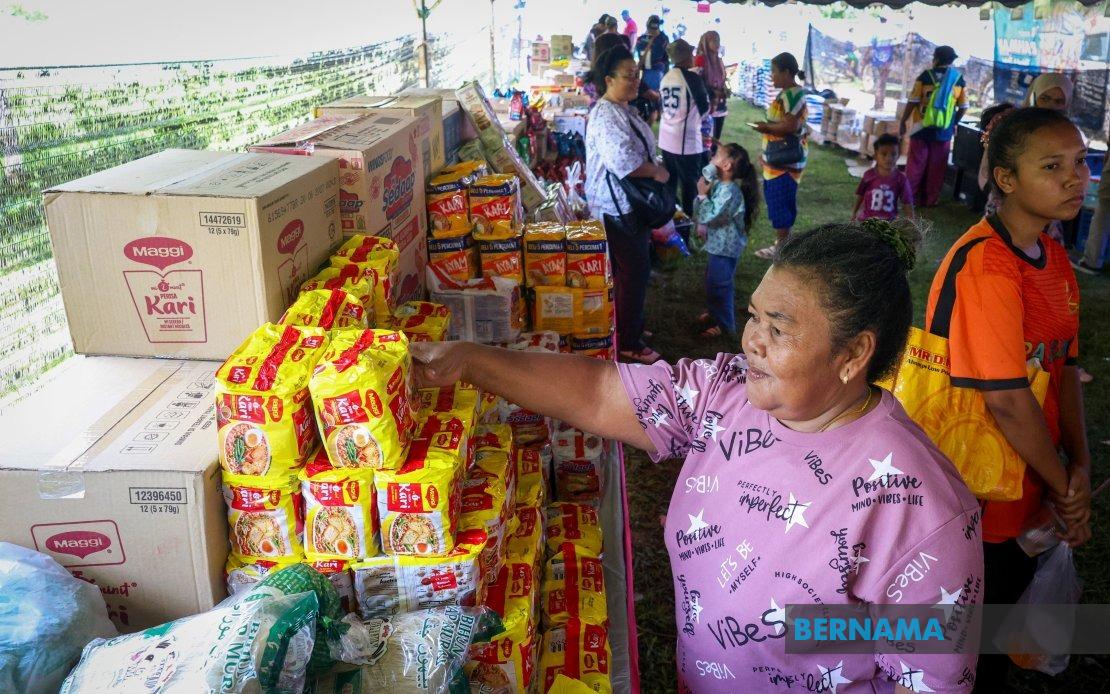
Over 1,000 Temiar Orang Asli residents living at the Pasik Resettlement Scheme in Gua Musang can now access subsidised essential goods through the Rahmah MADANI Sales Programme, using their SARA credit allocations to purchase items at significantly reduced prices. The initiative represents an extension of the government's cost-of-living assistance programme into one of Peninsular Malaysia's more geographically isolated indigenous settlements, addressing longstanding challenges faced by communities in remote areas where retail options are limited and transportation costs consume substantial household budgets.
Previously, residents of this highland settlement had no choice but to undertake exhausting journeys of approximately two and a half hours to Kampung Jerek whenever they needed to stock up on basic household items through the PJRM scheme. This travel requirement imposed severe financial and logistical constraints on families already struggling with limited income opportunities. Kampung Ayong resident Ramli Chimbong, 51, highlighted the practical burden these circumstances created, explaining that the combination of vehicle rental fees, food costs incurred during travel, and miscellaneous expenses could easily total RM600 per shopping trip. The arrival of PJRM at Pasik has fundamentally altered the economics of household purchasing for these families.
The price differential between locally available goods and subsidised items delivered through the programme is striking. A nine-kilogramme bag of rice, which typically costs RM40 at village shops, sells for only RM29 through PJRM—representing a 27.5 percent reduction that translates into genuine household savings for families purchasing staples regularly. These price gaps extend across numerous essential categories, making the programme particularly valuable for communities where conventional retail markups are steep due to high transportation costs and limited competition. For vulnerable populations with constrained budgets, such savings accumulate meaningfully over time and free up resources for other pressing household needs.
The first PJRM distribution at Pos Pasik was coordinated by SMS Maju Solution, which mobilised 100 categories of essential goods including 300 bags of rice, 300 trays of eggs, and 300 whole chickens for resident purchase. The early morning arrival of customers—some appearing as dawn broke at 9 am—demonstrated the enthusiasm with which the community embraced this new shopping opportunity. This response reflects both genuine need and appreciation for a service that eliminates the transportation and time barriers previously constraining their access to affordable provisions.
Data from the initial distribution revealed robust SARA credit balances among residents, with many families maintaining allocations ranging between RM300 and RM800 within their MyKad accounts. Such substantial reserves indicate either underutilisation of available credits or deliberate conservation of purchasing power, suggesting that residents have significant accumulated capacity to benefit from PJRM's expanded footprint. The presence of healthy credit balances across the community contrasts with the limited opportunities previously available to spend these credits conveniently, highlighting how poor retail infrastructure in remote areas can effectively lock residents out of government assistance programmes.
Operators managing the programme encountered practical obstacles reflecting the settlement's challenging geography. A vehicle carrying supplies experienced a tyre puncture caused by the rocky and muddy road conditions that characterise access to Pasik, underscoring the infrastructure constraints that isolation from urban centres creates. Despite such logistical difficulties, the commitment to serving the community demonstrated organisational capacity to overcome environmental barriers—a capability that will prove essential if the programme expands further into other scattered Orang Asli settlements across Malaysia's interior regions.
Nenggiri assemblyman Mohd Azmawi Fikri Abdul Ghani positioned the initiative within broader government efforts to support rural communities navigating inflationary pressures on basic household expenditure. Rising living costs have disproportionately affected remote populations, whose limited economic opportunities combine with geographic isolation to create particularly acute affordability challenges. The PJRM expansion addresses this pressure point by bringing government subsidy mechanisms directly to communities rather than requiring them to undertake costly journeys to access support.
The assemblyman called for further territorial expansion of similar programmes across all Orang Asli settlements, recognising that the Pasik initiative, while welcome, represents merely one example of multiple communities facing analogous challenges. Malaysia's Orang Asli population, distributed across numerous scattered settlements in the peninsula's interior, currently lacks systematic access to subsidised goods programmes that urban and semi-urban populations enjoy. Scaling these initiatives would require coordinating multiple logistics networks and identifying local operators capable of managing supply chains through challenging terrain, but would substantially improve access to government assistance for one of Malaysia's most economically vulnerable populations.
The programme's expansion to Pasik demonstrates the political viability of extending MADANI framework initiatives beyond conventional urban and suburban deployment. Rather than limiting subsidised goods schemes to town centres where distribution infrastructure is established, bringing such programmes to indigenous communities addresses an equity gap where genuine need combines with geographic disadvantage. For families like Ramli Chimbong's, the difference between travelling five hours for essential shopping and accessing goods locally represents not merely convenience but meaningful economic relief and recognition that government support systems can reach beyond conventional market networks.
Looking forward, the Pasik PJRM model offers lessons for scaling assistance to Malaysia's remote populations. It demonstrates feasibility of serving dispersed communities if appropriate operator partnerships and logistics planning are established. Success at Pasik, measured through resident uptake and satisfaction, could justify replication across other Orang Asli settlements and potentially other isolated communities facing similar infrastructure and affordability constraints. For policymakers prioritant cost-of-living support, this expansion suggests that geographic reach—ensuring programmes function beyond urban boundaries—may matter as much as programme generosity in achieving inclusive welfare outcomes.

