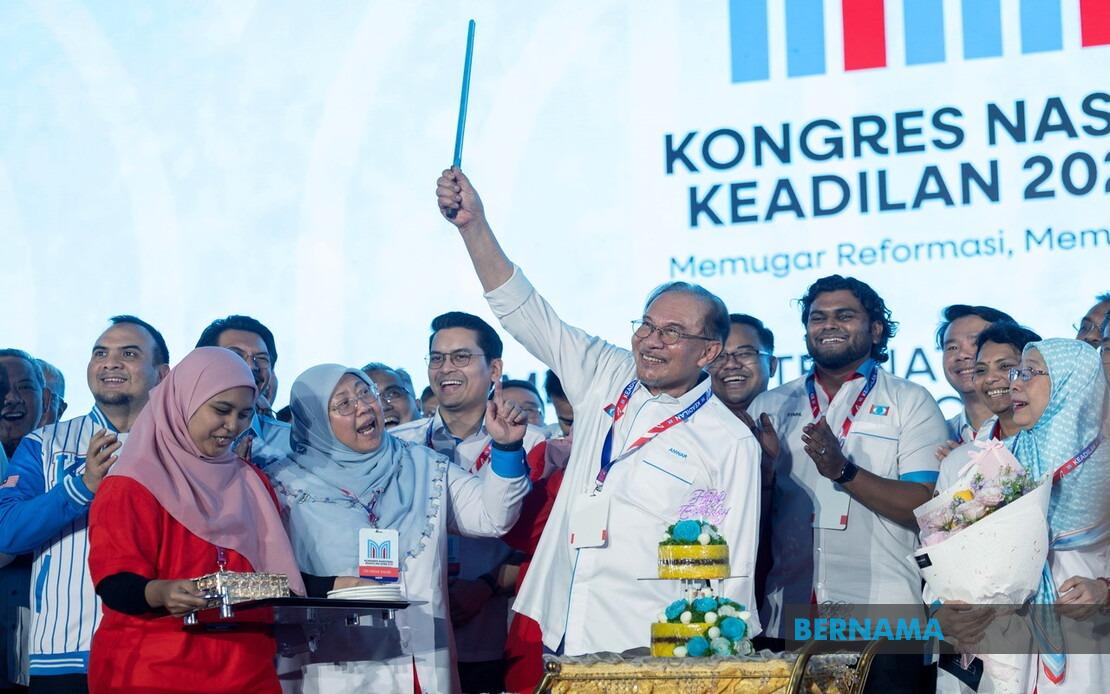
The PKR National Congress 2026 concluded in Melaka with a carefully calibrated message: the party remains committed to sustaining the Unity Government that underpins Malaysia's current political stability, even as it continues to advocate for substantive reforms across governance and policy. PKR president Datuk Seri Anwar Ibrahim used his closing address to strike this balance, emphasising that his party would remain a stabilising force within the coalition while refusing to abandon the progressive agenda that forms its ideological foundation.
Anwar's comments about the Unity Government's future reveal the delicate interdependence at play within Malaysia's current political arrangement. His suggestion that the coalition's longevity depends ultimately on UMNO and Barisan Nasional's commitment acknowledges a reality often understated in public discourse: PKR holds significant influence but not unilateral control over the partnership. This framing also serves as a diplomatic signal that PKR is neither taking its coalition partners for granted nor preparing the ground for unilateral action. For observers across Southeast Asia watching Malaysia's democratic consolidation, this careful stewardship of coalition dynamics provides an instructive case study in maintaining multi-party coalitions under pressure.
The Prime Minister's explicit warning against "excessive steps" that could destabilise the Unity Government carries particular weight given Malaysia's recent political turbulence. By anchoring the coalition in "political awareness and national interest rather than divisive politics," Anwar seeks to reframe coalition politics as a matter of governance maturity rather than cynical compromise. This rhetorical move matters because it shapes how ordinary Malaysians understand their government's foundations, potentially building public support for continued cooperation across traditional political divisions.
PKR deputy president Nurul Izzah Anwar's insistence that the reform agenda must accelerate—not decelerate—following the party's entry into government directly challenges a common criticism that parties lose their reformist edge once they assume power. Her point that administrative and policy reforms remain central to PKR's identity suggests the party views governance as an extension of its advocacy rather than a departure from it. The repeal of the Universities and University Colleges Act 1971 exemplifies this philosophy; the removal of restrictions on campus political activity represents precisely the kind of substantive change that distinguishes PKR from mainstream Malaysian politics.
Anwar's assurance regarding AUKU replacements addresses anxieties among student activists and civil libertarians who feared the repeal might be merely symbolic. By committing not to substitute new restrictive legislation and arguing that existing criminal law suffices to maintain campus order, Anwar stakes significant political capital on the principle that student freedoms can coexist with institutional discipline. This position potentially sets precedent for how future governments approach the tension between civil liberties and social order—a challenge not unique to Malaysia but particularly acute in Southeast Asian democracies.
The congress's emphasis on organisational readiness deserves closer examination. Rather than waiting for parliamentary dissolution announcements or candidate nomination cycles, PKR's leadership signalled that internal preparation must be continuous. For Malaysian political observers, this reflects lessons learned from sudden electoral surprises in recent years; parties that assume predictable timing risk strategic disadvantage. This organisational discipline, if maintained, could advantage PKR in any future election scenario, making it a formidable presence regardless of coalition arrangements.
Education Minister Fadhlina Sidek's dual role as PKR Wanita chief represents precisely the kind of institutional presence the congress emphasised. Her call for greater space for women in leadership positions within both party and government structures acknowledges that Malaysian governance remains predominantly male-dominated despite theoretical commitments to gender balance. By raising this issue at a national party congress, Fadhlina signalled that women's representation is not peripheral to PKR's reform agenda but central to its vision of transformed governance. Her emphasis on openness to criticism from both party and government ranks also suggests PKR is attempting to create internal cultures less prone to the personalised power dynamics that characterise much Malaysian politics.
The Angkatan Muda Keadilan's focus on technology sector inclusion, particularly artificial intelligence and semiconductors, positions PKR's youth wing within regional economic transformation debates. Malaysia's role in global semiconductor supply chains, alongside its aspirations in AI development, requires workforce policies that deliberately broaden participation beyond existing elite networks. By framing Bumiputera inclusion in these sectors as a strategic priority, PKR aligns economic nationalism with technological modernisation—a combination that could resonate across diverse Malaysian constituencies concerned about both economic equity and regional competitiveness.
Generation Z concerns raised by AMK—gig economy recognition, social protection, mental health, and skills development—reflect genuine demographic shifts in Malaysian labour markets that official policy has lagged behind addressing. A political party that integrates these concerns into its governance platform potentially creates advantages in electoral competition, particularly among younger urban voters. The recognition that gig workers deserve formal status and protection suggests PKR recognises the inadequacy of twentieth-century labour frameworks for twenty-first-century economic realities.
The congress outcome reinforces that PKR's political trajectory differs significantly from many regional opposition-turned-ruling parties that either abandoned reform agendas upon achieving power or fractured under the tension between governance and advocacy. Instead, PKR's leadership appears committed to a more demanding balancing act: maintaining coalition stability while pushing substantive policy change. Whether this dual commitment proves sustainable through the remainder of the Unity Government's tenure will substantially influence Malaysian politics' future direction and potentially offer lessons for other coalition governments across Southeast Asia navigating similar pressures between consolidation and change.

