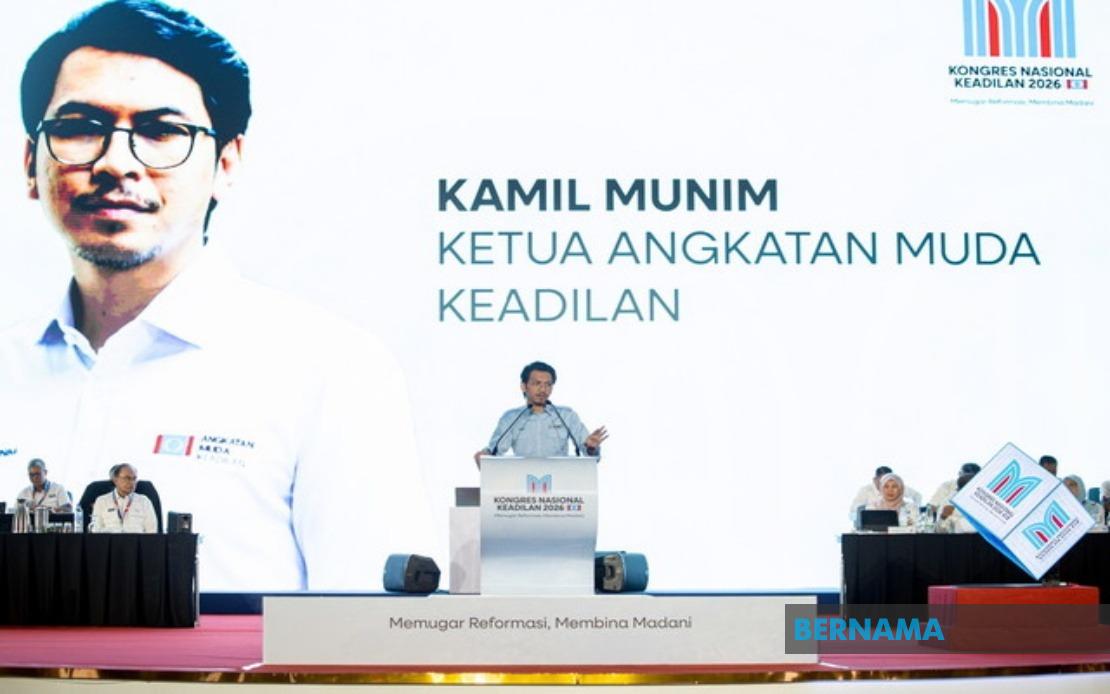
Muhammad Kamil Abdul Munim, chief of PKR Youth (AMK), has sounded a rallying call for the party to fundamentally recalibrate its political strategy in pursuit of voters aged 45 and below—a demographic that now comprises the single largest bloc within Malaysia's electoral roll. Speaking during the second day of the PKR National Congress at the Melaka International Trade Centre, he underscored the necessity of this pivot, arguing that recent electoral setbacks in Johor and Negeri Sembilan have exposed vulnerabilities that demand urgent reassessment of both party strengths and tactical approaches.
The timing of Muhammad Kamil's intervention reflects growing recognition within PKR that traditional campaigning methods may no longer suffice to mobilise the youth and young adult populations who will shape electoral outcomes in the coming years. By explicitly identifying the under-45 demographic as a priority, he has articulated a strategic imperative that carries implications far beyond party management—it speaks to a broader generational shift in Malaysian politics. This age group, shaped by digital connectivity, exposure to diverse information sources, and evolving social values, represents not merely a voting constituency but a demographic holding disproportionate influence over the nation's political trajectory.
Muhammad Kamil's acknowledgment that Johor and Negeri Sembilan have necessitated a comprehensive reassessment is significant. These elections, held relatively recently, evidently underperformed relative to PKR's expectations, signalling that gaps exist between party messaging and grassroots sentiment. Rather than dismissing these results as temporary fluctuations, he has interpreted them as diagnostic indicators, suggesting that the party machinery requires structural reform rather than cosmetic adjustments. This analytical framework positions PKR as willing to engage in honest self-critique—a posture that may itself resonate positively with younger voters sceptical of political complacency.
Central to his prescription is a shift in focus among grassroots leaders, away from administrative routines toward deeper engagement with constituent concerns. Muhammad Kamil has essentially reframed leadership itself, suggesting that effective political work extends beyond managing party structures to encompassing genuine community dialogue. This reorientation addresses a common criticism levelled at established political parties: that their cadres become disconnected from lived experiences of ordinary citizens, particularly in smaller communities and rural settlements where infrastructure development, economic opportunity, and social services remain pressing concerns.
The emphasis on direct engagement with communities—particularly in rural areas—carries special weight in the Malaysian context. Rural voters often experience governance more intimately and directly than their urban counterparts; they observe whether roads are maintained, whether schools are adequately staffed, whether livelihood opportunities exist. For PKR, a party with significant urban support but inconsistent rural penetration, this represents a critical frontier. Young voters in these areas frequently contend with limited economic mobility and outward migration, grievances that require authentic problem-solving rather than rhetorical flourish.
Muhammad Kamil's reference to the MADANI Government's broadly positive public reception provides important context. PKR, as a component of the Pakatan Harapan coalition, bears responsibility for federal-level performance. Yet apparent approval of government policy at the macro level has not translated uniformly into electoral success at the state level. This disconnect suggests that voters distinguish between appreciation for certain policies and confidence in particular parties or candidates. For PKR Youth, this creates both challenge and opportunity—the challenge of translating national government legitimacy into state and local victories, and the opportunity to demonstrate that younger party leadership can deliver tangible improvements in governance.
The party's historical narrative—that it successfully engineered the 2008 denial of Barisan Nasional's two-thirds majority and orchestrated the 2018 transition to Pakatan Harapan rule—functions as both inspiration and obligation. Muhammad Kamil invokes this record not merely to celebrate past achievements but to establish credibility for the reform agenda. The pattern he identifies, wherein PKR catalyses significant political shifts approximately every decade, frames the upcoming general election as a moment when such transformative capacity might be mobilised once more. However, this framing also carries risk; voters accustomed to expectations of periodic breakthroughs may demand substantive delivery rather than aspirational rhetoric.
For Malaysian politics more broadly, Muhammad Kamil's emphasis on younger voters reflects demographic reality. Malaysia's population has aged considerably since the 1990s, but the electorate remains disproportionately youthful compared to many developed nations. This demographic profile gives younger voters not merely numerical weight but structural importance in determining election outcomes. Parties that fail to secure majority support among under-45s face significant disadvantage, particularly as voter turnout among this group has historically exceeded that of older demographics in recent elections.
The call for grassroots leaders to identify and articulate solutions to specific community concerns implicitly acknowledges that political messaging must become more granular and localised. Rather than broad national narratives, voters increasingly demand responses to pocket issues—housing affordability, employment prospects for graduates, healthcare accessibility, environmental quality. Young voters in particular expect parties to address their specific generational challenges: student debt in an environment of wage stagnation, housing prices that outpace income growth, and career prospects affected by economic disruption and technological change.
Muhammad Kamil's rhetoric of preparation for the coming general election reflects awareness that political windows remain open only temporarily. With no fixed election date in Malaysia's constitutional framework, uncertainty itself becomes a strategic variable. Parties must balance readiness against over-mobilisation, sustaining organisational coherence and volunteer commitment over extended periods without exhausting resources or demoralising cadres through repeated false alarms. His invocation of learning from previous defeats suggests humility about electoral vulnerability—a position that may prove more persuasive to voters than overconfidence.
The substantive challenge for PKR Youth lies in translating strategic intent into measurable organisational change. Refining strategies requires not merely rhetorical recalibration but tangible investment in youth engagement, digital communication infrastructure, and locally relevant policy development. This demands resources, internal coordination, and willingness to empower younger party members with genuine decision-making authority rather than relegating them to symbolic positions. Whether AMK can achieve this transformation will determine whether Muhammad Kamil's call for paradigm shift becomes historical turning point or campaign-cycle exhortation.
Ultimately, Muhammad Kamil's address to PKR delegates articulates a diagnosis and prescription that extend beyond party management to reflect wider imperatives within Malaysian democracy. Demographic shifts, evolving voter expectations, and prior electoral performance have converged to create pressure for political innovation. Whether PKR successfully captures the younger demographic remains uncertain, but the urgency with which party leadership now addresses this question suggests the competitive landscape has fundamentally shifted, demanding adaptation from all major political forces.

