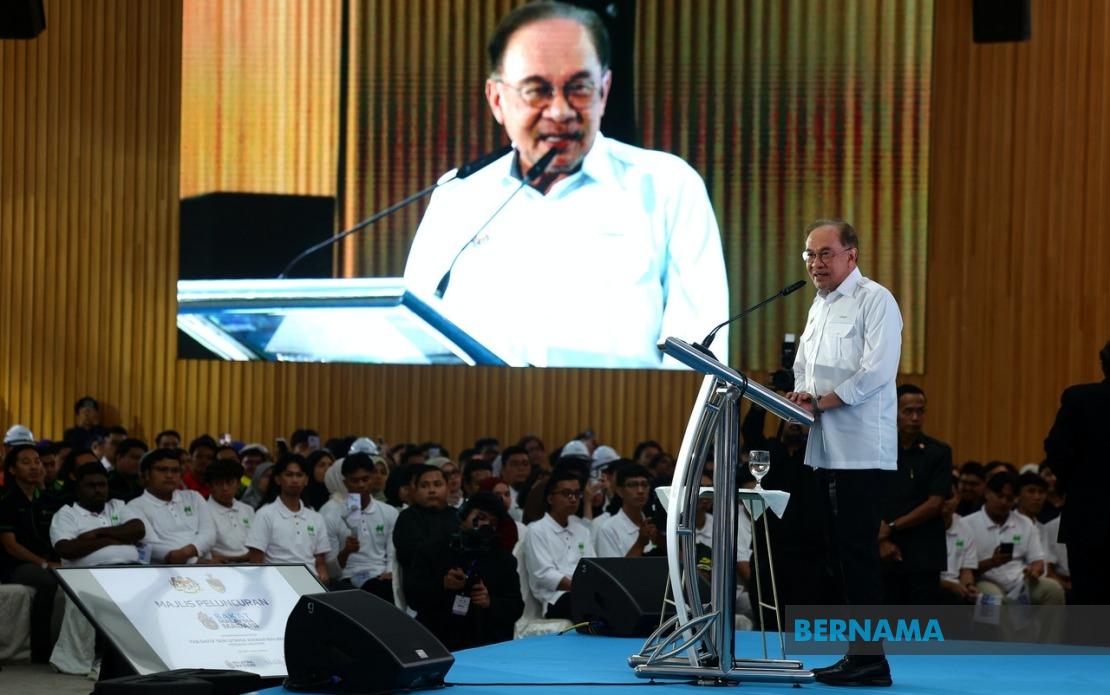
Prime Minister Datuk Seri Anwar Ibrahim launched the Bakat MADANI initiative in Seremban on June 29, announcing that the nationwide programme will benefit approximately 25,000 individuals seeking skills development and career advancement. The initiative represents a coordinated effort among government-linked investment companies (GLICs), government-linked companies (GLCs), and Petronas to strengthen Malaysia's human capital in critical sectors while simultaneously addressing structural employment challenges that have long plagued the nation's labour market.
The Prime Minister emphasised that the programme's success depends fundamentally on corporate sector commitment and proper execution by participating entities. He highlighted that while government provides the policy framework and oversight, the participating corporations and investment vehicles furnish the financial resources and institutional expertise required for meaningful implementation. This partnership model reflects a deliberate shift towards leveraging private sector efficiency and accountability in achieving public development objectives, a theme increasingly central to the government's economic transformation agenda.
Finance Minister II Datuk Seri Amir Hamzah Azizan outlined three strategic pillars underpinning Bakat MADANI. The first focuses on enhancing employability and facilitating career placement within the GLIC, GLC and Petronas ecosystem, ensuring that trained individuals transition smoothly from skill acquisition to meaningful employment. The second pillar expands job placement opportunities across key strategic sectors, recognising that talent development must align with genuine labour market demand rather than speculative training. The third pillar empowers Technical and Vocational Education and Training (TVET) institutions, acknowledging that these institutions remain underutilised reservoirs of practical talent in Malaysia's education landscape.
The initiative prioritises sectors identified as critical to Malaysia's economic transformation and competitive positioning. Semiconductors, renewable energy, the digital economy, and advanced manufacturing receive particular emphasis, reflecting the government's strategic focus on high-value industries with sustained growth trajectories. This sectoral targeting ensures resources concentrate where Malaysia possesses genuine comparative advantage and where skills shortages currently constrain expansion. The emphasis on semiconductors is particularly significant given the geopolitical importance of semiconductor supply chains and Malaysia's historical role in this industry, while renewable energy investments align with both climate commitments and the need to diversify energy sources amid global energy transition dynamics.
Tax incentives represent a novel component designed to deepen corporate participation in Bakat MADANI. The government will introduce special tax breaks for companies operating training programmes under the initiative, seeking to offset training costs and encourage expanded industry involvement in workforce development. This fiscal measure acknowledges that while corporate social responsibility motivates some engagement, financial incentives can unlock broader participation from firms previously hesitant about substantial training investments. The incentive structure also rewards quality outcomes rather than mere participation, creating alignment between government objectives and corporate interests.
Existing talent development programmes are being substantially enhanced and integrated under Bakat MADANI's umbrella. Petronas is transforming its VISTA programme into Vista i-Plus in collaboration with Malaysian Petroleum Resources Corporation and the Malaysian Oil, Gas & Energy Services Council, creating an integrated TVET training model that bridges institutional fragmentation. This consolidation approach mirrors recognising that Malaysia's vocational training ecosystem has historically suffered from siloed institutions with insufficient coordination, limiting effectiveness and creating redundancies. The restructuring involves MARA Skills Institutes, National Youth Skills Institutes, Advanced Technology Training Centres, and the Malaysian Construction Academy, creating a more cohesive pathway from initial training through advanced specialisation.
Within the GLIC and GLC ecosystem, Khazanah Nasional Berhad is spearheading collaboration with 23 higher education institutions including Universiti Teknologi MARA, Universiti Teknikal Malaysia Melaka, and Universiti Malaysia Sabah. These partnerships facilitate industrial training, technical certification, and direct exposure to industry requirements, bridging a persistent gap between academic training and workplace expectations. This university engagement broadens Bakat MADANI's reach beyond TVET institutions alone, recognising that Malaysia's higher education system must evolve towards greater industry integration and practical application of knowledge.
The initiative addresses a fundamental challenge in Malaysia's labour market: structural misalignment between available skills and employer requirements. Unemployment among graduates persists despite relatively strong economic growth, suggesting that conventional education pathways insufficiently prepare individuals for actual workplace demands. Bakat MADANI attempts to remedy this through direct employer involvement in curriculum design, training delivery, and employment placement, creating feedback loops that continuously align skill development with genuine labour market needs. This approach contrasts with traditional education models where employers are consulted retrospectively rather than integrated throughout programme design and delivery.
For Malaysian workers and job seekers, Bakat MADANI offers tangible pathways into quality employment within growth sectors. The emphasis on fair compensation through higher minimum allowances signals commitment to quality job creation rather than merely expanding low-wage precarious employment. The integration of TVET graduates alongside university-trained individuals reflects recognition that vocational pathways deserve equal status and opportunity as traditional academic routes, potentially addressing lingering prejudices that marginalise non-university credentials in Malaysia's labour hierarchy.
Regionally, Bakat MADANI's focus on semiconductors, renewable energy, and digital sectors reflects Malaysia's positioning within broader Southeast Asian competition for high-value manufacturing and service investment. Competitors like Vietnam, Thailand, and Indonesia are simultaneously investing heavily in talent development in these identical sectors, making Malaysia's initiative part of a regional race for skilled workforce capability. The initiative's success will materially influence Malaysia's ability to attract and retain semiconductor manufacturing facilities, digital economy investments, and renewable energy infrastructure projects that increasingly require sophisticated local talent pools.
The programme's design recognises that sustainable economic growth depends ultimately on human capital quality rather than merely capital accumulation or labour quantity. By investing in skills development for 25,000 individuals across priority sectors, Malaysia is addressing supply-side constraints that have previously limited expansion in high-value industries. However, the initiative's success will depend on whether created training opportunities translate into actual employment, whether compensation remains competitive to prevent talent outflow, and whether corporate partners maintain engagement beyond initial enthusiasm.

