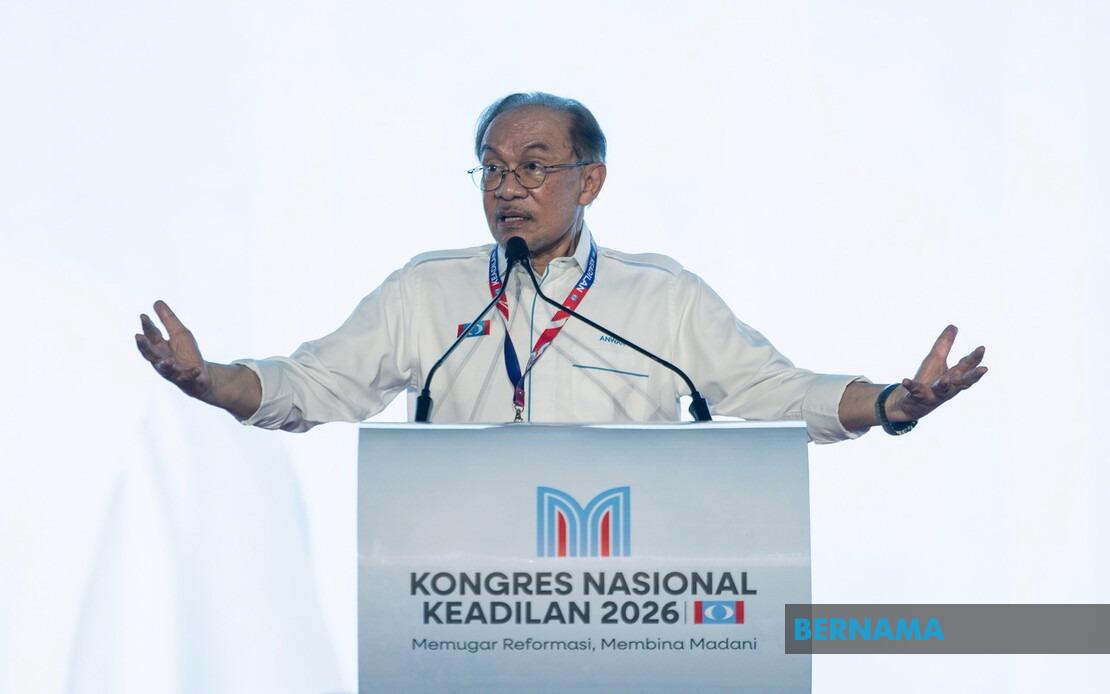
Prime Minister Datuk Seri Anwar Ibrahim has unveiled a significant boost to grassroots funding, announcing an additional RM1 million allocation for each of Malaysia's parliamentary constituencies. Speaking at the 2026 PKR National Congress held at the Melaka International Trade Centre on August 16, Anwar emphasised that the funds would flow directly to communities to tackle pressing local issues without unnecessary red tape. This move represents a tangible expansion of the government's financial commitment to the people, particularly in addressing welfare concerns, basic infrastructure needs, and community-level priorities.
The announcement underscores the MADANI Government's stated philosophy of bringing macroeconomic success down to the household level. According to Anwar, who also holds the portfolio of Finance Minister, this additional injection of resources complements existing social safety nets rather than replacing them. The government has already committed RM16 billion through two flagship assistance programmes: the Sumbangan Tunai Rahmah and Sumbangan Asas Rahmah. Together with this new allocation, the financial architecture supporting lower and middle-income households is becoming increasingly layered, with multiple entry points for assistance across different segments of society.
The timing of this announcement carries political significance for the ruling coalition. By channelling funds directly to constituency level, the government potentially strengthens the relationship between federal resources and local representatives, enhancing the visibility of MADANI initiatives at the ground level. This decentralised approach to welfare spending reflects a deliberate strategy to ensure that economic growth translates into tangible improvements in living standards for ordinary Malaysians, rather than remaining confined to macro-level statistics that may feel distant to average households.
Poverty alleviation continues to form a cornerstone of the administration's policy agenda. Anwar highlighted that the hardcore poverty rate has declined to just 0.09 per cent, a dramatic reduction from historical levels. While this figure demonstrates progress, the persistence of poverty in any form underscores why the government maintains multiple support mechanisms. The additional RM1 million per constituency represents an acknowledgment that economic challenges remain widespread, affecting not only the poorest households but also the middle-income earners struggling with cost-of-living pressures. This holistic approach targets both the B40 and M40 income brackets through various channels, including school assistance, subsidised goods through Rahmah outlets, and affordable housing financing schemes.
The Prime Minister's emphasis on reducing bureaucratic obstacles reflects frustration with implementation delays that have plagued social programmes in the past. By designating funds directly to constituencies rather than routing them through multiple layers of approval, the government aims to expedite assistance delivery. This structural change acknowledges a persistent challenge in Malaysia's public sector: the gap between policy intent and practical execution. For constituents waiting for repairs to community facilities or assistance programmes to commence, faster approval mechanisms could prove transformative, particularly in rural areas where distance and communication barriers have historically slowed development.
Anwar also stressed the responsibility of party machinery to actively engage communities in explaining available assistance. This call for ground-level engagement suggests that awareness remains a bottleneck—not all eligible beneficiaries may know what support exists or how to access it. The emphasis on party leaders and grassroots activists becoming conduits for information highlights a recognition that government programmes can only succeed when people actually utilise them. This dual responsibility—providing resources while simultaneously educating the public—places significant demands on PKR's organisational capacity to deliver on the MADANI vision.
For Malaysia's regional neighbours and investors watching the country's fiscal trajectory, this announcement signals continued government spending in social support despite economic constraints. The commitment to maintain and expand welfare allocations reflects political priorities that place social cohesion alongside economic growth. In Southeast Asia, where income inequality remains a concern across multiple economies, Malaysia's sustained investment in broad-based assistance programmes stands out as a distinctive policy choice, one that attempts to balance market economics with social protection.
The allocation's structure—distributed equally across all parliamentary constituencies regardless of their economic profile or population size—raises questions about targeting efficiency. A uniform RM1 million per constituency treats urban areas with dense populations the same as rural constituencies with smaller populations, potentially creating variations in per-capita benefit. Whether this represents optimal resource allocation or prioritises political equity over economic efficiency remains a subject for scrutiny. Nonetheless, the symbolic value of equal treatment across constituencies may outweigh technical optimisation concerns in the government's political calculus.
Moving forward, the success of this initiative will depend heavily on implementation mechanisms. How local representatives decide to deploy these funds, whether through community consultation or unilateral decision-making, will shape public perception. Transparency in fund allocation and documented outcomes will be essential for building public confidence in the programme's integrity. As the MADANI Government continues to refine its approach to welfare delivery, this additional allocation represents another layer in an increasingly complex ecosystem of social support, one that requires careful coordination to avoid duplication while ensuring comprehensive coverage.

