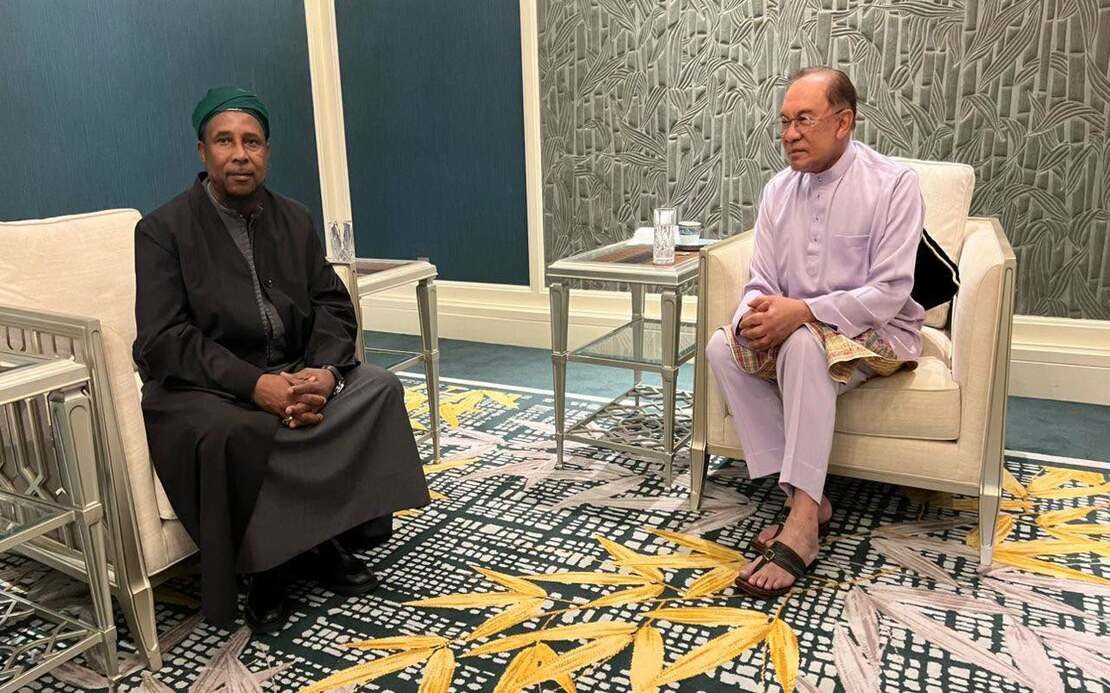
Prime Minister Datuk Seri Anwar Ibrahim received a farewell visit on June 26 from Gambian Islamic scholar Sheikh Muhammad Haydara Al-Jilani, marking the conclusion of the scholar's month-long engagement across Malaysia. The meeting, documented on Anwar's official Facebook page, took place on a date coinciding with the Day of Ashura, a significant occasion in the Islamic calendar that fell on a Friday. The encounter provided an opportunity for the Prime Minister to request special religious supplications for Malaysia's continued prosperity, stability, and divine protection.
Sheikh Muhammad Haydara Al-Jilani's extended presence in Malaysia served a broader spiritual and educational mission, during which he led numerous knowledge-sharing sessions and dhikr programmes—gatherings focused on the remembrance of Allah—at multiple venues across the nation. These religious assemblies formed part of a structured dakwah initiative designed to deepen Islamic understanding and strengthen communal spiritual practice among Malaysian Muslims. The scholar's itinerary reflected a deliberate outreach strategy targeting diverse communities throughout the country, bringing scholarly Islamic discourse to audiences beyond the capital.
In his social media statement, Anwar emphasised the significance of the Day of Ashura as the backdrop for this encounter, a day commemorated across the Muslim world for its historical and spiritual importance. The timing demonstrated Malaysia's engagement with the global Islamic calendar and the Prime Minister's personal commitment to observing major religious occasions. By combining the farewell meeting with specific prayers requested during this auspicious day, Anwar underscored the government's investment in spiritual welfare alongside material development for the nation's people.
The prayer requests articulated by Anwar during the meeting encompassed three interconnected dimensions: the collective well-being of all Malaysians, the maintenance of peace within the country, and the nation's continued blessing with divine mercy and protection. These aspirations reflect conventional governmental concerns with social cohesion and stability, but framed within an explicitly Islamic theological context. For a Muslim-majority nation like Malaysia, such invocations carry symbolic weight in demonstrating leadership's alignment with the faith values held by the majority population.
Sheikh Muhammad Haydara Al-Jilani's background as a Gambian scholar positioned him as a representative of West African Islamic scholarship, bringing transnational Islamic learning traditions to Malaysia. His month-long sojourn suggests a reciprocal arrangement, potentially involving cooperation between Malaysian Islamic institutions and Gambian religious circles. Such exchanges strengthen interfaith and inter-community bonds across the Islamic world, fostering intellectual dialogue and shared spiritual practice.
The dakwah programmes conducted throughout the scholar's visit encompassed a variety of religious gatherings held in strategically selected locations nationwide. These sessions would typically combine scholarly discourse on Islamic knowledge with devotional exercises, creating space for both intellectual engagement and spiritual practice. The nationwide scope of these programmes indicates an attempt to reach diverse Muslim communities across urban and potentially rural areas, democratising access to Islamic scholarship beyond centralised religious institutions.
From a Malaysian political perspective, the Prime Minister's public acknowledgement of the scholar's visit through official social media channels demonstrates government support for Islamic educational and spiritual initiatives. This outreach aligns with broader narratives around Malaysia's positioning as a moderate, knowledge-based Islamic nation—one that welcomes international scholars and fosters interfaith dialogue while maintaining strong Islamic practice. The timing of the farewell visit's documentation suggests careful attention to public messaging around religious affairs.
The Day of Ashura, falling in the Islamic month of Muharram, holds particular significance for Shia Muslims worldwide, though it is observed across various Muslim communities with different emphases and practices. In Malaysia's context, where Sunni Islam predominates, the acknowledgement of this day by the Prime Minister reflects the country's inclusive approach to Islamic observance and respect for diverse Muslim traditions. Such gestures contribute to Malaysia's self-image as a nation respectful of Islamic pluralism within the broader Muslim ummah.
The scholar's departure concludes a significant religious engagement initiative that extended over an entire month, suggesting substantial investment in hosting and facilitating the visit. For Malaysian Islamic organisations and communities, such visits provide opportunities for exposure to different scholarly perspectives and deepen understanding of Islamic traditions from other regions. The knowledge transfer occurring through these sessions represents intangible cultural capital that strengthens Malaysia's Islamic intellectual ecosystem.
The farewell meeting between Anwar and Sheikh Muhammad Haydara Al-Jilani encapsulates contemporary Malaysia's approach to Islamic governance: one that balances the practical demands of national administration with explicit recognition of spiritual values and international religious cooperation. Through this encounter, the Prime Minister publicly invested in demonstrating that Malaysia's leadership takes religious scholarship seriously and views engagement with international Islamic figures as an asset to national development and cultural identity.

