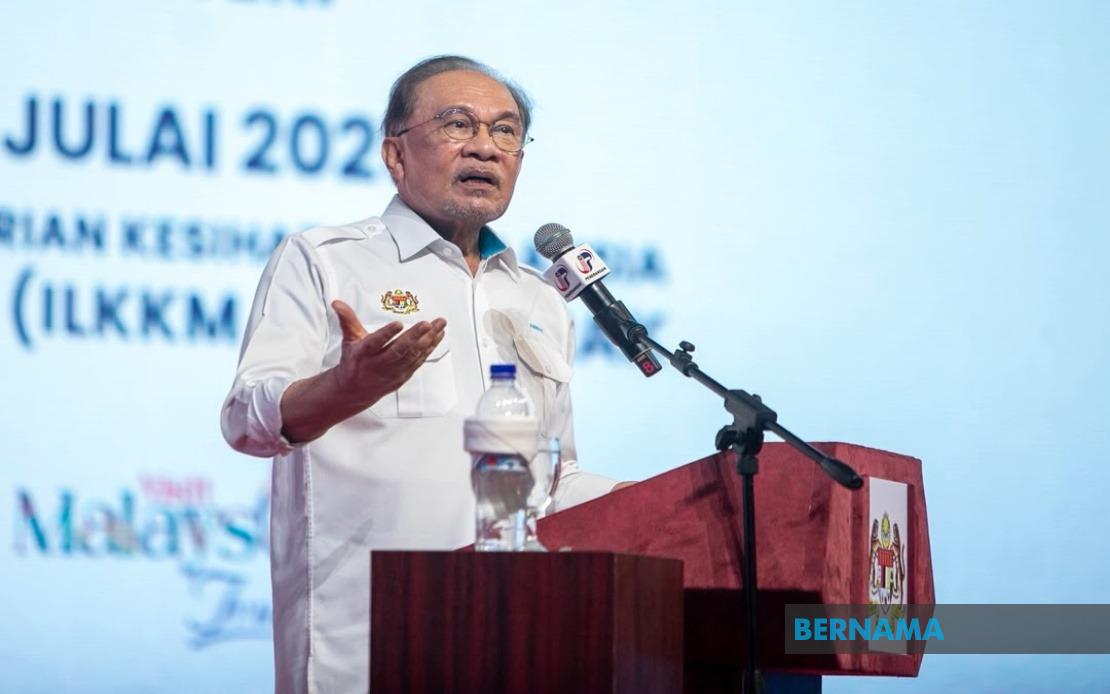
Prime Minister Datuk Seri Anwar Ibrahim has made an impassioned appeal to Malaysia's youth to recognise and value the profound historical legacy underpinning the nation's independence, emphasising that contemporary citizens must grasp the gravity of earlier generations' struggle. Speaking at the inaugural event for the 2026 National Month and Fly the Jalur Gemilang Campaign in Ipoh on July 19, Anwar stressed that understanding this foundational narrative remains essential for nurturing genuine national pride and cohesion among Malaysians today.
The Prime Minister's intervention reflects growing concern among senior government figures that younger cohorts, removed by decades from the independence era, risk underestimating the hardship and sacrifice embedded in the nation's history. Anwar framed the relationship between historical memory and contemporary appreciation in unambiguous terms, suggesting that comfort and stability enjoyed by today's citizens emerged directly from the blood, perspiration, and determination of liberation fighters who confronted colonial rule.
Central to Anwar's message was the notion that National Month observances should transcend superficial patriotic gesture—flag-waving and ceremonial ritual—to become genuine opportunities for Malaysians to comprehend what independence fundamentally represents. He articulated a three-stage framework: first, citizens must revisit and study the historical record; second, they must activate this knowledge by displaying national symbols like the Jalur Gemilang; and third, they must channel this understanding into concrete action toward building a stronger, more prosperous Malaysia.
The campaign launch itself carried symbolic weight, taking place in Ipoh, the capital of Perak—a state with profound significance in Malaysia's independence narrative and early postcolonial development. The geographical choice underscored the government's intention to ground the 2026 campaign in specific regional contexts rather than treating National Month as purely a central phenomenon.
Several senior cabinet members attended the Ipoh event, signalling institutional commitment to the initiative. Communications Minister Datuk Seri Fahmi Fadzil, National Unity Minister Datuk Aaron Ago Dagang, and Perak Menteri Besar Datuk Seri Saarani Mohamad were present, indicating that this endeavour commands attention across communications, unity, and state-level portfolios—suggesting coordinated messaging around historical consciousness and national identity.
Anwar's remarks carry particular resonance within Malaysia's contemporary political environment, where questions of national identity, social cohesion, and the meaning of constitutional democracy remain contested. By invoking the independence struggle's collective dimension and its foundation in cross-communal cooperation, the Prime Minister implicitly addressed ongoing anxieties about communal division and the erosion of shared national purpose that have periodically surfaced in Malaysian politics.
The campaign's emphasis on flag-flying carries dual significance: it functions simultaneously as patriotic expression and as a tangible practice that integrates individual citizens into a visible national community. Anwar's framework suggests that such symbolic participation, when accompanied by historical understanding, becomes meaningful rather than merely performative—a distinction reflecting broader debates about authentic versus superficial patriotism.
For Malaysian educators and policymakers, Anwar's intervention suggests renewed priority toward history curriculum and civics education that connects past struggles to contemporary national challenges. The implicit message concerns whether younger Malaysians possess adequate historical literacy to comprehend the foundations underlying their nation's stability and constitutional framework. This resonates with similar concerns expressed across Southeast Asia regarding generational transmission of historical knowledge.
The 2026 National Month campaign itself represents a forward-looking initiative—choosing a future year for launch allows extended preparation and potentially deeper integration of historical content into educational institutions and media channels. This differs from conventional National Month announcements made closer to the August celebration, suggesting more intentional pedagogical design.
From a regional perspective, Anwar's appeal reflects a broader Southeast Asian pattern where governments increasingly emphasise historical narrative and national founding myths as bulwarks against fragmentation and external influence. Malaysia's particular historical experience—involving multiple communities achieving independence through negotiated transition rather than revolutionary rupture—provides distinct material for such civic education efforts.
The inclusion of national unity as a thematic priority alongside history and independence reflects understanding that these concepts remain interconnected in Malaysian context. Historical consciousness about how diverse communities negotiated independence collectively serves instrumentally to reinforce contemporary messages about intercommunal harmony and shared destiny.
Looking forward, the campaign's success will depend substantially on translating Anwar's rhetorical appeal into concrete educational and cultural programming that reaches younger demographics. Digital platforms, school curricula, and community-level activities will determine whether 2026 National Month becomes a mechanism for genuine historical engagement or remains confined to ceremonial politics.

